By Chloe Teixeira, Local Journalism Initiative Reporter
Halton got an early start to the Halloween season with Bronte Creek Provincial Park’s annual two-day “Ghost Walks” earlier this month.
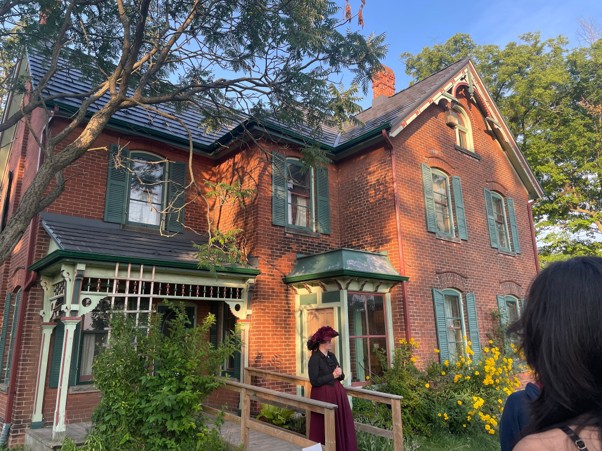
Visitors to Bronte Creek Provincial Park took part in a guided tour of the restored 1899 Spruce Lane Farmhouse and its nearby barn, learning about reported paranormal activity on the property, from potential ghost sightings and seemingly random noises to Victorian traditions surrounding death.
Named after Queen Victoria, who reigned from 1837 to 1901, the Victorian era was a period marked by distinctive traditions surrounding death, mourning, and the afterlife.
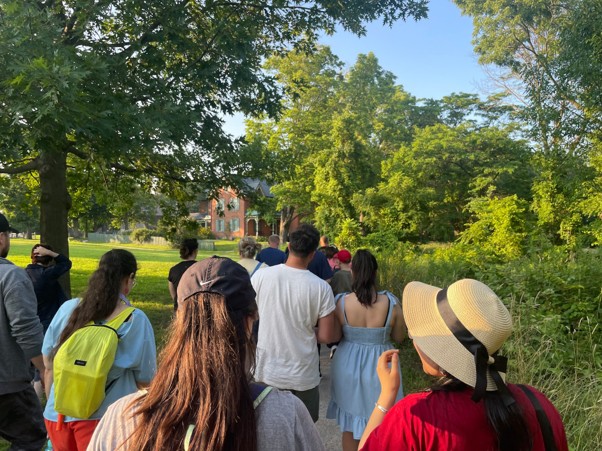
The 45-minute-long tour started at a fire pit, where attendees were told to meet. Tour guides were dressed in Victorian-era attire, waiting to greet visitors.
At 7 p.m., the crowd was guided down a path to the Spruce Lane Farmhouse.
The tour paused outside the farmhouse, where a guide spoke to the group about reported paranormal activity that has occurred at the restored residence.
The tour guide showed photos of orb-like shapes that have appeared in the house, and left it up to the group to interpret the images for themselves, based on their own beliefs.
A large speaker beside the tour guide played various noises captured by the Southern Ontario Paranormal Society (SOPS). The guide explained that SOPS had tuned their equipment to a specific frequency, allowing listeners to hear noises in the recordings that, she said, would otherwise be inaudible to the human ear.
The guide had her own opinions on what the different sounds could mean, but once again left it up to the group’s own interpretation. Some attendees thought that some noises could have been a child laughing or singing, while another sounded like a chair moving.
The guide also shared her own experiences at the house, along with a story from a coworker who had felt a tug at his sleeve while inside, as though a child were asking him to play.
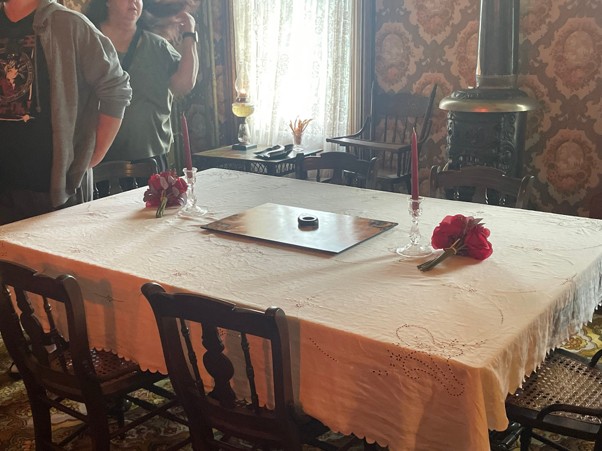
Later during the tour, the guide took the group to the dining room where entertainment would have happened back in the house’s Victorian heyday.
She talked about a device invented by Thomas Edison in 1920, which Edison claimed could “communicate with the dead.”
“When it didn’t work, he said it was all a joke,” she explained.
The guide said Victorians were “so interested in paranormal stuff” for various reasons, including Queen Victoria’s reported attempts to communicate with her late husband, Prince Albert. Séances and mediums were two things Queen Victoria was involved with, as mentioned by the tour guide.
“And with her doing that and partaking in those activities, it made everybody else want to as well. So things like Ouija boards and seances became really, really popular.”
The guide said “parlour tricks” were popular, where people would create fake paranormal experiences for guests, who would believe they were real.
Magnets were placed on Ouija boards and attached to strings to be pulled, making it seem like participants were communicating with the dead. Shadows and candles were also used in order to “trick” visitors into thinking the home had spirits or ghosts.
The stories of paranormal activities were mixed in with discussion of Victorian traditions surrounding death and grief, starting outside the farmhouse.
Today, wreaths are commonly displayed during occasions such as Advent and Christmas, as well as in autumn. In the Victorian era, the tour guide explained, a wreath on the door meant, “the family [was] in mourning.”
Inside the Spruce Lane Farmhouse, mirrors and picture frames were covered with black cloth. Picture frames without glass were not covered.
The tour guide explained this custom was due to the belief that if the spirit of someone who passed away saw its own reflection on their way to heaven, they would get stuck in the glass reflection.
Another Victorian custom surrounding death was stopping all the clocks in one’s home “until the burial,” said the guide. She did not specify a reason for this custom, but an article from the Foster Hill Road Cemetery explains that stopping the clocks was intended to mark the time of death and ward off bad luck, as well as prevent the spirit from becoming lost.
The tour guide said, “There’s a lot of modern traditions that we have with funerals that actually originate from [the Victorian] era.”
One of these traditions is bringing flowers to a wake, a social gathering to remember a person who has died. As explained by the tour guide, the visitation area during a wake was often inside a house, in the front parlour.
The guide said it could take “five to six days” for all visitors to arrive, by which time the body in the coffin would begin to smell. Embalming, the process of preserving the human body by replacing blood and bodily fluids with chemical solutions, was not yet common practice. People would bring flowers, candles, and other things in order to “mask the smell” of the decaying body in the coffin.
The guide also said the extended wakes helped ensure the person was dead, since modern medical technologies for confirming death did not yet exist.
Despite wakes lasting days to ensure a person was dead, and to accommodate visitors’ travel times, “some people actually had been buried in deep comas,” said the tour guide.
“There have been times where they had dug a coffin and [there were] some scratch marks on the inside, things like that.”
An invention to aid in these scenarios was a bell attached to a string, tied to the finger of the person in the coffin. The bell was placed on the gravestone, and if rung, it meant the buried person was alive, as they would be moving their finger attached to the string.
Victorian mourning also came with customs of its own. The tour guide explained that “a lot of people didn’t have photos of themselves, or of their loved ones,” so they would keep a lock of the deceased person’s hair.
Whether it was then made into a brooch or wreath, or even placed into lockets, the tour guide said these were all physical reminders of a loved one.
In other cases where people didn’t have photos of their loved ones, some families staged a photograph with the dead person, posing their bodies sitting up in a chair, for instance.
The tour guide reminded everyone, “Some of the things that Victorians did, or maybe other people do, might sound odd to us, but if that’s what brings them peace and something that everyone feels, then that’s a beautiful thing.”
For information on the next Ghost Walks event, visit Bronte Creek Provincial Park — Events or call 905-827-6911 ext. 224. You can also stay up to date using Oakville’s events calendar.