
By Emily R. Zarevich, Local Journalism Initiative Reporter
The world has never been busier. Many adults are working more than one job to make ends meet, while also juggling side hustles and personal projects. Children’s schedules are jam-packed with homework and extracurriculars. Between all that there are chores, errands, and appointments that need to be taken care of, not to mention the extra responsibilities of commuting, caregiving, and filling out seemingly endless paperwork.
It often feels like there are just not enough hours in the day to get it all done. Wouldn’t it be nice if there were more hours in the day? Wouldn’t it be great if bedtime just never came at all?
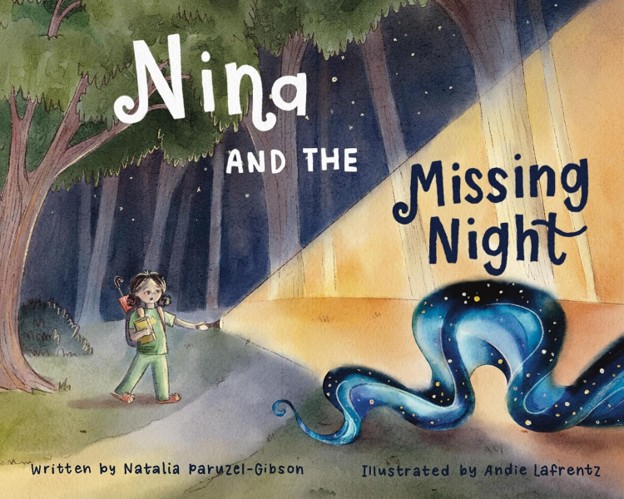
Absolutely not, says Burlington-based children’s book author Natalia Paruzel-Gibson, who has collaborated with Pownal Street Press to protest this problematic, workaholic mindset in the form of reading material for young children. It would not be great at all. As a new heroine and a whole town full of people and animals discover in Paruzel-Gibson’s soon-to-be-published young beginner readers’ book Nina and the Missing Night, no to-do list and no standard of productivity are worth anyone’s health. It’s a message to both children and their parents that has never been more relevant or needed.
Nina is a clever little bookworm who likes to sit in bed reading books every evening before going to sleep. Joining her in her relaxing nightly ritual is her good friend Night, who is characterized in this storybook as a beautiful, willowy raven-haired maiden wearing a sweeping cloak of stars that curls like tentacles, drawn with elegant style by Calgary-based illustrator Andie Lafrentz.
In her community, Nina seems to be alone in loving bedtime, as the busy adults and energetic children would rather have more time to work and play. One day, Nina awaits Night’s usual visit, but Night never comes. The sun stays shining in the sky and never descends. Night has disappeared.
At first, Nina’s town rejoices. The adults can finish more tasks, the children can play for as long as they want to, and even the animals can spend extra time hunting and foraging for food. But as the endless daylight drags on, mass fatigue sets in, and everyone becomes cranky and lethargic. Without sleep or downtime, no one has the energy to do what needs to be done anymore. Nina, despite not being well-rested herself, takes on the responsibility of seeking out the underappreciated Night and begging her to return.
Nina and the Missing Night is a tender, emotionally charged story about the loving friendship between Nina and Night, but it is also a statement against the “hustle culture” lifestyle that’s become something of a global health crisis. The author’s overarching message is that anyone who lives and breathes also needs to rest and sleep, and this is non-negotiable. Nina and the Missing Night is recommended for readers aged 6–8, but the parents reading with their children are likely to pause in reflection as a despondent Night laments her bad reputation.
“Everyone wants more daylight to get it all done,” says Night, who feels rejected by the world.
Making Night a fully realized character is a clever creative decision by the author-illustrator team. Night has a mystic presence, and readers will be drawn to her eye-catching colour scheme of deep purple, sky blue, midnight blue, black, and gold. Night is a relatable figure who has much more in common with human adults than she realizes. She also has a job, an important one, for which she is not given due respect or gratitude. And yet it is an empathetic child, Nina, who recognizes Night’s significance and forms a bond with her.
Pownal Street Press will bring out Nina and the Missing Night on November 3, 2026. In the meantime, Paruzel-Gibson’s other picture books Something Lost and Something Found and A Picture Day to Remember are also available.


