By Emily R. Zarevich, Local Journalism Initiative Reporter
We keep seeing it happen, over and over again. A popular celebrity with access to social media has an opinion about global wars, politics, the arts, or other people. They post it online or express it in an interview, and a disastrous PR nightmare ensues. At once, their career plummets. Their tours and events are cancelled, no one wants to be associated with them anymore, and they may even receive dangerous threats from an outraged public who previously idolized them.
This pattern appears to be an invention of the internet, which nowadays circulates opinions faster than people can think them up. The truth is that this isn’t a new series of events. It happened during the age of print media too, and this is demonstrated realistically in Mark Rosenblatt’s Giant.
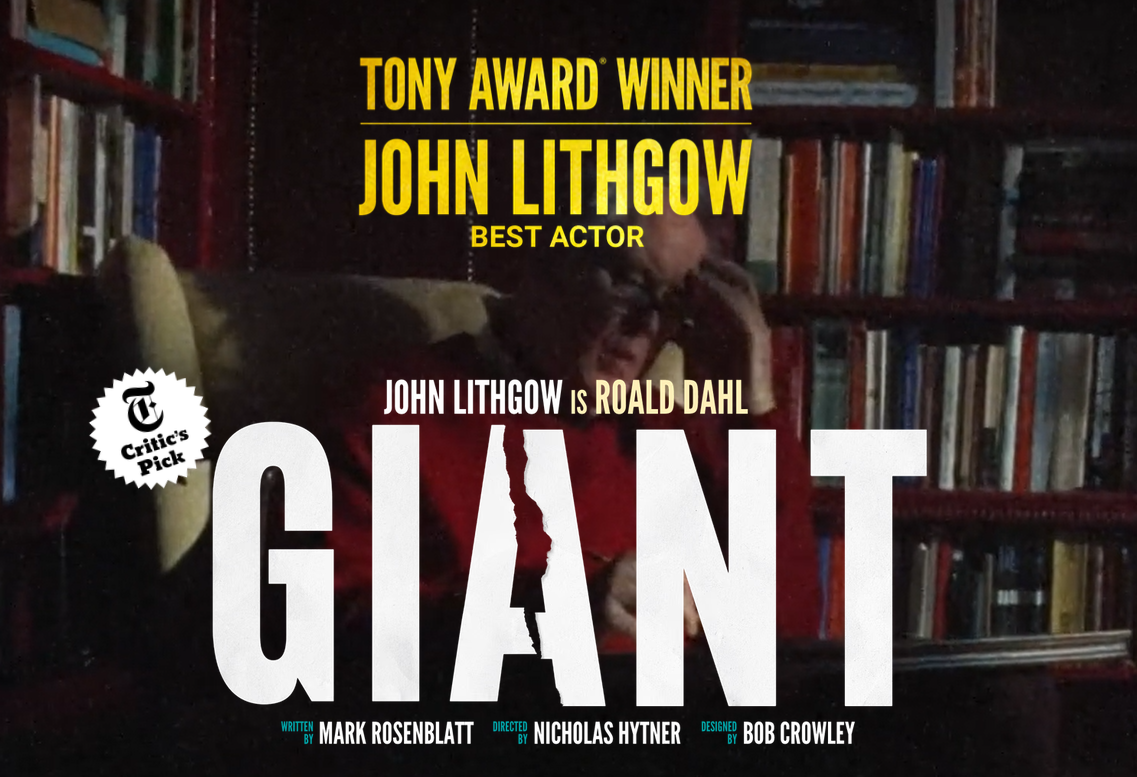
As part of an initiative to make theatre more accessible for the masses, Famous Players Burlington in the Brant Street Plaza is screening Giant. It’s a broadcast that was filmed live at Harold Pinter Theatre in London’s West End, so there is no need to hop on a plane to experience British theatre. Famous Players Burlington is screening the production from Thursday, November 19, 2026, to Saturday, November 28, 2026. This production follows an unfortunate episode in the life of children’s book author Roald Dahl and the deep hole he dug for his reputation during the year 1983, when he published an infamous book review in the Literary Review.
Giant’s timeline is one afternoon’s luncheon in Dahl’s country home, not long after the publication of the review. Dahl has used the widely circulated magazine to express antisemitic views in response to the 1982 Israeli invasion of Lebanon and the siege of Beirut. Backlash promptly ensues. Journalists and radio hosts slam him in the press. Libraries and bookstores want to pull all of his books from their shelves. The Witches, Dahl’s newest book, is about to come out, but his publishers fear no one will buy it. His publishing team and his fiancée Felicity want him to apologize, but in this fast-paced, razor-sharp script by Rosenblatt, Dahl’s defiance is stark. He will not bend.
The West End production brings together a stellar cast to tell the story of this spectacular and historic fall from grace in the literary world. John Lithgow embodies an arrogant, no-filter, and deliberately provocative Roald Dahl who puts up every defence possible against the pleas to repent. Rachael Stirling plays Dahl’s long-suffering partner Felicity Crosland, who attempts to act as peacekeeper in this stand-off but is no match for her lover’s stubbornness. Elliot Levey plays Dahl’s publisher in England, Tom Maschler, who cannot seem to convince his best-selling author of the severity of the situation. And Aya Cash gives a powerful performance as Dahl’s U.S. publisher Jessie Stone, who courageously confronts Dahl about his racism when the others prefer to dance around it and stroke his fragile ego.
Nicholas Hytner directs, moving the unnerved side characters around a quaint dining room like chess pieces while Dahl is content as the immovable king, sitting in his chair for most of the story, undisturbed by the scandal. Set designer Bob Crowley created a country house in the middle of renovations, chaotic and scattered, representing the state of Dahl’s career at that exact moment in time. There are unpacked boxes, dust, and tarps, the exact opposite of perfect domestic bliss. This is reflected in the struggling relationship between Dahl and Crosland, who is reasonably shaken by a threatening phone call made to her house by an anonymous caller who didn’t like what Dahl wrote. The dilemma the character faces throughout the play is evident on the actress’s face. Is it safe to stay with him?
Giant is the story of a broken pedestal. Jessie Stone enters the narrative as one of Dahl’s most ardent admirers. Throughout the play, her admiration dissolves into disgust as she is faced with the flawed and emotionally stunted human being who wrote her favourite books. Through the character of Stone, the play dramatizes the very real and very heartbreaking experience of discovering that a childhood hero is not the person you thought they were. Audiences will get the sad sense that, in a way, a childhood is ending and is being replaced by adult disillusionment. Rosenblatt is conscious of the pain of this common milestone in his script, and Cash’s performance personifies it.
Real-life fans of Roald Dahl’s books who go to see this film of a play may be severely disappointed to find that this is not a play that celebrates the author. If you grew up touring Willy Wonka’s chocolate factory, flying through the sky on James’s giant peach, or even following Henry Sugar on his wonderful campaign to do good through gambling, you might be crushed to be presented with Rosenblatt’s picture of the author. This version of Dahl is a loud-mouthed, arrogant bigot who takes no responsibility for the words that spill out of his mouth and onto the page. At one point, Stone even suggests that the reason Dahl writes so well for children is because he’s still a child himself, someone who never matured. The playwright, the director, the actors, and the crew all come together to expose the author’s dark side.
Giant also tests the limits of “freedom of speech” and how far the universal right to speak one’s mind extends. Roald Dahl’s book review wasn’t the first published piece of its kind, and it won’t be the last. Giant makes audiences ask themselves hard questions. What should be done when this sort of issue arises? Should apologies be made, or does a person have a right to stand by their opinions, especially if their opinions are politically charged and rooted in something personal, as Roald Dahl’s were? The play never really gives a clear answer, but it does present perspectives from both sides of this incredibly complicated conflict.
Theatregoers who are interested in learning more about Giant’s cast and crew can find more information on Playbill. The last showing of Giant will take place at Famous Players Burlington on Saturday, November 28, 2026, at 3 p.m. The play is two hours and sixteen minutes long, with an intermission of fifteen minutes at the halfway point.