By Jack Brittle, Local Journalism Initiative Reporter
At its May 11 Committee of the Whole meeting, Burlington city council focused on two major policy debates: proposed guidelines for the use of strong mayor powers and a significant update to the city’s Housing Community Improvement Plan. The meeting saw a split vote on the governance policy and unanimous support for housing incentive changes.
Item 8.3, titled “Guidelines for the Use of Strong Mayor Powers and Amendments to the Council-Staff Relations Policy,” drew extended discussion between councillors and the mayor.
Ward 2 Councillor Lisa Kearns and Ward 3 Councillor Rory Nisan have both been outspoken critics of Mayor Marianne Meed Ward’s use of the strong mayor powers, and are both running for mayor in the upcoming fall election.
Staff recommended that council adopt the proposed guidelines, which would be considered by the mayor when exercising strong mayor powers. The document outlines factors such as previous council decisions, staff advice, timing considerations, and whether other, more collaborative decision-making options are available.
However, the guidelines are non-binding and do not affect the legal authority of strong mayor decisions under Ontario’s Municipal Act, 2001. Staff also noted in their report that they were unable to find examples of similar policies in other Ontario municipalities.
“The likely reason for that is because a municipal policy cannot limit or otherwise remove the statutory powers that are assigned to the Mayor in the Municipal Act, 2001,” the report stated.
Curt Benson, chief administrative officer for the city, said that the provincial government is looking into its own law limiting strong mayor powers.
“We are aware of a proposal from the provincial government to introduce a regulation rendering strong mayor powers ineffective as it relates to the budget in the last year of the term,” Benson said. “We are monitoring the status of that regulation.”
Mayor Marianne Meed Ward said she supports the intent behind the guidelines, even though they are not binding.
“I certainly always support additional principle-based decision making and additional opportunities to set some policy,” Meed Ward said. “The principles that are articulated in the policy are really important and valid.”
Meed Ward noted that the province already has restrictions on strong mayor powers, like “lame duck” and spending provisions. She added that many of the considerations outlined in the proposed guidelines already reflect her own approach to decision-making and said the guidelines could help clarify expectations as council continues to work under the province’s strong mayor framework.
Nisan weighed in on the discussion and voiced his opposition to the policy, arguing that it does not address what he sees as a fundamental problem with the legislation itself.
“I don’t see the value in a non-binding policy to control strong mayor powers,” Nisan said. “I’m concerned that if we adopt this policy here as council, it will paper over what is a fatally flawed law and provide an excuse for using strong mayor powers when, in my opinion, other than approving bylaws, there is no excuse for it.”
He added that the policy risks legitimizing the use of strong mayor powers without meaningful constraint.
“There is always a more inclusive avenue for decision-making available,” Nisan said. “And that’s this table right here. So there’s no point in this policy, although I appreciate staff bringing it forward according to our request…hopefully the provincial government expands that regulation and just cancels these ridiculous powers.”
The motion to “adopt the Guidelines for the Use of Strong Mayor Powers Policy attached as Appendix A to legislative services report LLS-25-26,” passed four to two, with Ward 5 Councillor Paul Sharman, Meed Ward, Ward 1 Councillor Kelvin Galbraith, and Ward 6 Councillor Angelo Bentivegna voting for, and Nisan and Kearns voting against.
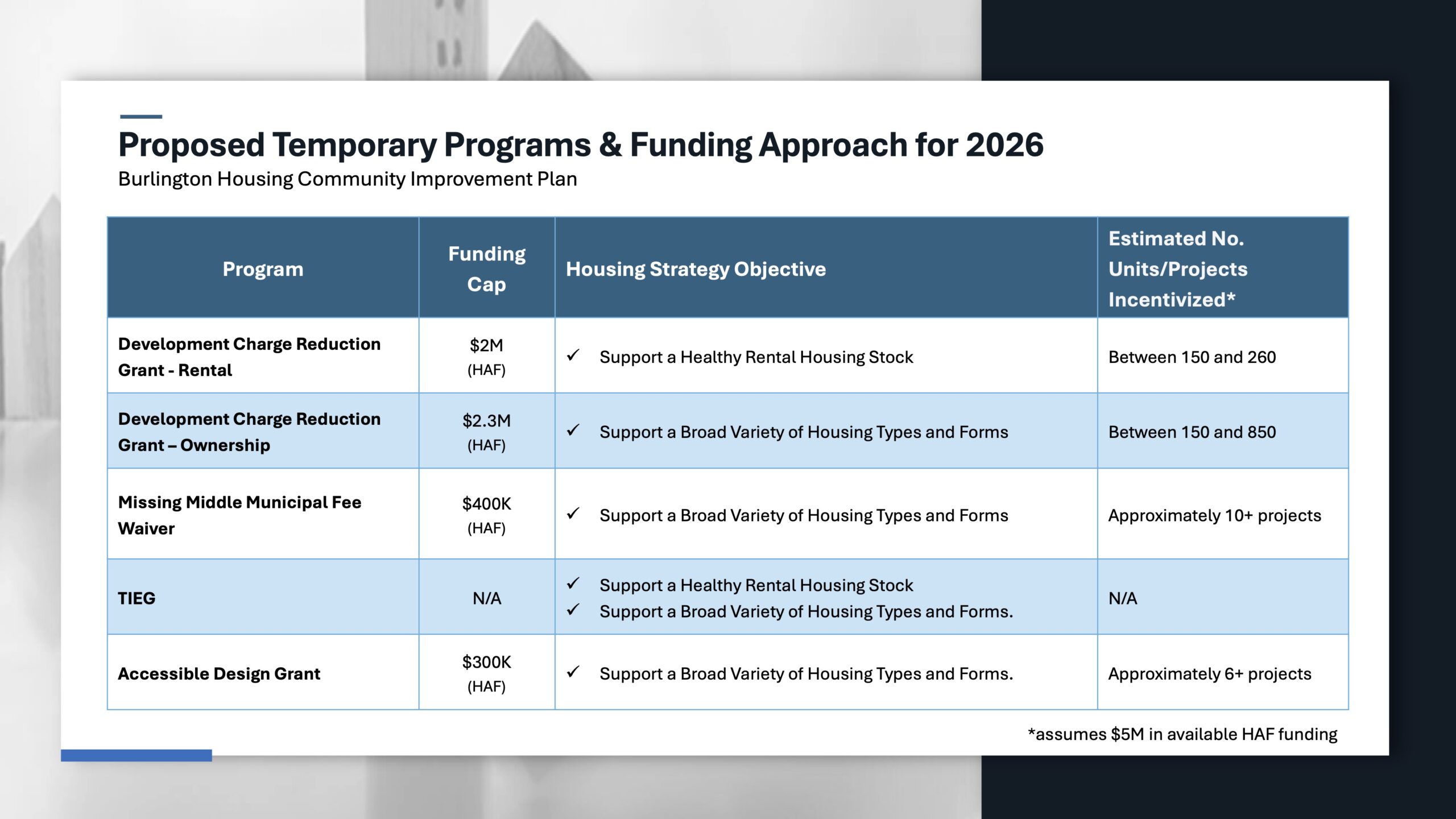
Item 12.2, the “Amendment to Burlington Housing Community Improvement Plan,” was discussed later in the meeting and includes updates to a suite of temporary housing incentive programs, including the elimination of development charges for some projects in the city.
Kate Hill-Montague, supervisor of planning policy for the city, presented an update on the amendment, noting that the proposal had been refined following feedback from the public, the development community, and council since the April 14 statutory public meeting.
The temporary programs would run until Dec. 31, 2027, and be funded through federal Housing Accelerator Fund (HAF) allocations. The initiative was described as a pilot program, with future funding dependent on whether the city meets its housing targets and whether additional HAF funding becomes available.
The first year of the program would be funded by $5 million in HAF funding, after which, according to Hill-Montague, staff would report back to council with “information about program uptake, confirm the availability of any additional housing accelerator funding that may become available and recommend a 2027 funding approach.”
Any future funding will be determined by monitoring how the program operates in its first two years, with flexibility allowing resources to be shifted between programs depending on demand.
“At the discretion of the Commissioner of Development and Growth Management, the funding may be redistributed across the temporary program, subject to funding availability,” Hill-Montague said. “And this will allow for flexibility that is responsive to program uptake.”
She said that the estimated range of units that may be incentivized for the Development Charge Reduction Grant – Ownership program is wide because it will depend on the type of developments that choose to participate in it.
“This program does provide a 100% grant for the city’s portion of the development charges for our missing middle type developments,” Hill-Montague said. “And a 30% equivalent grant for mid-rise and tall buildings…this means that the grants for units in a mid-rise or tall building built form cost significantly less to incentivize per unit, compared to the low-rise buildings.”
Staff also proposed replacing the Missing Middle Affordable Housing Grant temporary program with a simplified missing middle Municipal Fee Waiver program. “This simplified program waives up to 100% of eligible municipal permit fees for missing middle housing forms to a maximum of $40,000 per project,” Hill-Montague explained.
An Accessible Design Grant was also added following feedback from the statutory public meeting and consultation with the Burlington Accessibility Advisory Committee.
“This program can be paired with other programs to grant eligible applicants funding to incorporate universal or barrier-free design practices and features that exceed the Ontario Building Code,” she said.
Council is scheduled to vote on the amendment on May 26. Staff will also continue to monitor funding opportunities at the federal and provincial levels as more details become available.
Sharman said he is pleased with the proposals.
“I think this is a major success in principle, now we have to deliver housing out of it,” Sharman said. “I’m delighted that we’re on the right path and will deliver something that we had hoped we could accomplish in a very effective and efficient way.”
Meed Ward gave her thoughts on the temporary programs.
“I think what we have here shows that municipalities have a role to play in the delivery of housing,” she said. “And this is a way for us to play our role in an appropriate and responsible way and contribute to ensuring that we incentivize the kind of housing that we want and that our community needs and is asking for.”
The item passed unanimously.