
By Maisha Hasan, Local Journalism Initiative Reporter
A question that should be top of mind for people across the world is one that occupies writer Jesse Wente’s mind: how do we — both Indigenous and non-Indigenous people — heal from colonialism?
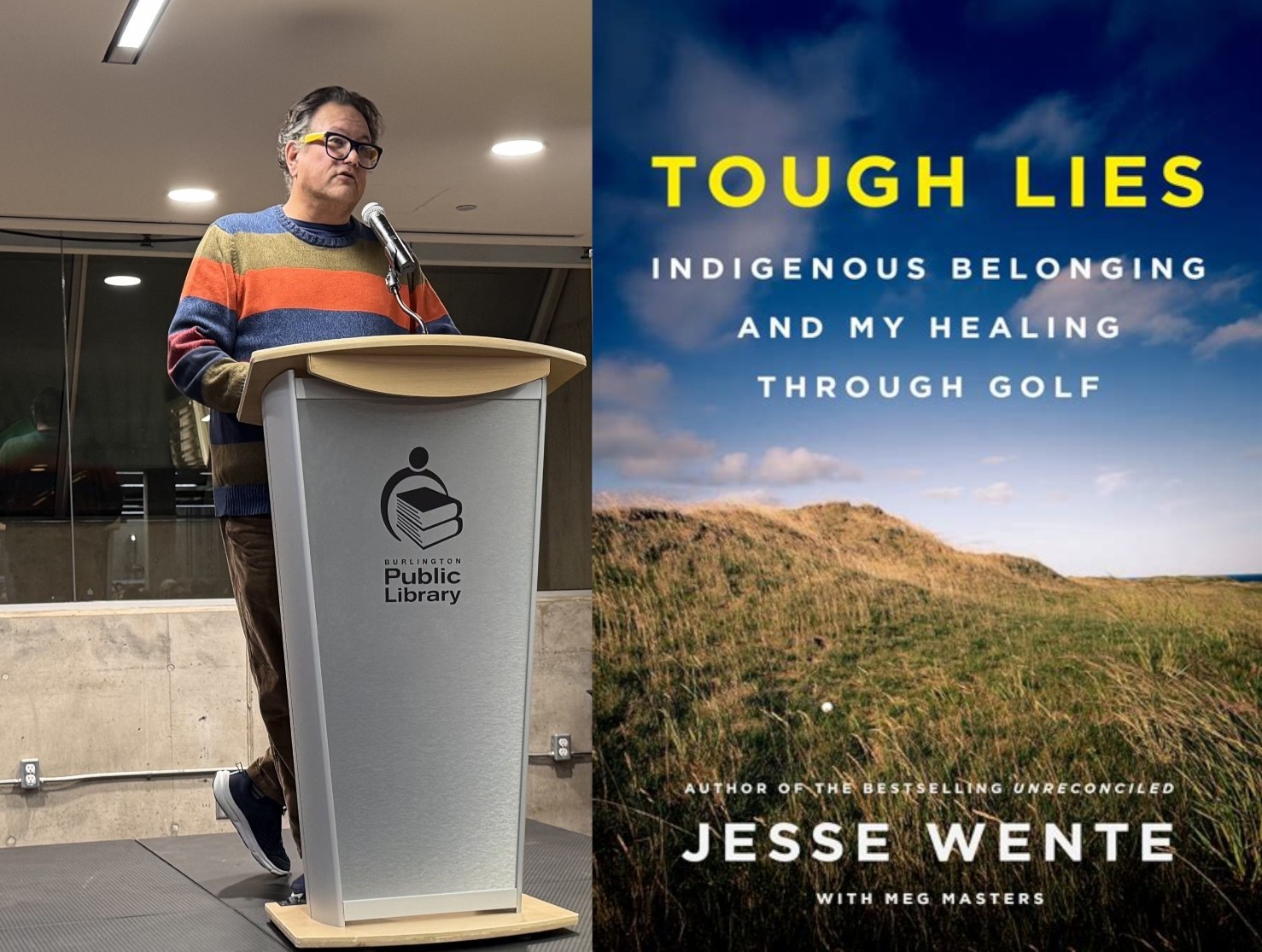
Wente offers insight in his latest book, Tough Lies: Indigenous Belonging and My Healing Through Golf, which he discussed in this interview and at Burlington Public Library (BPL) on Nov. 16. This conversation is a deeper dive into Wente’s thoughts on colonialism’s legacy for Indigenous people today and the path to healing.
READ MORE: Jesse Wente Shares His Healing Journey at Burlington Literary Festival
The memoir centres on Wente’s own experiences with healing, including how particular incidents and the challenges of everyday life led him to prioritize healing through Anishinaabe healing practices and golf.
Wente is certainly not the only author to have written about colonialism, and he has learned from other people’s analyses. Indeed, the first page of Tough Lies starts with a quote from James Baldwin: “There is a reason, after all, that some people wish to colonize the moon, and others dance before it as before an ancient friend.”
“I’ve returned to [Baldwin] again and again, and over the course of my life. He’s been a huge influence on my storytelling style,” Wente said. He described his typical practice of using his own life experiences to explore themes like colonialism.
“In terms of an anti-colonial or de-colonial thinker,” Wente said of Baldwin, “[he was] someone who expressed a lot of ideas that I think continue to resonate, as someone who was prescient, around the situation that we face ourselves today.”
Although Wente offers similar suggestions to Baldwin and other anti-colonial thinkers, throughout the book he discusses how he struggled with the idea that he was the “right” type of Indigenous person, let alone a public advocate.
When filmmaker Michelle Latimer faced controversy in 2020 over the validity of her self-claimed Indigenous identity, it hit close to home for Wente; he was one of the producers on the Latimer-directed film The Inconvenient Indian.
“When something that big happens and you’re sort of caught in the whirlwind of it, and you’re so close to the centre of it, it just opens up old wounds. I think what I’ve learned is that trauma and how [it] often works is that you go through something really difficult, [and] what hurts more is what it brings up, which can sort of confirm some of those negative things that you tell yourself that aren’t true,” Wente continued. “One of the things I wanted to explore in the book was how the particular issue of misidentified Indigenous sort of belonging affects those around it and affects them in a number of ways, personally and individually.”
The issue of non-Indigenous people misrepresenting themselves as Indigenous also raises broader questions about Truth and Reconciliation, and the lengths the Government of Canada went to conceal its atrocities.
“For First Nations people, telling our story has been an ongoing struggle, because in many ways, it was quite literally against the law. There was a lot of pressure to ensure that we wouldn’t tell our own stories, that those stories wouldn’t be known,” Wente said.
The inability to share the truth about residential schools and the cultural genocide Indigenous people faced allowed the negative effects to continue, Wente explained.
“Not knowing our stories has made it easier for negative things to be done to us and for us to experience negative outcomes of Canada. Part of the way you’re marginalized, and part of the outcomes of being marginalized is that your story isn’t heard, and because your story isn’t heard, you’re not as fully human as those communities whose stories are always heard,” Wente said.
Healing, in the Anishinaabe sense, relates to the understanding of the mind, body, and spirit as one. Wente leaned further into healing as a whole person after suffering a heart attack on Christmas Day in 2023.
“What I would say is I had lived my life almost entirely concerned with the mind and not necessarily attending to the spirit, and definitely not to my body,” Wente said.
Navigating a healing journey can be challenging in a society seemingly more occupied with selling health and wellness than providing the conditions needed to achieve them.
“I think we live in systems that want to commodify everything. Look at now, they’re trying to commodify our attention, our searches, every little thing that we do. We’re conditioned because we were born into these systems…I had a very interesting conversation at a book event with a fellow Anishinaabe author, Quill Peters, who wrote this great book called On Wholeness. [She discusses] how it’s difficult to talk about healing right now when there’s so much harm occurring in the world, and I agree,” Wente said.
That ongoing harm has affected Wente’s perspective on healing: “I think that’s in part why there’s no such thing as being healed. There’s no end to the process because there’s so much harm. We’re living in harmful systems that are perpetuated. We’re living in harmful systems that are perpetuating harm globally.”
A lot of Wente’s own healing came through golf, which is its own character throughout Tough Lies. Given golf courses’ long and complicated history of occupying Indigenous lands, it’s interesting to consider why Wente gravitated towards the game.
“I came to golf because I played it as a kid…it was surprising how some of the elements of the game, especially when it came to respect for the land, respect for each other, and respect for the course and all that, really resonated,” Wente continued. “Golf, not so much the game itself, but how we access the game, through private clubs, and the fact that it, of course, arrived here through colonialism…We are transforming [golf] into something different, something that suits us. There’s courses First Nations people now run and manage that approach the environment very differently, [that] community accesses very differently. Like so many things, we’re turning it into something that suits us a little bit better.”
When it comes to bridging the gap between Canadians and Indigenous communities, and the collective healing needed by both parties as a result of colonialism, the path forward is hard to pin down.
“I think we’re still at a point where the truth hasn’t been fully accepted. We talked earlier about acceptance around not being fully healed. It feels a bit like that’s what Canada also has to accept, right? That [the country] is hurt by this, and that it needs to heal,” Wente said.
Healing could happen, Wente believes, “if Canadians could really embrace that acceptance part.”
“You can’t ever heal if you don’t accept that this has happened and [if] you’re just going to argue about it, you never get to the good part of it,” Wente said.
Wente also discussed his book and healing journey at a Burlington Literary Festival event on November 16. Read our coverage of the event here.