
By Jack Brittle, Local Journalism Initiative Reporter
Earlier this month, the City of Burlington held a Special Council Meeting to discuss the 2026 Budget Review. The discussion was preceded by a Committee of the Whole meeting on the same morning. Since the Dec. 2 Special Council Meeting, the city’s tax increase has continued to spark discussion among residents on social media, where many have raised concerns about affordability and the budget process.
Eric Stern delegated to council about the budget on behalf of Focus Burlington, a not-for-profit community group. Stern thanked the city for giving residents “a few extra days” to review the budget by releasing a draft.
“This is an improvement over last year, but still far short of the 30 days Oakville residents are permitted to review their draft budget,” Stern noted.
Stern said that the city’s budget blueprint document is too “high-level” and doesn’t allow for meaningful engagement due to a lack of details.
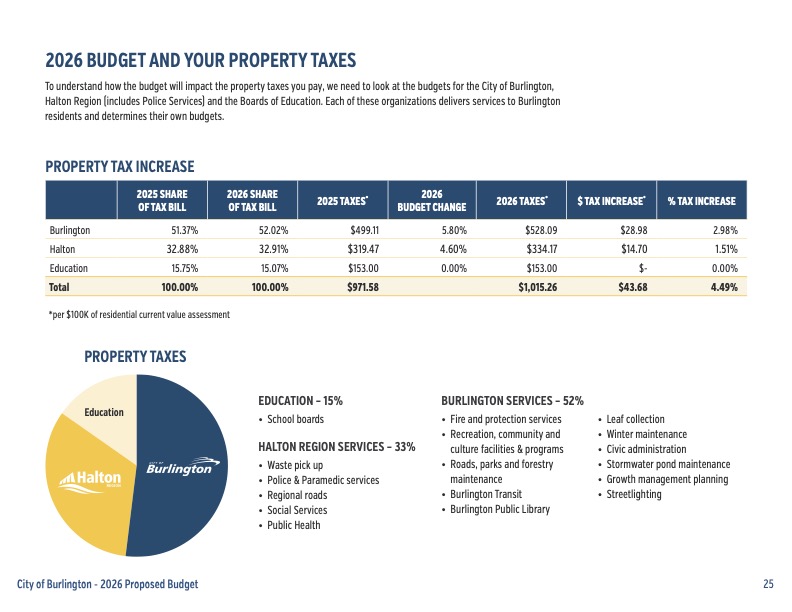
The city’s 2026 budget will increase by 5.80%, which includes an overall property tax increase for residents of 4.49%. According to the city, that amounts to $43.68 in property taxes for every $100,000 of residential current value assessment.
“We heard the city chose to share the tax increases by 2.98%. I choose to continue to object,” Stern said.
He said that Focus Burlington asked the city how to calculate the 2.98% increase by comparing a final 2026 bill with that of 2025. Stern claims that the city didn’t show them.
“Every other thing you ever talk about for percentage increases, you can calculate from the bill,” Stern said. “If the city has some wonderful calculation that involves 51% of the property tax bill being for Burlington, which effectively means you divide the increase by half, that’s your choice to share that number. That’s not a meaningful number to residents, and it’s not reflected on the bill.”
Stern also criticized the city for holding budget town halls before a draft version had been released to the public. In the days since the meeting, residents commenting online have echoed concerns about transparency, while also noting practical trade-offs — one resident acknowledged that sacrifices are inevitable but argued the 5.8% increase remained too high. Others questioned service levels, pointing to issues such as leaf collection, unfinished construction work, and the need for barriers along the new bike path.
Stern said that Focus Burlington had reviewed the budget’s numbers and came back with a different analysis than the city.
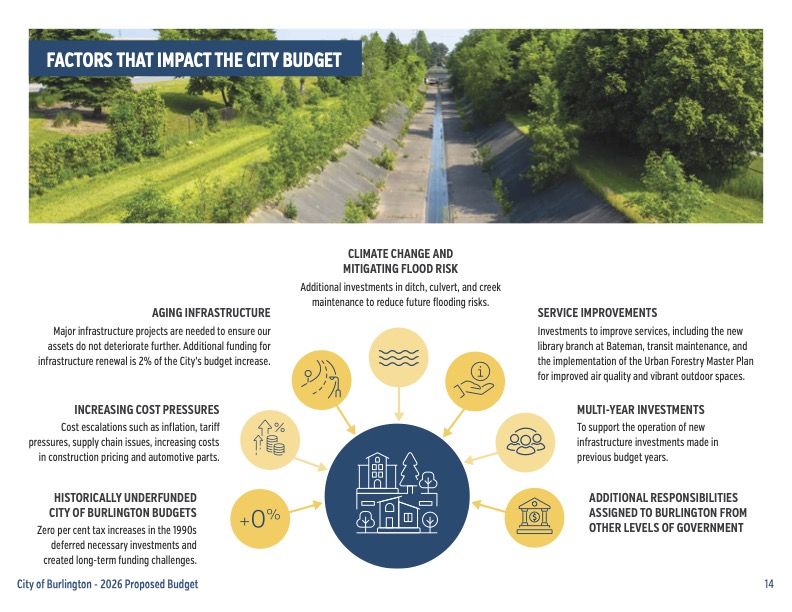
“We learned that 2% was for inflation, 2% was for infrastructure, and 1.8% was for additional pressures,” Stern said. “A 5.8% property tax increase adds almost $17.5 million to the city’s coffers. Where is the money going? All you have to do is look at page 42 for the answer. The change in salaries, wages, and benefits is shown as $11,412,000. Meaning $11,412,000 of the $17,477,000 tax increase is going to salaries, wages, and benefits. Using the blueprint’s terminology, 3.79% of the 5.8% tax increase is going to salaries, wages, and benefits.”
Stern invoked the Mayor’s Elect Respect pledge to make a comparison to how the city treats taxpayers.
“Elect Respect is an important initiative,” Stern said. “A safe and respectful workplace is essential for everyone. Is it time for a taxpayer respect initiative, one where members of the community, residents, the media, and taxpayers are treated with respect? After all, we are the source of the revenue on which the city is dependent.”
Burlington Mayor Marianne Meed Ward clarified Stern’s comments about salary increases.
“The salary piece is included in inflation,” Meed Ward said. “There’s a part of that that is related to cost of living, which is inflation, and that’s why that sits there.”
Meed Ward asked Sue Evfremidis, chief human resources officer for the city, if anybody is getting a 10% or 15%-plus salary increase.
“Absolutely not,” Evfremidis said. “No one is getting a 10% increase.”
Meed Ward asked Lori Jivan, manager of budgets and policies, how the city’s share of the overall tax increase of 4.46% is calculated.
“We are one of three levying bodies, and we make almost 52% of the property taxes levied,” Jivan said. “So you would take the city’s budget increase and multiply it by our 52%, and that should land you at the city share of the blended rate.”
Craig Millar, chief financial officer for the city, expanded on how taxes are distributed between levels of government.
“We are a multi-tier municipality, so we’d have the city’s portion and the city services that we deliver,” Millar said. “We have the regional services, so the city collects the taxes and pays them to the region, based on their budget and then thirdly, the province also has us collect property tax dollars to help fund some of the school board costs.”
An amendment was passed unanimously to revise wording in the budget to properly reflect what council has the authority to approve under the Strong Mayors Act. Council can no longer approve the entire budget, only its amendments.
“The budget is built in a new way because of the legislation that we don’t control,” Meed Ward said. “But all council members had the opportunity to bring amendments to change the tax increase.”
Before voting on the amendments, councillors gave their final comments on the budget.
Lisa Kearns, Ward 2 councillor, stressed the need for more austerity in future budgets.
“Many people would hopefully describe this budget as sustainable,” Kearns said. “I think it’s a bit of a challenge, and I respectfully acknowledge that this budget, the 5.8% city portion tax increase, which means we spent 5.8% more than last year, is, in fact, hard for taxpayers to accept despite the many layers of rationale that’s been tabled, and I really encourage us continuing in the next few years to put a harder emphasis on fiscal responsibility.”
“I’ll continue to challenge consulting costs, phasing in new positions, and striking expenses that provide incumbent advantages,” Kearns continued. “I lose sleep over our Tax Stabilization Reserve Fund and encourage the focus on this necessary fund’s growth. While we continually struggled to break meaningful assessment growth, we need a better balance for those here and now. I didn’t support last year’s budget, and unfortunately, I can’t stand behind this one either.”
Kearns said that she offered three-quarters of a million in savings or cost avoidance, while proposing one position that was not accepted.
“But it did open up a great dialogue,” Kearns said. “I’m grateful for that conversation to manage funding that advances equity in our city.”
Paul Sharman, Ward 5 councillor, said that the city’s unwillingness to spend in the past has caused council to play catch-up.
“For years, we underfunded really important things, and we had consequent failures,” Sharman said. “Council then had to put in additional funding.”
“I will be honest with you,” Sharman continued. “I felt everybody needed a break. We couldn’t get the break we wanted, which would have been zero or negative. We don’t know how to do that because there are some factors in there that need to be addressed and [for us to be] constantly aware of.”
Kelvin Galbraith, Ward 1 councillor, said that while he knows the increase will be uncomfortable for residents, he thinks council did the best they could to keep it as low as possible.
“I know it is a hefty increase again,” Galbraith said. “And I know we’ve had three years of those coming out of COVID. Inflation has been rampant, and not just the regular inflation. When we look at our assessment growth of 0.75%, and it looks like we’re not even going to hit that…we are the slowest growing municipality in our region. Oakville is almost 2%, and Milton is over 2%. They have that assessment growth to drive down their budget. Burlington doesn’t. So we’re stuck with a higher tax increase, although theirs is higher this year as well.”
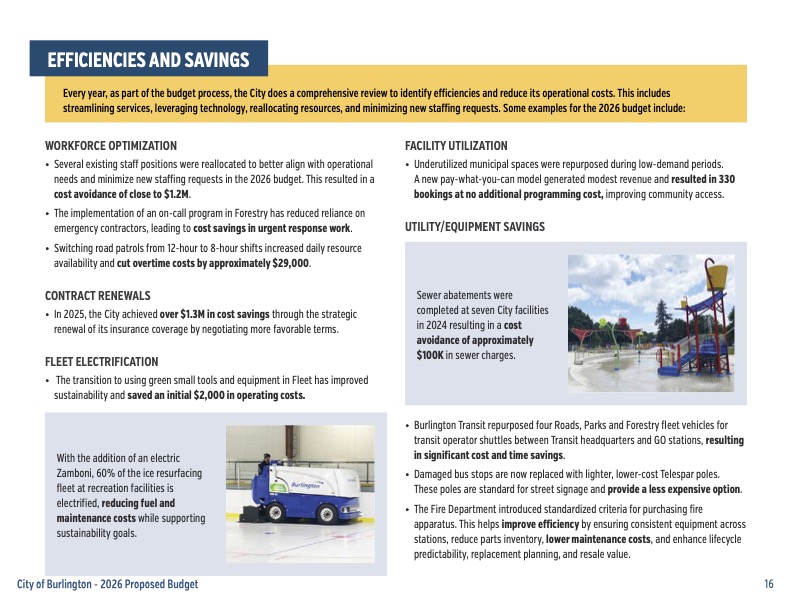
“I am supportive of the budget,” Galbraith continued. “I think we did a great job in our amendments; we all tried to find efficiencies as best we could.”
Meed Ward said that residents will ultimately reap the benefits of the additional expenditures that the city is investing in.
“What we heard certainly was concern about affordability,” Meed Ward said. “We also heard the need for sustainability and protecting our amazing and wonderful quality of life here, and did not get substantive suggestions from the community, or even amendments from council that were approved, to significantly cut service in any way. So I think that really speaks to the value for dollar that residents are getting with this budget.”
The budget amendments passed 6–1, with only Kearns voting against.
“I’ll be issuing the mayor’s decision to end the ten-day period for my review, and not exercise the veto,” Meed Ward said. “So later today, hopefully, we’ll have a full budget locked and loaded for our staff.”
Meed Ward later issued the mayor’s decision to end the ten-day review period.
Following the meeting, Kearns also released a statement on Facebook reiterating her concerns about the budget, writing, “I respectfully acknowledge that the 2026 Burlington City Budget is hard for taxpayers to accept.” She added that her concerns “are not rooted in opposition for its own sake, but in a thoughtful evaluation of how best to serve Burlington’s residents during challenging economic times.” Several residents thanked her in the comments for voting against the budget.