
By Emily R. Zarevich, Local Journalism Initiative Reporter
The original fairy tale novel by Italian author Carlo Collodi came out in 1883, and since then, it has been teaching children all over the world a valuable lesson: lying to other people has consequences.
In the lush countryside of Tuscany in the nineteenth century, a lonely puppet carver named Geppetto builds a marionette out of an enchanted log. It promptly comes to life, and Geppetto names his new wooden son Pinocchio. Pinocchio is a mischievous boy-doll and has a special quirk that gives him away when he misbehaves. When he tells a lie, his nose grows. With the help of a talking cricket acting as his personal advisor, Pinocchio must learn to navigate a world full of chaotic, colourful, and sometimes nefarious characters and eventually emerge from his adventures with a developed human conscience.
Theatre Burlington is set to premiere their own version of the beloved story on November 29, 2025, with tickets for all showings still available here. Based on the script by the late Burlington playwright Vic Hyde, Theatre Burlington’s Pinocchio will be directed by University of Waterloo graduate Tyler Collins, who has made a name for himself in scriptwriting and songwriting for shows performed at Canada’s Wonderland.
Collins possesses encyclopedic knowledge of his subject matter and seeks to pay fair homage to both Collodi’s storytelling and the values of handmade, handcrafted theatre that defined the time period Pinocchio was written in. He was happy to share his insights on what Theatre Burlington will accomplish with Pinocchio’s story. Answers have been lightly edited and condensed for clarity and flow.
Collins on putting together Pinocchio and his creative vision for the finished product:
The project began about six months ago when I was in a set of meetings with the leadership of Theatre Burlington, and we were talking about ways of reinventing the holiday show here at the theatre. We started with a script written by Burlington playwright Vic Hyde that was first produced in the early 1960s. I came in with a vision, wanting to completely reimagine the show and honour a lot of the original text, while adding some new music and lyrics to it.
And then we had to go about redesigning the show. Instead of it being just set in its proper time and place of the Italian countryside of the late nineteenth century, we’re staging it as a travelling carnival and making it like a trunk show. When Pinocchio was written in 1883, that was the main form of entertainment that existed in Italy. It was in these piazzas, carnivals and fairs that would happen in the rural countryside. They would set up wooden planks, and that was their stage. And so there were all of those techniques that made past storytelling so exciting, colourful, and organic.
That’s the approach we decided to take with Pinocchio. Where I got lucky and what makes our production so unique is that we have created this world from a time gone by. All the materials are completely authentic and raw. There is almost no digital use anywhere in the show, and we’ve staged it as if you were watching a play staged a hundred years ago, which is such a rare opportunity these days. It gives the show a timeless quality.
Collins on how his version of “Pinocchio” will adhere more closely to the original story than the well-known Disney animated film:
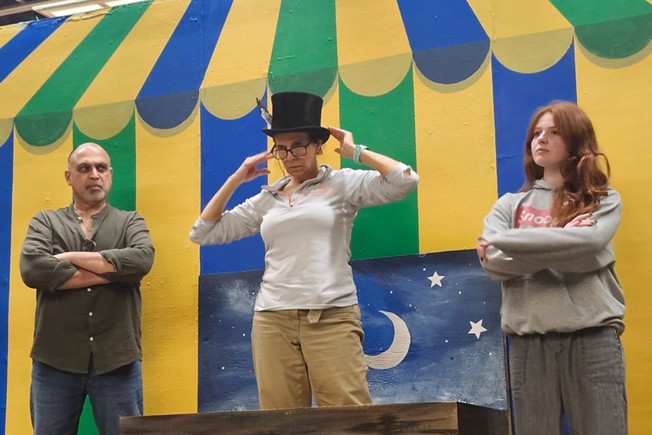
We have a couple of costume pieces that are a slight hat tip to the design and look of the 1940 Disney film, but we’ve created something completely unique to us. We wanted to emulate the styles, the colours, the textures, and the materials of creating theatre in the Romantic Era in Europe. Basically, what creating theatre would have been like in the 1880s.
But aside from that, Disney made changes from the original story, and we’ve gone back more to the book instead. For example, some characters in the Disney version, like Foulfellow and Gideon, the mischievous pair that sell Pinocchio to the circus, are full-fleshed characters with names. In the original book, they are “the fox and the cat.” That’s what we call our characters here, the Fox and the Cat. In the Disney movie, it’s a giant whale that eats Pinocchio, but in the original book, it’s a sea monster. We have our own sea monster named Gargo, who comes to life near the climax of the play. We’re creating a modern version of Pinocchio that we want to feel timeless, as if it could have existed long ago.
Collins on what audiences, both young and old, can expect from the show:
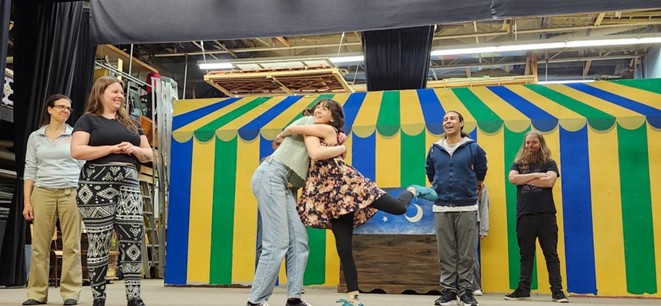
To me, as a theatre creator or as a theatre practitioner, what excites me most is how we evoke joy and surprise from the audience. A number of people in the audience are already familiar with the basic elements of the Pinocchio story, and so we wanted to honour those audience members while also telling the story in a way that was going to surprise them with its presentation.
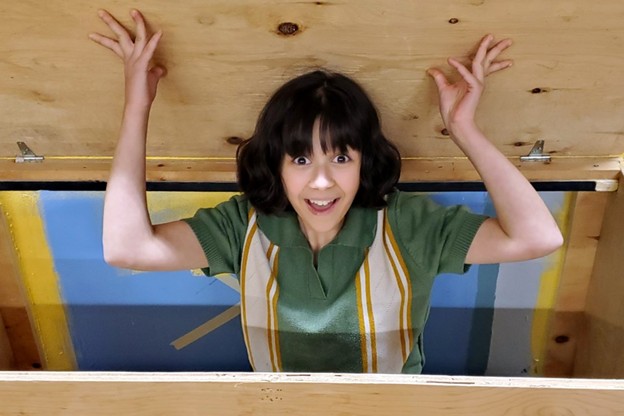
And that’s where the concept of the travelling circus or the trunk show comes in. We’ve set the stage in a circus tent, but the show begins on a completely bare stage with a giant chest, and that is the caravan chest of this theatre group that you’re going to meet at the start of the play. As the show goes on, almost everything magically comes out of the trunk. We have an amazing set building and properties team that made all of the items possible.
I’m pretty optimistic the kids are going to like it. We’ve been mindful throughout the whole process that we weren’t making the show specifically for children. We’re taking the Pixar approach, where it is appropriate and approachable for children, but it is meant to be enjoyed and appreciated by all ages. It doesn’t matter how old you are. We want you to get invested. And I think our cast has risen to the challenge.