By Jack Brittle, Local Journalism Initiative Reporter
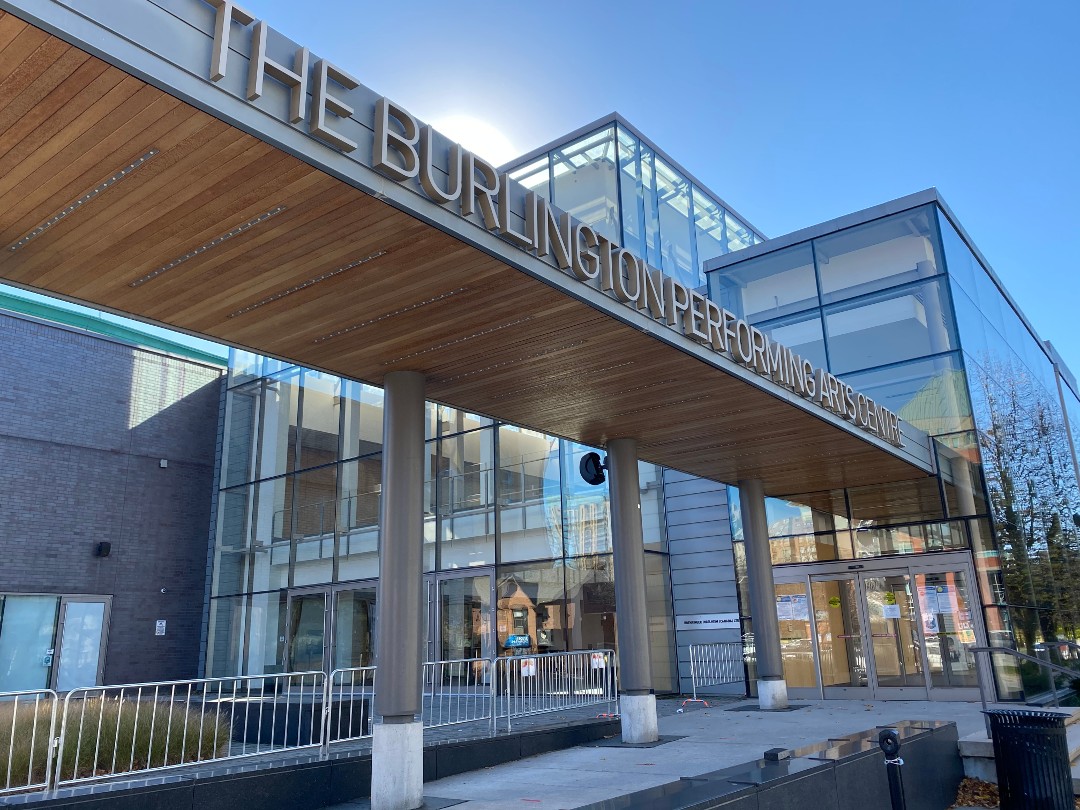
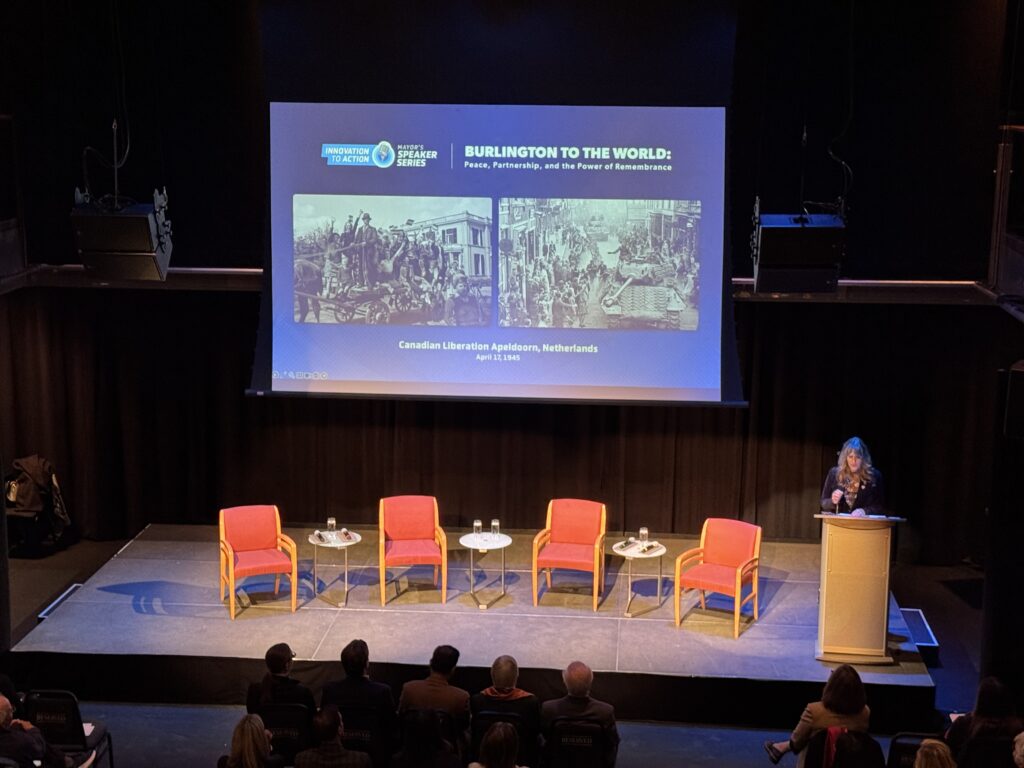
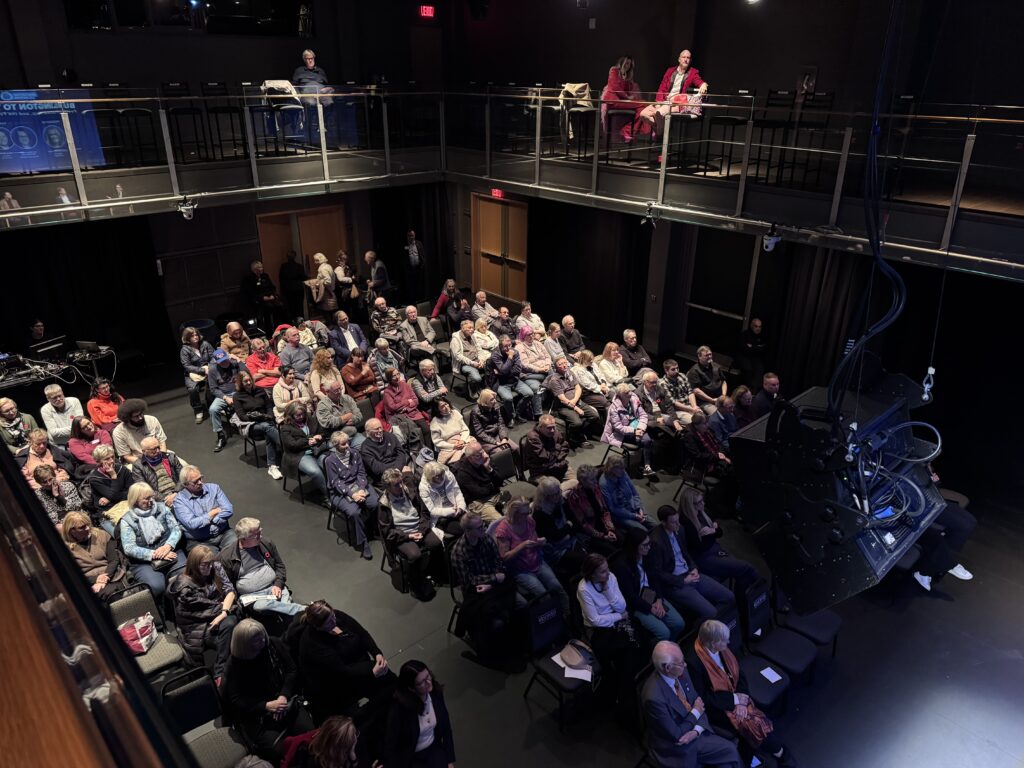
Last week, on November 12, the Burlington Performing Arts Centre hosted an event as part of the Mayor’s Speaker Series, moderated by Burlington Mayor Marianne Meed Ward. The event, titled “Burlington to the World: Peace, Partnership, and the Power of Remembrance,” paid tribute to Burlington’s fallen soldiers during World Wars I and II, and highlighted the city’s Mundialization Committee.
The panel discussion was preceded by a trade show featuring various Burlington organizations and charities, including Community Development Halton and the Burlington Food Bank.
Two slides in the mayor’s accompanying presentation were dedicated to Burlingtonians lost during both World Wars, listing the names of each fatality.
“These are all Burlington boys that went off to war in a different land, where they didn’t know the language or culture,” Meed Ward said. “But they went for the cause of peace.”
Their sacrifices are a reminder, Meed Ward said, that “people in Burlington back then saw themselves as part of a global community, and when the need arose, did not hesitate to answer the call to serve.”
Meed Ward highlighted Burlington’s WWII veteran Gordon Schottlander, who celebrated his 100th birthday in January.
Her focus then turned to one of Burlington’s twin cities — Apeldoorn, Netherlands.
“Canadian troops liberated the city of Apeldoorn, Netherlands, from the Nazi occupation on April 17, 1945, and many residents who now call Burlington their home were living in the Netherlands, some even in Apeldoorn,” Meed Ward said.
Burlington’s twinning agreement with Apeldoorn (as well as with Itabashi, Japan) was made through the city’s Mundialization Committee, which was established in 1984. According to the city, the committee “encourages citizen connections as a way of fostering world peace and global understanding.”
Meed Ward, along with Kelvin Galbraith and Rory Nisan, Ward 1 and 3 councillors respectively, visited the Netherlands in May to celebrate the 80th anniversary of the liberation of the country.
“As part of that trip, I had an opportunity to visit cemeteries where some of Burlington’s fallen heroes were laid to rest,” Meed Ward said. “We participated in Remembrance Day ceremonies, and I was able to bring remarks and greetings on behalf of Burlington. And it was one of the most powerful and moving experiences of my life.”
Meed Ward said that visiting Burlington’s twin cities is also an opportunity to learn from them and observe practices that could potentially be implemented in Burlington. In particular, she referenced a stormwater management ditch built on top of a parking garage, a vending machine for returning cans and bottles, and indoor bicycle storage as examples.
“There’s an idea that maybe you can learn all this now from the internet or from a book, but until you actually go with your eyes and see things that are relevant to you and the community… there’s nothing like being there in person,” Meed Ward said.
Burlington signed its twinning agreement with Itabashi in 1989. Meed Ward spoke about their “world-class” flood and tsunami preparedness, which Burlington representatives were shown during their 30th anniversary visit in 2019.
Every Itabashi resident was sent an emergency kit, amounting to over 50,000 kits in total. The city is also equipped with cameras to see where water is coming from through its stormwater management system.
Meed Ward also mentioned the Great Lakes and St. Lawrence Cities Initiative, which brings together mayors from both the U.S. and Canada to cooperate on trade and tourism.
“This group was formed well before the current trade and tariff situation that we find ourselves in,” Meed Ward said. “And that region accounts for about six billion dollars worth of trade. If it were a country, it would be the third-largest country in the world. So it is an incredibly important part of trade. And of course, now we know that we are under significant threat and strain because of the tariffs that have been imposed in the U.S.”
Meed Ward also spoke about the city’s recent trip to Helsinki, Finland, which serves as one of the foundations for Burlington’s Horizon 2050 project. The trip was paid for through a grant from the Canadian Institute for Health Research, and intended to find out why Helsinki was “the happiest country in the land.” Another potential learning was in how to resolve homelessness: Helsinki went from 1370 families experiencing homelessness in 1987 to just 165 in 2021.
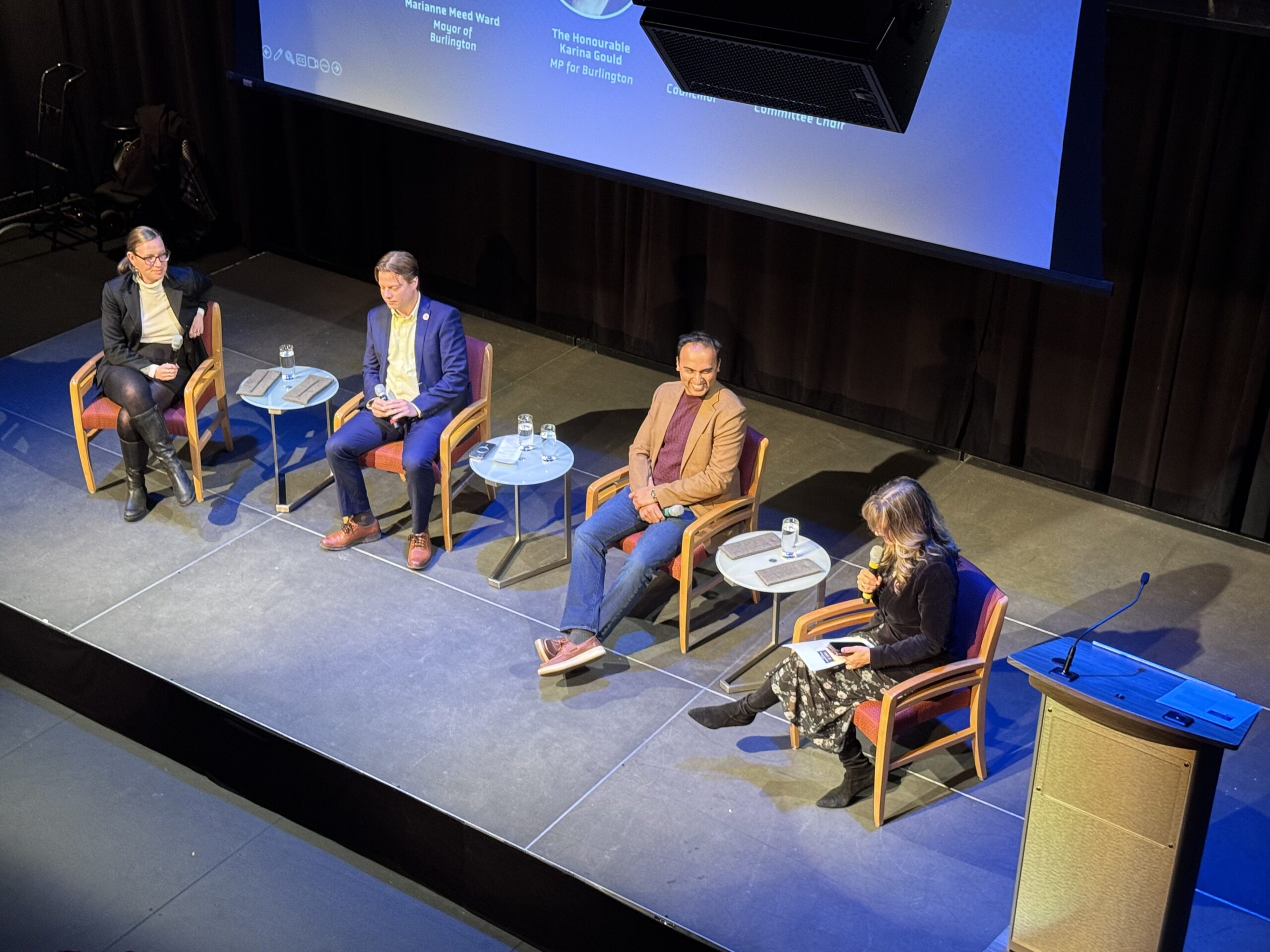
Meed Ward then introduced the three panel speakers: Burlington MP Karina Gould, Nisan, and Hassan Raza, chair of the Mundialization Committee.
Meed Ward asked Gould how the landscape of international relations has evolved in recent years and what role Burlington could play in promoting stability.
“One thing that I don’t think has changed is how much citizens continue to care about the world and continue to engage with each other,” Gould said.
Gould referenced the Trump administration’s cuts to U.S.A.I.D., noting that it was indicative of a trend of countries pulling back international aid — including Canada, in the Carney government’s recent budget.
“Now is not the time to pull back,” Gould said. “Now is the time for us to engage because, in fact, our security is interconnected. What World War II and World War I taught us is that those connections and relationships across borders are so unbelievably important for global cooperation, peace, and prosperity.”
Gould said that many post-war institutions are now coming into question.
Meed Ward asked Nisan, who is also the council liaison on the Mundialization Committee, what lessons Burlington can learn from its relationships with Apeldoorn and Itabashi.
Nisan spoke about the culture around cycling in Apeldoorn.
“They’ve integrated transportation and health together, by cycling more and building their city around that mode of transportation,” Nisan said. “And so they live longer and happier lives than many other cities.”
Nisan also mentioned rent discounts in Helsinki that students can receive if they volunteer with seniors.
Gould said that because of Canada’s legacy social service systems, it can be hard to move and adapt quickly.
“In some other countries where they haven’t had those, they’re actually able to leapfrog us with technology in ways that we can’t quite imagine,” Gould said.
She gave an example of how, in Kenya, citizens have their entire health record accessible electronically on their cell phones.
Meed Ward asked Raza about his motivation to serve in his role on the committee and why he believes it’s important for Burlington to build and maintain their international connections.
Raza said that the Mundialization Committee is a place where he can use his civic sense of volunteerism and learn about new cultures and new countries, and what makes them tick.
“That’s where partnership comes in,” Raza said. “And to be able to ask our civic leaders to say, ‘Look at what the Dutch do. They’re really good at water matters. We’ve got a flooding situation in Burlington. Let’s connect those people who do [those] things really well.”
“If you feel ill, you don’t self-medicate,” Raza continued. “You ask someone who knows something better than you do. And so I think we need to do that more. We need to reach across borders and learn from people.”