By Jack Brittle, Local Journalism Initiative Reporter
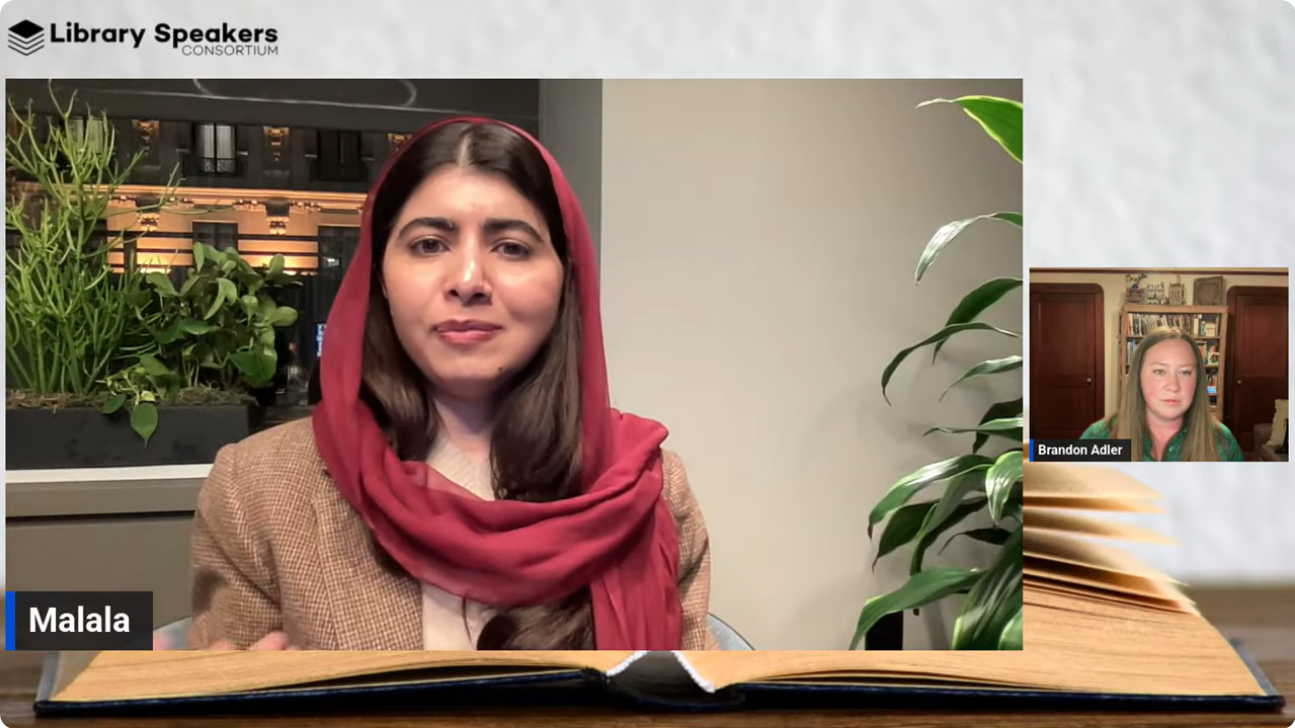
Late last month, the Burlington Public Library hosted an author talk with education activist Malala Yousafzai, where she spoke about her new memoir Finding My Way.
The online event was facilitated by the Library Speakers Consortium, which host Brandon Adler described as “a partnership of more than 500 library systems across the U.S., Canada, and New Zealand, with the goal of making author talks more accessible to communities of all sizes.”
Adler started the discussion by asking Yousafzai how this memoir differed from her previous book, I Am Malala.
Yousafzai described Finding My Way as the most personal reflection she has ever shared.
“I have grown into this young woman,” Yousafzai said. “I have learned so much about myself in these years, making friends, finding love, and I have opened up about so many things that I never thought would be part of my story.”
The book outlines the more personal elements of Yousafzai’s life, including her mental health, almost failing her exams, and getting “ghosted” by her first crush.
“This is me reintroducing myself for who I am, and the most important thing for me in all of these years has been to be true to myself,” Yousafzai said. “This is not to show myself as a symbol or as a hero, but to show myself for who I am.”
Adler asked Yousafzai how she made sure she would not be purely defined by her trauma.
“I would still be introduced by people as ‘the Malala who was attacked by the Taliban,’ and it was still the story of the 15-year-old girl,” Yousafzai said. “But I knew that there had been so much more to my life, and that is definitely part of the reason why I just could not wait to share more about my life experiences.”
Yousafzai said that one of the first people she befriended when she moved to the UK after the attempt on her life in Pakistan was a young woman named Cora.
“When we met, I instantly knew that we were going to be friends because she didn’t ask me about my activism, my role in the public, the attack, or the Nobel Prize,” Yousafzai said. “She asked me about what I was studying, what I was up to in college, what I wanted to do for the evening, and if we could go and get some groceries.”
“I felt like I could be myself here [amongst her friends in the UK],” Yousafzai continued. “I don’t have to live up to any expectations. I can be silly. I can say the wrong thing. I can make mistakes, I can learn. Friends created that perfect place for me.”
Yousafzai told a story about how her friends would poke fun at her international recognition.
“I became a relationship counsellor for them,” Yousafzai said. “And I remember just looking at the situations that they were facing, and they would sometimes make a joke that I was like a mediator, and I was resolving their conflicts.”
“And they were like, ‘You have won the Nobel Peace Prize, can you solve this college conflict?’” Yousafzai continued. “And I thought, we can think about world problems and we can hope to solve them one day, but let’s focus on the college problems first.”
For a while, Yousafzai turned her attention away from academics in favour of the social aspects of college life — certainly not an uncommon occurrence for college students, though Yousafzai’s reasons were perhaps less common.
“I was prioritizing the social side of my life because that is something that I had missed,” Yousafzai said. “And I knew that I would not grow as a person or actually not be learning if I limit myself too much to books and not get human interaction by being among people my age. So, that is why I prioritized all of that, because it helped me in my learning.”
Yousafzai said that during her first year of college, she struggled to balance her studies with the many engagements she attended as a public figure. As a result, she nearly failed her exams.
“That’s when I was called by my tutor and warned that I really needed to prioritize my studies,” Yousafzai said. “When I learned about the academic support at college, I initially did not want to consider it because I thought somehow that I was an imposter, and I didn’t deserve to be here.”
“As soon as I met the academic support person and had those first few sessions, I realized how much I needed them,” Yousafzai continued. “And I also learned that so many of my friends were getting similar support for one reason or another.”
Yousafzai also spoke about her struggles with mental health, and how persistent panic attacks eventually led her to talk to a therapist about her anxiety and PTSD.
“I encourage everybody to do that [seek help],” Yousafzai said. “I wish I had asked for help a lot sooner, but it’s never too late. Always ask for help — academic support and mental health support from your friends and family. Always ask for help when you need it, and also when you see somebody else needing help and support, be there for them. I’m so grateful for everybody who was there for me, for the friends who were just around me, for my family, for everybody.”
Yousafzai closed the talk by encouraging participants to visit their local library and pick up a book. “Read whatever you love, fiction, nonfiction, whatever genre you like,” Yousafzai said. “Reading is always fun.”
“Or you could read my book, Finding My Way,” she laughed.
As Remembrance Day approaches, Yousafzai’s reflections on bravery, perseverance, and justice feel especially resonant. The event, held on October 22, is still available to watch online; to watch Yousafzai’s full discussion with Adler, click here.