By Jack Brittle, Local Journalism Initiative Reporter
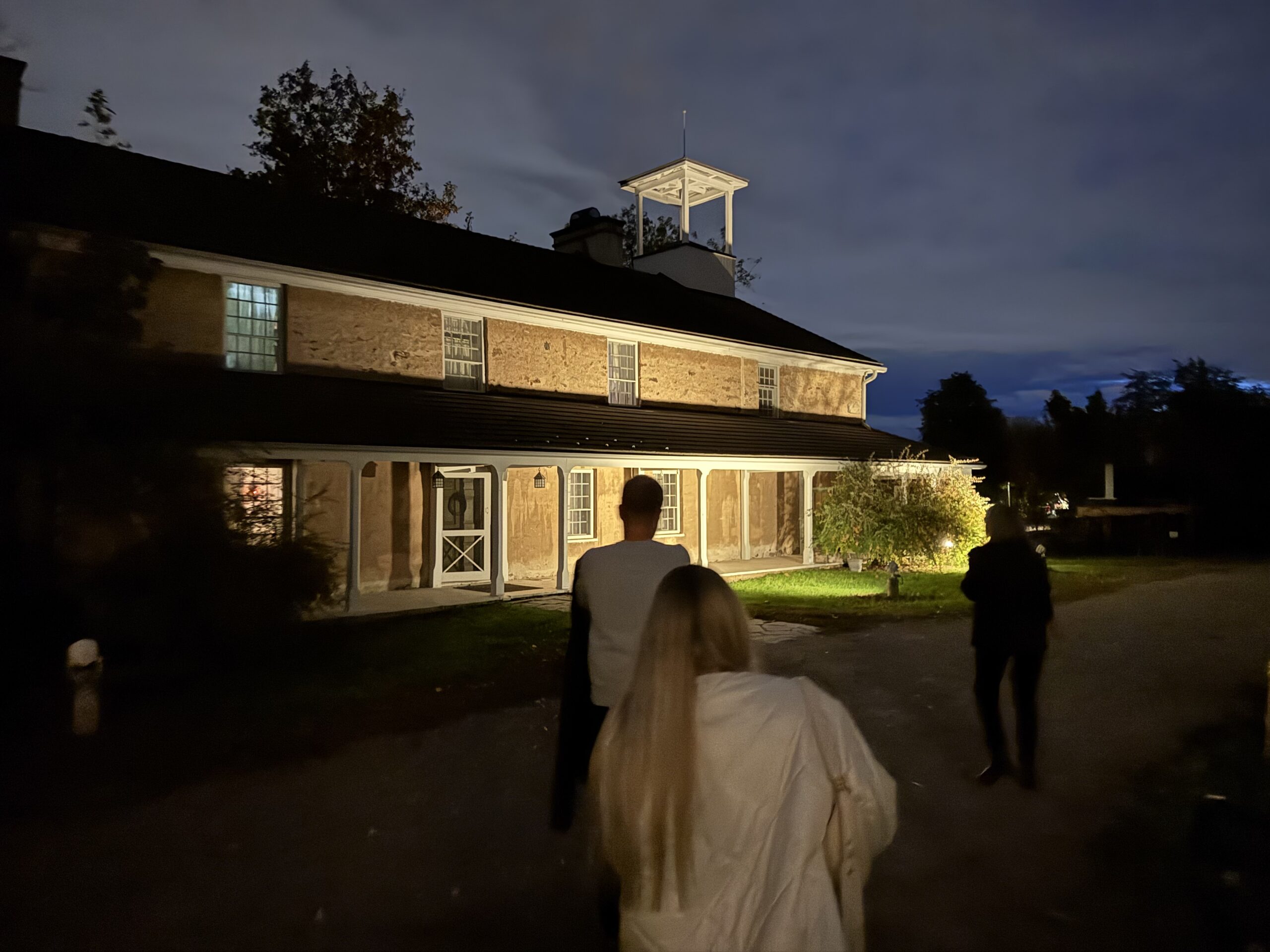
Last week, in good time for Halloween, the Ireland House hosted one of its “After Dark” events, this one themed around Victorian mourning.
The Museums of Burlington website described the house as being “draped in mourning” for the event and said it would teach attendees about the “beliefs and superstitions associated with death, and the practical arrangements which had to be made.”
The tour began in the building adjacent to the Ireland House, with a guide discussing the history of the house and its occupants throughout the years. Guests then moved to the house itself, which is a replica of the one where Joseph Ireland, the original owner, grew up in Yorkshire, England.
As the attendees filed into the house, the tour guide encouraged them to touch the weather-worn 200-year-old back door, using the sense of touch to set the stage. The first room visited was the parlour, which was used not only to entertain guests on holidays and special occasions — it was also used for funerals.
The body would be laid out in the middle of the room for about a week on a charcoal base, which absorbed the odour and kept the body fresh. A family member would always be by the deceased’s side, just in case they woke up, which was not uncommon in the early 19th century. This is the origin of the term “wake.”
Even when the body was buried, a string attached to a bell was tied around the deceased’s finger, which they could ring if they were still alive.
During a wake, all mirrors and other reflective surfaces would be covered in black to protect against the possibility of the mirror summoning a soul to inhabit them.
In what would be considered a macabre fashion today, wreaths were often made from the hair of the deceased, along with dried leaves, nuts, and feathers. A wreath made by some of the Ireland girls was on display in the parlour.
For Victorian-era Ontarians, death was not as medicalized and remote as it is today — death was rather a well-known acquaintance, permeating how their living spaces were used. For instance, connected to the parlour was the “coming-and-going” room, where the family would isolate those who fell ill. The name, according to the guide, comes from the fact that many people who came into the room to stay would “go,” or pass away, which is also why it is connected to the parlour.
Recovery from illness in the Victorian era was also more fraught than it is today: many of the remedies for sickness were very dangerous in their own right.
Both arsenic and laudanum were administered in small doses to dull pain, but overdoses and addiction were common. Arsenic was also used in many fabrics to achieve a deep, intense colour, which could result in tiny particles being rubbed off onto the skin and/or inhaled. “Beauty is pain” took on a morbid irony in the Victorian era — looking fashionable could slowly poison you.
One poster set up in the basement of Ireland House focused on body snatching, which “reached its height in the 19th century when there was a massive increase in medical students, each of whom was required to dissect three cadavers before graduation.” Religious concern for the dead meant that body donation was not practiced, and so the demand for bodies for medical training meant that a good price would be offered by medical schools for those who turned up with a cadaver in reasonably good condition, with few or no questions asked.
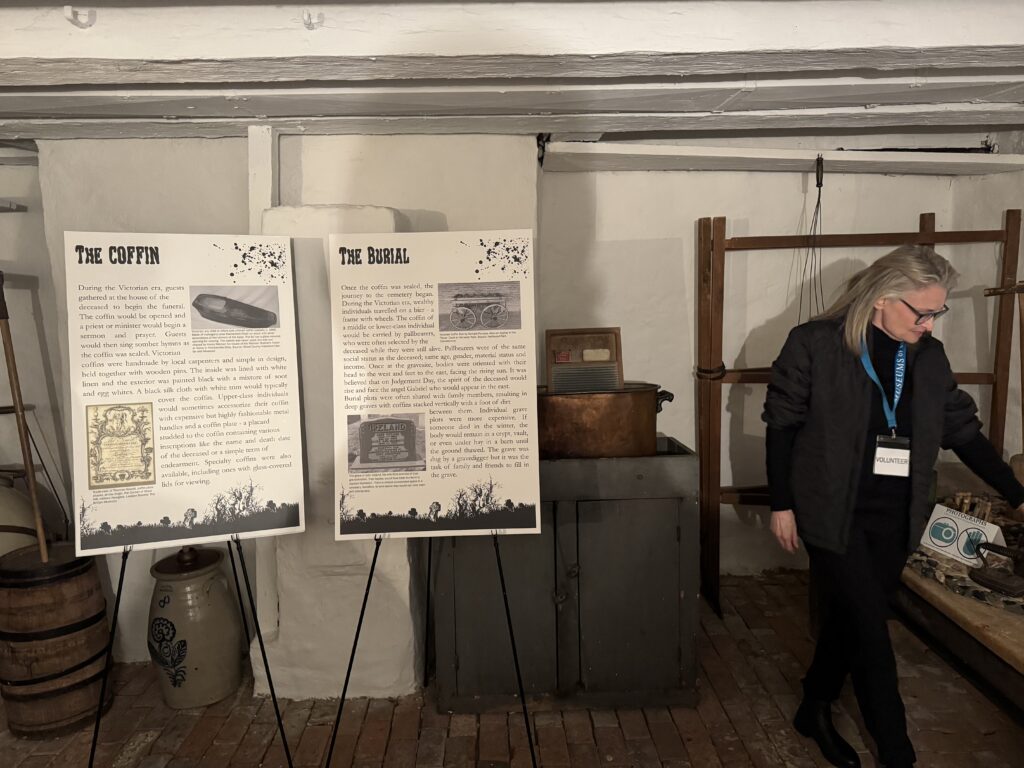
Another poster touched on the titular Victorian mourning and how Queen Victoria’s own obsession with grief influenced customs around death in her lifetime. For the 10 years following her husband’s death, Victoria was rarely seen in public, and for the next 40 years, she almost exclusively wore black.
The result was that “elaborate and prolonged mourning etiquette, and expensive funerals and burials for the upper classes became the norm across the British Empire.”
Usually, women would mourn for around 13 months and men for one. The closer women came to the end of their mourning period, the more they could gradually introduce shades of grey into their attire.
The tour guide also told a story about Joseph Ireland’s brother, who fought in the War of 1812. Ireland’s brother was promised Crown property for fighting in the war, but did not live long enough to receive it. Joseph petitioned the government, and as a result, part of the Ireland farm is Crown property.
The tour then made an even sharper turn towards the spooky: it was said that a ghostly soldier from the War of 1812 used to pace the dining room, but once his brother’s musket was removed, the pacing stopped, the ghost appeased.
As the tour group passed by artwork done by the Ireland girls, the guide also remarked that children can often be heard running up and down the staircase of the house. The sound was once loud and insistent enough that the bedrooms were searched and the Ireland House’s closing time was postponed in case a child was indeed hiding upstairs. No (live) child was found.
Ireland House will host more After Dark events in November and December, themed around Victorian Christmas.
To find out more about the Ireland House, visit https://museumsofburlington.ca/visitor-information/ireland-house-museum/.