By Sydney Alexandra, Local Journalism Initiative Reporter
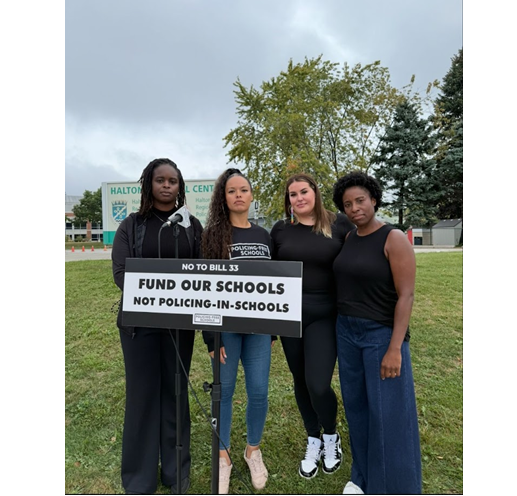
On Wednesday, September 24, Andrea Vásquez Jiménez, director of Policing-Free Schools, joined attendees and community leaders across from Halton Regional Police Service headquarters to deliver a clear message: “No to Bill 33, and fund our schools, not policing in schools.” The press conference, part of a provincial campaign tour, spotlighted the harms of mandated policing in education and uplifted community-led demands for safe, caring, and properly resourced schools.
Policing-Free Schools Canada, led by Vásquez Jiménez, is a national and Ontario-based movement dedicated to creating equitable, healing-centred, and policing-free educational spaces. The organization defines “policing” in schools not only as the physical presence of officers but as a broader carceral infrastructure, punitive discipline, surveillance, exclusionary practices, and systemic control. Their work emphasizes building transformative environments that go beyond simply removing police to dismantling harmful structures inside schools.
“Bill 33 is a distraction from the real issue: a chronically underfunded public education system,” said Vásquez Jiménez.
Ontario’s Bill 33, titled the Supporting Children and Students Act (2025), has drawn significant debate across the province. The legislation, introduced by the Ford government, would make it mandatory for publicly funded school boards to implement School Resource Officer (SRO) programs wherever local police services provide them. Beyond policing, the bill also gives the Ministry of Education sweeping new powers over local school boards. If passed, the government would have the authority to rename schools, approve or reject naming decisions, and even direct the sale of school properties. The Ontario Human Rights Commission has already raised concerns, warning that SRO programs lack evidence of improving safety and may instead deepen inequities. Many concerned parents, students, educators, and community leaders argue that this effectively reintroduces police into schools, despite years of evidence and community pushback showing that such programs disproportionately harm marginalized students.
Vásquez Jiménez opened the press conference with a critique of Bill 33’s logic and intent. She echoed concerns that local communities, school boards, and trustees will lose control over their schools: “Bill 33 has everything to do with a power grab, seeking to further centralize provincial government power, dismantle school boards as we know them, and standardize policing as a normalized feature in schooling spaces.”
A recurring theme throughout the press conference was that Bill 33 is less a public safety initiative and more a centralizing move on education power.
Gennile Thomas-Smith, founder of Halton Black Voices, focused on the systematic injustice and the impact this bill would have on the community.
“Students are left policed, stigmatized, and unsafe — this is not about safety,” said Thomas-Smith, “the research is clear: policing in schools does not keep students safe. It causes harm, especially to Black, Indigenous, Afro-Indigenous, racialized, disabled, neurodivergent, undocumented, queer, and trans students. Our children deserve learning spaces that are liberatory, healing-centred, equitable, and life-affirming. That is the future we are fighting for.”
Her words underscore the interplay between policing, stigma, and student identity in school settings.
“Real safety comes from classrooms that are properly funded, and where students are met with care and dignity, not suspicion and punishment,” said educator Nia James of the Black Teachers Association of Halton Catholic District School Board.
“Bill 33 does not support children or students. It only harms them. This legislation is an attack on public education,” stated James. “For many students, the presence of police does not mean safety. It means fear. It means suspicion. It means punitive measures. Our children deserve better. They deserve schools where they are seen, heard, valued, and supported.”
Julia Galloway, a parent and project lead for Boxes for Our Sisters, brought a personal and abolitionist perspective, stating: “Policing in schools will never create safety. Real safety comes from care, culture, and community, and investing in the resources our children need to thrive.”
Galloway recalled asking her daughter how she would feel if police were in her school: “[She] told me she would be confused and scared if police were in her school — she asked if the police would be there because she had done something wrong.” Galloway’s voice highlighted the emotional stakes and how policing signals threat more than care to children.
Galloway also pointed to the misallocation of public funds: “Every dollar spent on policing in schools is a dollar taken away from the critical, culturally grounded, and evidence-based resources that Reconciliation requires.”
Galloway continued, “The risks our communities face are a lack of opportunity, unaddressed mental health, poverty, and systemic inequities, and those will never be solved through policing.”
All four speakers stressed that the “policing equals safety” narrative ignores both evidence and lived experience. As Vásquez Jiménez and James put it, “For many students, the presence of police does not mean safety. It means fear and punitive measures.”
Policing-Free Schools also emphasizes that policing is a system of control embedded in policy, discipline, infrastructure, and culture — “carceral logics.” Building policing-free schools means replacing those logics with care-centred approaches, such as rethinking how schools discipline, monitor, exclude, and structure authority, and investing in proven supports like smaller class sizes; accessible mental health services; social workers; child and youth workers; graduation coaches; restorative practices; robust arts and extracurriculars; and genuine community partnerships.
The fight against Bill 33 insists that schools be educational spaces of care, dignity, and justice. The message from Policing-Free Schools and the Halton community was unequivocal: fund our schools, not policing in schools.
How to take action
With Bill 33 poised to transform school governance and reintroduce police across the province, advocates call on Ontarians to act:
- Sign the petition: Policing-Free Schools is gathering signatures (especially on paper) to be tabled in the legislature (PolicingFreeSchools).
- Communicate with decision-makers: Reach out to MPPs, the Minister of Education, and school trustees to express opposition (PolicingFreeSchools).
- Lift marginalized voices: Support community storytelling and testimonials from students and educators impacted by policing (PolicingFreeSchools).
- Organize locally: Join or form local campaigns, teach-ins, and solidarity networks to resist the mandates (PolicingFreeSchools).