
By Jack Brittle, Local Journalism Initiative Reporter
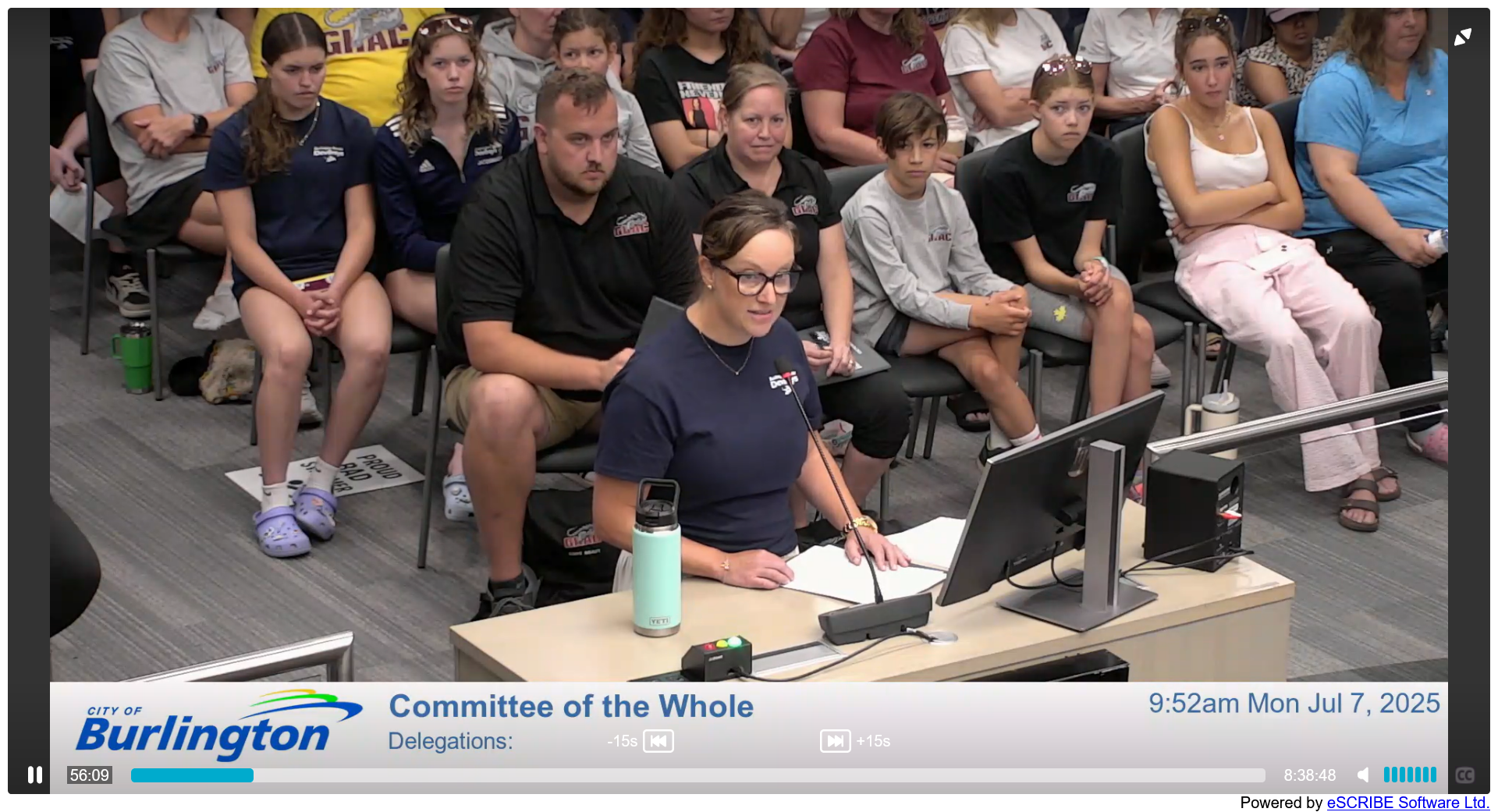
On July 7, Burlington City Council held its monthly Committee of the Whole meeting to discuss various items relevant to the city and its residents.
Several delegates from both the Burlington Aquatic Devilrays (BAD) and the Golden Horseshoe Aquatic Club (GHAC), both competitive swim clubs, spoke to council about the ongoing dispute between the two organizations about the Request for Proposal (RFP) process that was used to bid for swim time at City of Burlington pools. The successful RFP bid would get 2000 swim hours for their club members.
BAD’s RFP was never evaluated by staff due to missing documentation, and a contract was instead awarded to GHAC. Both BAD and GHAC are not-for-profit organizations, per the requirements for the RFP process.
Dr. Katie Lebel, a sports business professor at the University of Guelph’s Lang School of Business and Economics, former competitive swimmer, BAD vice president, and parent of a child who competes with BAD, delegated to council first.
“I’ve delivered talks around the world on the power of sport, but I’m not sure I’ve ever spoken with more at stake than I do today,” Lebel said. “What’s at risk isn’t just pool time. It’s community, continuity, and the systems we count on to support our children and protect what matters in civic life.”
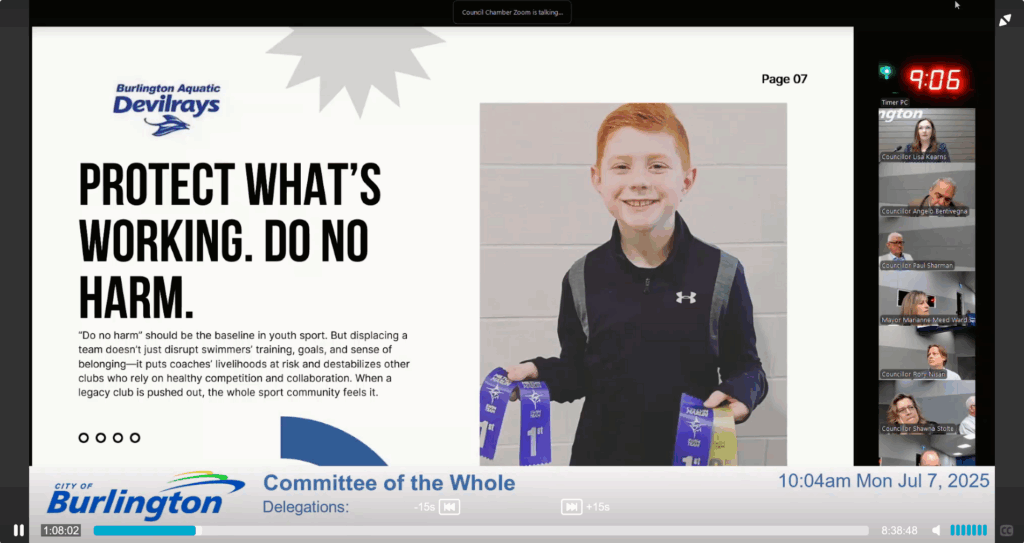
Lebel said that while the club did file for a judicial review after their proposal was rejected without evaluation, they have paused that process because they believe a “collaborative solution” is still possible.
“We’re not asking for special treatment,” Lebel said. “We’re here to advocate for fairness, for transparency, and for a shared use model that reflects Burlington’s values.”
Lebel said that the club serves over 400 swimmers from Burlington and its surrounding areas and has helped to fund diving blocks and timekeeping equipment at Nelson and Centennial pools. She also said BAD has raised money for the Terry Fox Foundation, the Burlington Food Bank, and the Compassion Society.
Lebel elaborated on why BAD’s proposal was rejected.
“That legacy and everything we’ve built was destabilized by a process that disqualified our proposal over a document that doesn’t exist in the form requested,” Lebel said. “The language in the RFP asked for a current and valid Certificate of Incorporation, a document that, in Ontario, is not reissued after initial incorporation.”
“What’s typically used to verify legal status is a Certificate of Status or a Corporation Profile Report from Service Ontario,” Lebel continued. “This technical ambiguity in language had real consequences. Our proposal was rejected outright without review. The result was not a level playing field. It’s a signal that the process, while well-intentioned, may not be aligned with the realities of youth sport.”
Lebel claimed that BAD “met every substantive expectation laid out in the RFP” and “has an impeccable track record as a responsible facility partner.”
“We were disqualified because these strengths could not even be considered or evaluated,” Lebel said.
Lebel questioned whether or not the RFP model was appropriate for evaluating youth sport delivery.
“It is not designed to capture the depth of community relationships, the values of consistency for youth, or the contribution of legacy volunteer-run organizations,” she said.
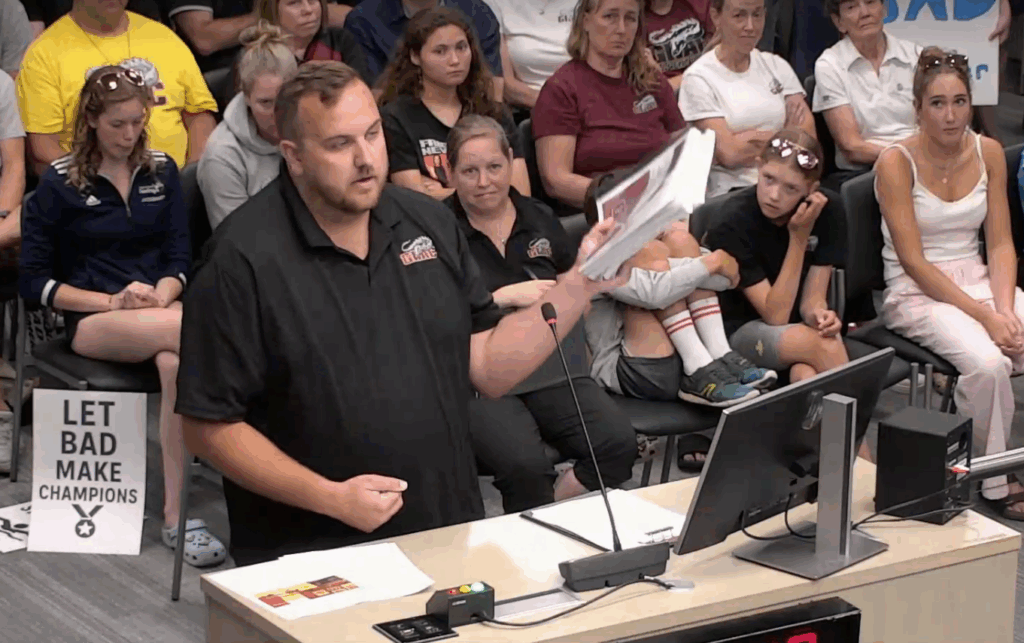
Cody Bradt, the chief operating officer and associate head coach of GHAC, also delegated to council and explained why the city initially adopted the RFP model in 2020.
“[It was] based on growing public need,” Bradt said. “According to the city, the overall demand for pool time has increased over the past four years, surpassing the city’s ability to meet all needs. There were over 600 people on the swim lesson waitlist in 2019 alone. Managing multiple user interests, needs, and expectations while attempting to maintain broad community access became exceedingly difficult. To meet that challenge, the city committed to rebalancing the mix of programming to ensure that the interests and needs of the broader community are met first, while still ensuring support for youth and master’s competitive swimming.”
Bradt defended the RFP process and stressed the need for decisions to be made by non-political actors.
“The RFP process was not only justified, it was essential,” Bradt said. “It was governed by clear and ethical standards as stated by Mayor Meed Ward on her website in 2020 when the initial competitive swimming youth RFP process launched. Purchasing decisions are best made on value for service, not political influence. It’s imperative that the process be administered by staff and continue to be fair and impartial in manner. The city’s procurement bylaw prohibits elected officials from engaging with or influencing the bid process.”
Lebel said that, to her knowledge, competitive swimming is the only youth stream in Burlington currently operating under an RFP process.
“That fact alone suggests we should stop and consider,” Lebel said.
Lebel said that since their proposal was rejected, there have been significant disruptions in the club, including many swimmers leaving for other organizations, and swimmers feeling uncertain about their future in the sport.
“This kind of disruption doesn’t just cause uncertainty, it risks pushing families out of our sport altogether,” Lebel said. “Some are now exploring new clubs in different cities, adding cost, travel, and logistical strain, especially for working families.” Volunteer staff are demoralized and coaches are “stuck in limbo,” she continued.
Bradt provided a more optimistic outlook on the situation.
“The reality is that the youth of Burlington are not losing their place to swim,” Bradt said. “They’re gaining a new opportunity to continue their development with a different organization if they so choose.”
Lebel spoke about what she called a “broader shift in how sport is being delivered across Canada.”
“Our club reflects a community model,” Lebel said. “Affordable, team-based, volunteer-run, and grounded in long-term athlete development. In contrast, we’re seeing the rise of market-based models and regional fee-for-service programs that function more like private providers than community-rooted teams.”
“This isn’t just about two swim teams,” Lebel continued. “It’s about two different visions for youth sport. One prioritizes access, development, and community. The other prioritizes flexibility, expansion, and the ability to scale, at a significantly higher cost to families.”
Lebel said that while she believes that there is room for both organizations to exist in the city, she said that “giving public pool time to a fee-for-service provider should never come at the expense of a long-standing, community-based club that’s served Burlington for more than 40 years.”
“That’s not innovation, that’s displacement,” Lebel said. She also warned that this situation may set a precedent for other Burlington organizations, such as Student Theatre and Teen Tour Band, to be excluded as well.
Bradt offered GHAC’s side of the story.
“The Golden Horseshoe Aquatic Club negotiated the contract in good faith with the understanding that the City of Burlington was also acting in good faith throughout the process,” Bradt said. “We trusted the integrity of the city’s procurement framework, and we continue to uphold our end of the agreement with the same level of professionalism, transparency, and commitment we bring to all of our partners.”
Bradt said that in February of this year, GHAC reached out to BAD to request a meeting to discuss jointly approaching the city to return to a shared-pool use model, which had been in place prior to 2020.
“This conversation included their head coach, their president, and their past president,” Bradt said. “However, the offer for the meeting was declined by their head coach. We respected that decision and informed them that, in light of that, we would be submitting a proposal, just as we did in 2020.”
Bradt said that if the city and council were to intervene in the RFP process, GHAC would still be open to having that conversation.
BAD has started a petition to reinstate their pool access, which has received over 2000 signatures.
Mayor Marianne Meed Ward asked Lebel if she had any advice for the city on crafting a different process to allocate pool time.
Lebel suggested a rental agreement, which is how the city allocated pool time and other resources prior to 2020.
“[With the RFP], there’s no weighting for community legacy, and I don’t think that it’s able to capture the difference between the community model and the market-based model that we’re starting to see show up,” Lebel said.
The club is willing to work with staff and other organizations that want pool time to sort the issue out for the 400 swimmers currently in BAD’s program. However, Lebel noted that if the process goes through as it stands, she is not sure the club will be able to continue to exist.
Kimberly Calderbank, BAD president, also delegated on behalf of the club and further elaborated on the RFP process.
“The city RFP was clear,” Calderbank said. “This contract should prioritize Burlington families. It asked applicants to demonstrate how they would deliver high-quality programming for our Burlington youth. Our club is already doing exactly that. We serve more than 320 Burlington swimmers across our competitive and pre-competitive programs. There are no projections. These are the kids who live here, who go to school here, and who have built a community here.”
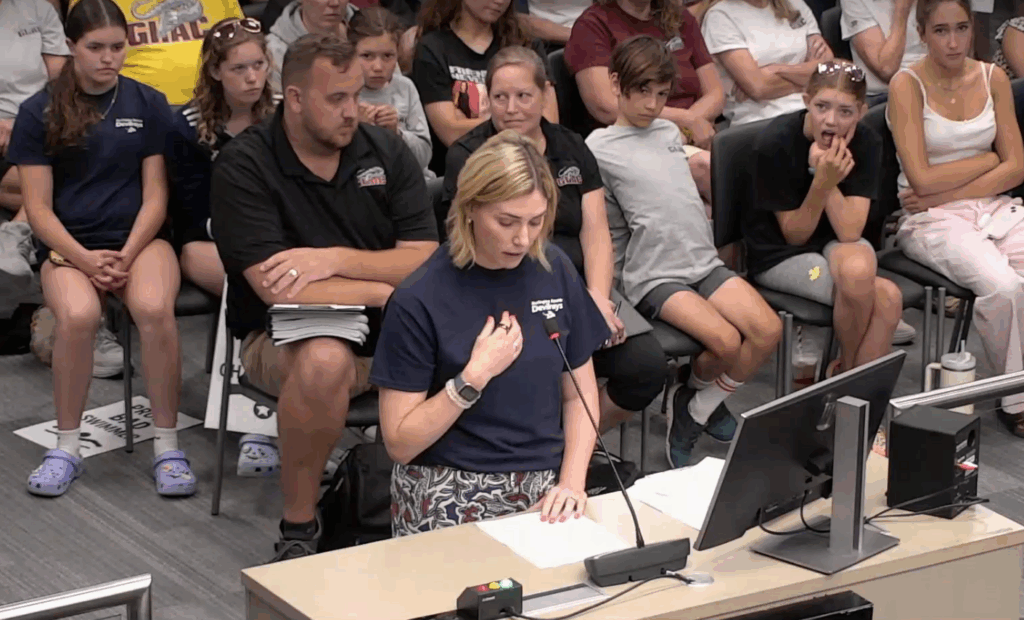
Calderbank said that GHAC is not Burlington-based and is listed as a Dundas club operating in the Hamilton region according to Ontario’s not-for-profit registry and Swim Ontario.
Bradt addressed this claim in his delegation.
“First and foremost, the Golden Horseshoe Aquatic Club is not a Hamilton club,” Bradt said. “We are proud to serve swimmers from across the entire Golden Horseshoe, including Burlington, Hamilton, Dundas, and Stoney Creek, and we’ve been a part of those communities for over 20 years.”
Bradt also addressed the criticism around the fact that only 28% of GHAC’s members reside in Burlington, as reported by Swim Ontario.
“This number reflects home addresses across our full membership,” Bradt said. “It does not reflect where swimmers train. Over 85% of swimmers training at our Burlington practice locations and private facilities are Burlington residents, and that figure has remained consistent.”
Calderbank also claimed that GHAC has not followed Swim Ontario’s standard process for regional expansion. Accordingly to Calderbank, BAD met with city staff before the meeting to discuss the situation.
BAD is currently asking the city for 40 hours of pool time per month so that they can continue to hold their swim meets, which Calderbank calls a “financial lifeline” for the club.
“With less than 40 hours, we’ll be forced to cut full training groups, turn away families, and potentially lose coaches who rely on consistent scheduling to sustain their livelihoods,” Calderbank said. “This threatens the viability of our club.”
BAD also wants the city to conduct a formal review of the RFP process with regard to how it is used to allocate youth sport resources.
Calderbank said that the RFP process resulted in 50 hours per month for GHAC and zero for BAD. Calderbank also said that BAD is losing swimmers every day to other clubs as a result of this decision. She said that any less than 50 hours means BAD will have to secure private pool time, and that they have been looking at those contingency plans.
Bradt also said that the city is not the only provider of pools.
“Alternative arrangements can be made by organizations to access pool time in non-city pools if they so choose. Also, swimmers will have the opportunity to join the chosen organization or continue to follow their organization to their alternate location if they so choose.”
Calderbank said that non-city pool time is hard to come by.
“There are not a lot of private pools here in Burlington,” Calderbank said. “There is not a lot of accessible pool time for us. So we went right down to looking at condos and apartments. We’re desperate to pull this together. It just doesn’t exist here in the City of Burlington.”
Calderbank said that without their facilities, BAD would no longer be viable as a club, whereas GHAC will “just become a bigger club with more pools to practice in.”
Bradt said that in 2020, they were on the losing end of the RFP process.
“[In 2020] we submitted a proposal and narrowly missed being selected,” Bradt said. “We respected the outcome and requested a formal debrief and used that feedback to improve our organization. Although we lost nearly 150 Burlington members that season, we remained committed to our mission and continued to provide high-quality programming outside of city-owned pools.”
“It’s also important to clarify that the incumbent organization did not lose their pool time,” Bradt continued. “They completed their contract term. The 2020 agreement was for three years with two possible one-year extensions, and it ran its full course.”
Calderbank said that after their proposal was rejected in the RFP process, BAD requested a review, and the city created a committee to do so. Many of the committee members were from departments of the city not related to youth sport, including those involved in parks and roads, as well as engineers, Calderbank noted.
In the closing of his delegation, Bradt further defended the RFP process and questioned whether or not the merits of why it was adopted in 2020 have changed.
“The city’s rationale for launching the RFP in 2020 remains valid today, if not more urgent, as there has not been a new pool built in the city yet,” Bradt said. “The population continues to grow. Yet here we are, facing public pressure not because the process was flawed, but because the unsuccessful bidder was simply louder this time. Has the standard shifted from the merit of the proposal to the volume of its protest?”
Bradt said that GHAC will not “engage in tearing down other organizations,” and will instead “focus on facts, solutions, and a commitment to putting the youth of Burlington first within the competitive use swimming contract.”
Ward 4 Councillor Shawna Stolte asked Bradt if he would agree that GHAC has benefited from an error in the administrative process.
Stolte said that if both proposals had been evaluated, this situation probably would have been avoided.
Bradt said that procurement is there to “protect the city, its taxpayers and its constituents,” and indicated that the city can’t simply overlook administrative errors.
July 10 saw a Special Meeting of Council that went into closed session on the potential litigation for aquatics procurement. Bradt delegated to council again and presented supplementary material that included a host of letters from GHAC swimmers’ parents, many from Burlington, testifying to GHAC’s strengths. Questions from councillors focused on the possibility of shared swim space, which Bradt was open to discussing further.
After the closed session, Meed Ward reported that council had “discussed and provided direction to staff on the confidential verbal update regarding aquatics procurement ADM-09-25,” and that council would update the community as soon as they had more information.