By Sydney Alexandra, Local Journalism Initiative Reporter
“Time is anything but a line. It’s a helix, a spiral — generations building a collection through generations of makers, scholars, and curators who have been in this space,” says the Art Gallery of Burlington’s Artistic Director and Curator Suzanne Carte.
Carte uses this idea of non-linearity to describe the organic evolution of the Art Gallery of Burlington’s (AGB) permanent collection. With its latest exhibition, “A Curve, Not a Line,” the gallery invites audiences to step into a reimagined version of its 50-year legacy.
“A collection is built not only by makers but by scholars and curators who have contributed to this space,” Carte explains. “To think it was built from point A to point B negates all the work that happens in between, the relearning we can do from the objects, the artists, and the many individuals who have donated their time and energy to telling stories.”
Over the past five decades, the AGB has become a national leader in contemporary ceramics, now home to over 4,000 pieces. But Carte, who joined the gallery in 2019, sought to uncover the personal, communal, and emotional narratives behind each object. She approached the collection as a listener, collaborator, and storyteller.
“It takes a full team to do this,” she says. “Our collections manager teaches me so much. And physically handling these works during the installation gave me a bodily experience of the collection, a privilege, especially when considering objects that were meant to be touched, used, brought to your lips, sat on, or stood on. Holding them with my white glass gloves, this space is a privilege I’m acutely aware of. For me, the learning happens through tactility and experience, rather than reading.”
Carte spent time in the vault, understanding the collection’s depth and its weight — literally and metaphorically. “The title ‘A Curve, Not a Line’ speaks to the idea that collections don’t develop in straight paths,” she says. “They loop back. They spiral. They shift depending on who’s telling the story.”
Rejecting a chronological or medium-specific structure, Carte drew inspiration from a moving exhibition she once saw at the Brooklyn Museum, curated by a director retiring after decades of service.
“He picked all his favourite works; they were his legacy, and he put them all together in one room. As an audience member, I thought, ‘What is even happening here? This is bonkers. No curator would ever throw all this together.’ But once I understood the intention, it was so touching and joyous.”
She wanted to channel that spirit: to focus not just on aesthetics, but on the totality of the collection.
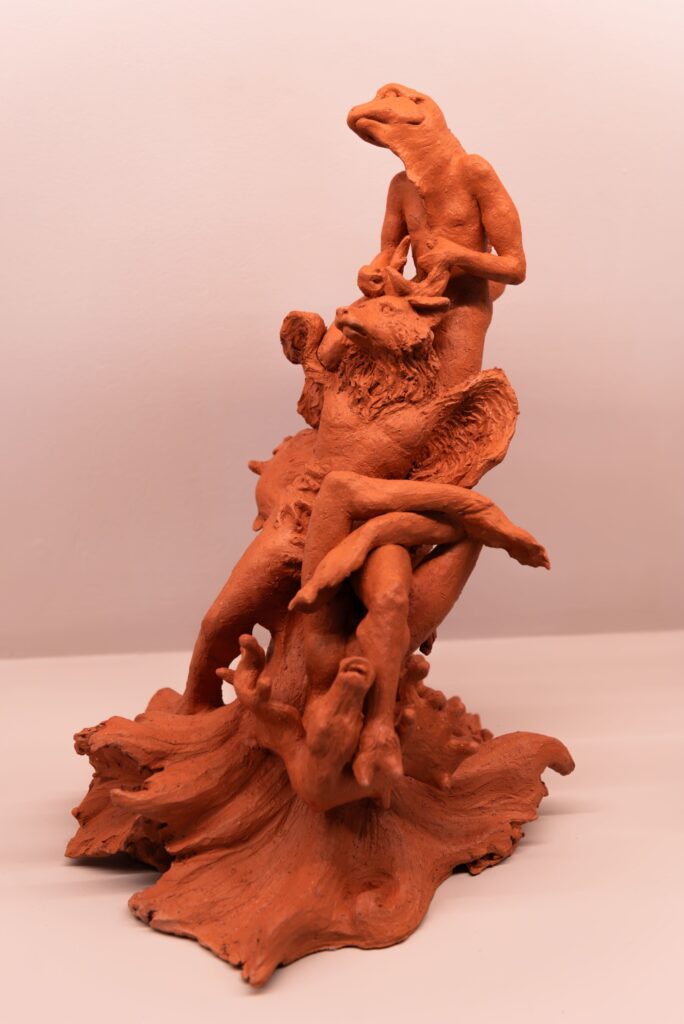
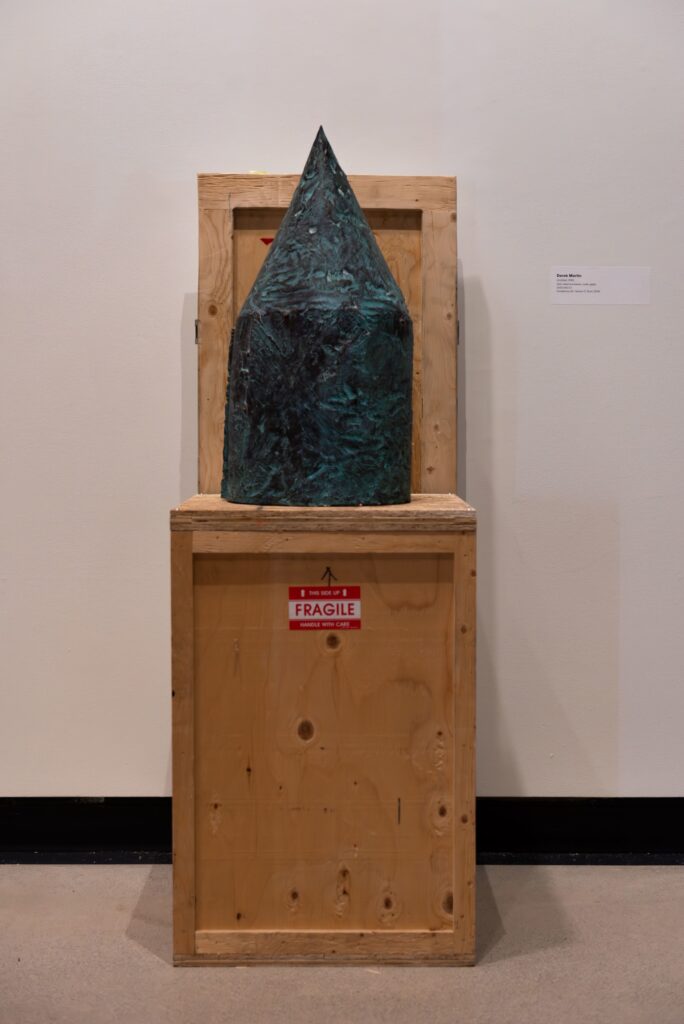
“We have works that are brilliant demonstrations of ancestral techniques, pieces made with different clay bodies, sculptural forms, whimsical, and functional alike. It was important to look at the whole picture,” Carte says. “And to invite a team to help choose what they found meaning in.”
That sense of collectivity echoes the spirit of community gatherings like Culture Jam, which Carte recalls fondly. “It’s that feeling you understand, the heart. And this is the heart, right? The art. The ability to bring people together and find deeper meaning in these pieces. Not just looking at them, but seeing into them.”
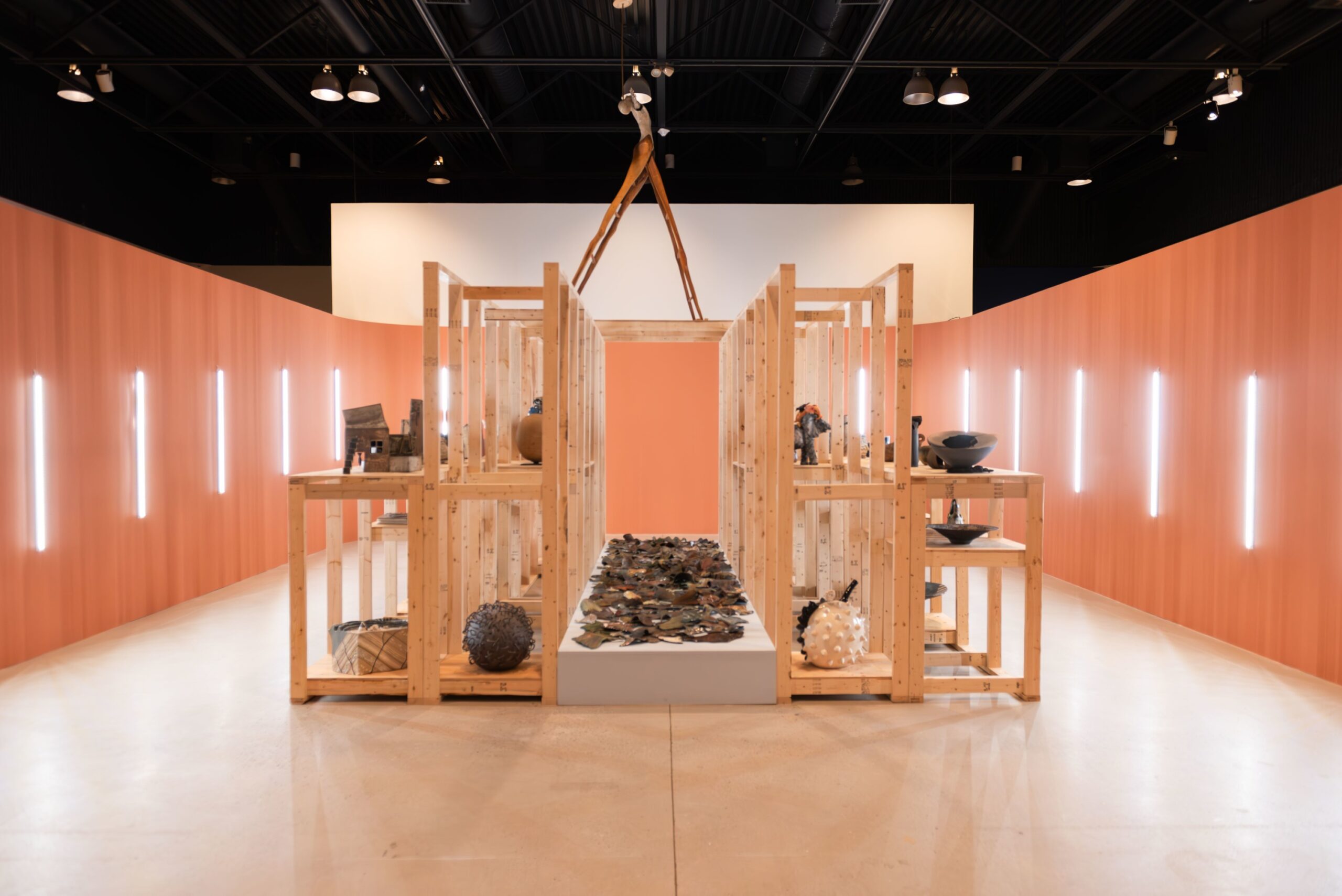
Carte organized the exhibition thematically around gestures and experiences: words and movements that come from the body and emotions.
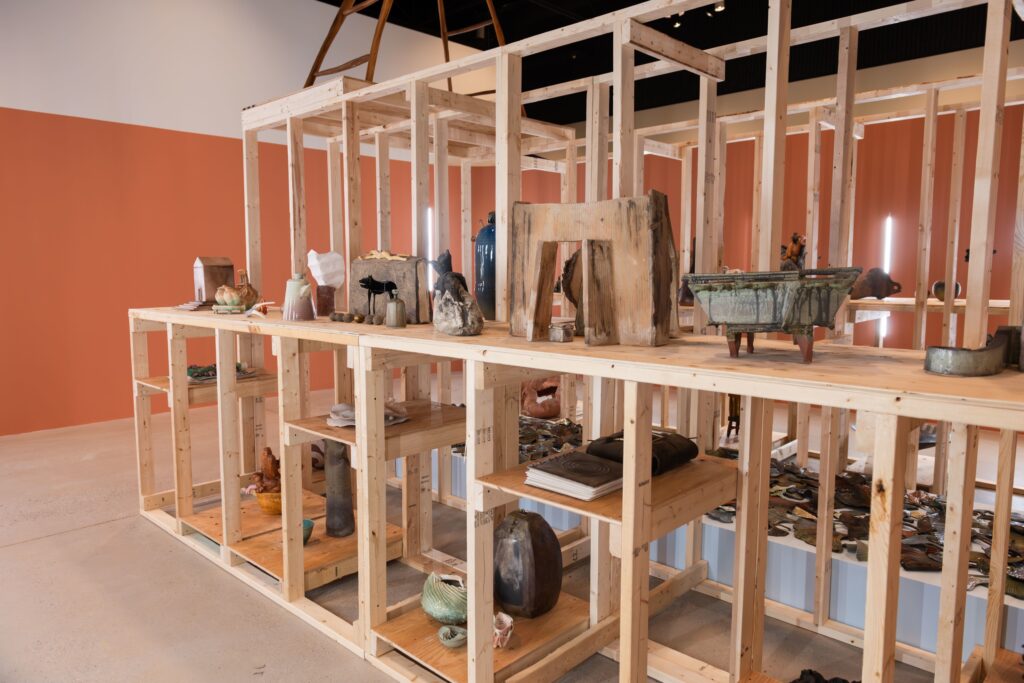
Across several gallery rooms, more than 200 works are displayed in clusters. Ceramics are suspended from ceilings, embedded into floors, and placed at unexpected heights, inviting viewers to crouch, stretch, and move.
“I wanted to create an embodied experience,” she says. “To make people aware of their physical relationship to the objects.”
She also dismantled traditional curatorial hierarchies by inviting staff from across departments, not just curatorial roles, to help select works and write exhibition texts.
“It brought so much life and a different lens to the collection,” Carte says. “We want everyone to feel like they belong in this space.”
This collaborative approach mirrors the collection’s evolution: shaped over time by artists, collectors, donors, curators, and community members.
“The idea of permanence suggests something fixed, but we want people to understand this collection is constantly evolving,” Carte says. “It responds to the times, to the people, to the questions we’re asking.”
That responsiveness is vital in a Canadian art context reckoning with exclusion and erasure. A Curve, Not a Line makes space for voices long marginalized in museum narratives.
“We’re thinking about what voices are missing, what makers have been underrepresented, and how we can ensure this is a collection for the future,” Carte says. “One that reflects the fullness of our communities.”
That future-oriented vision includes showcasing emerging, racialized, queer, and otherwise underrepresented artists. Carte is also committed to addressing Indigenous representation in the collection, currently at just 1%.
“Curating isn’t just about selecting and displaying objects,” she says. “It’s about listening. We need to reconcile with the fact that our collection includes only 1% Indigenous representation. And we’re talking about an art form as old as the Earth itself. It needs a greater connection to the land’s stewards and water protectors.”
Building that representation, she says, is a key priority, through Indigenous Shared Circles and new acquisitions that honour artists previously overlooked.
Carte’s reflective and inclusive approach has resonated widely. Artists are grateful to see their earlier works revisited. Visitors have commented on the warmth and accessibility of the show. And Carte herself remains moved.
“One of the most beautiful parts of this process was discovering how much care had gone into building this collection over the years,” she says. “Every piece has a story. Every story connects to someone.”
While the exhibition honours five decades of art and community, it also looks ahead. Carte hopes A Curve, Not a Line inspires visitors to consider the stories public collections can tell and the roles they can play in shaping them.
“This isn’t just about looking back,” she says. “It’s about imagining what comes next.”
As the AGB continues to evolve, Carte is committed to keeping the collection alive: growing, shifting, and shaped by many voices.
“We want to build something that reflects who we are,” she says. “Not just who we’ve been.”
A Curve, Not a Line is on view at the Art Gallery of Burlington through the fall. Visitors are encouraged to take their time, move with the curves, and listen closely, because in this space, every spiral has a story to tell.