By Jack Brittle, Local Journalism Initiative Reporter
On June 9, Burlington City Council held their monthly Committee of the Whole meeting to discuss various items relevant to the city and its residents. One of the items under discussion was the redevelopment of the Art Gallery of Burlington (AGB).
Emma Sankey, executive director of the Art Gallery of Burlington, delegated to the board to speak about the AGB’s Final Facility Master Plan and Future Needs Feasibility Study.
Sankey said the study “marks a key milestone in our redevelopment journey.” The report was subtitled “The Power of Place: Reimagining AGB for the Next Century,” and was authored by Lord Cultural Resources and Brooke McIlroy Architects.
Originally built in 1978, the AGB has undergone two expansions since then: in 1991, a second floor was added with two studio spaces, followed by another addition in 2001. The name has undergone similar changes, starting as the Burlington Cultural Centre, renamed in 1993 as the Burlington Arts Centre, and again in 2014 as the Art Gallery of Burlington. Now, 50 years after the Burlington Cultural Centre’s incorporation, the AGB is looking to the future with the report presented this week at the Committee of the Whole meeting.
The report includes preliminary plans for the new AGB facility concept, proposed site placement at their current location, public realm enhancements, and adjacent open spaces and trail connectivity.
“These plans are foundational to our future vision, supporting community access, cultural vibrancy, and long-term sustainability,” Sankey said.
The presentation stated that the planning process involved outreach to the Indigenous community, Arts Burlington guild members, City of Burlington representatives, and various external opinion leaders. Through these consultations, five core priorities were established: enhance openness, flexible and sustainable, maximize community impact, strengthen collaboration and design with nature.
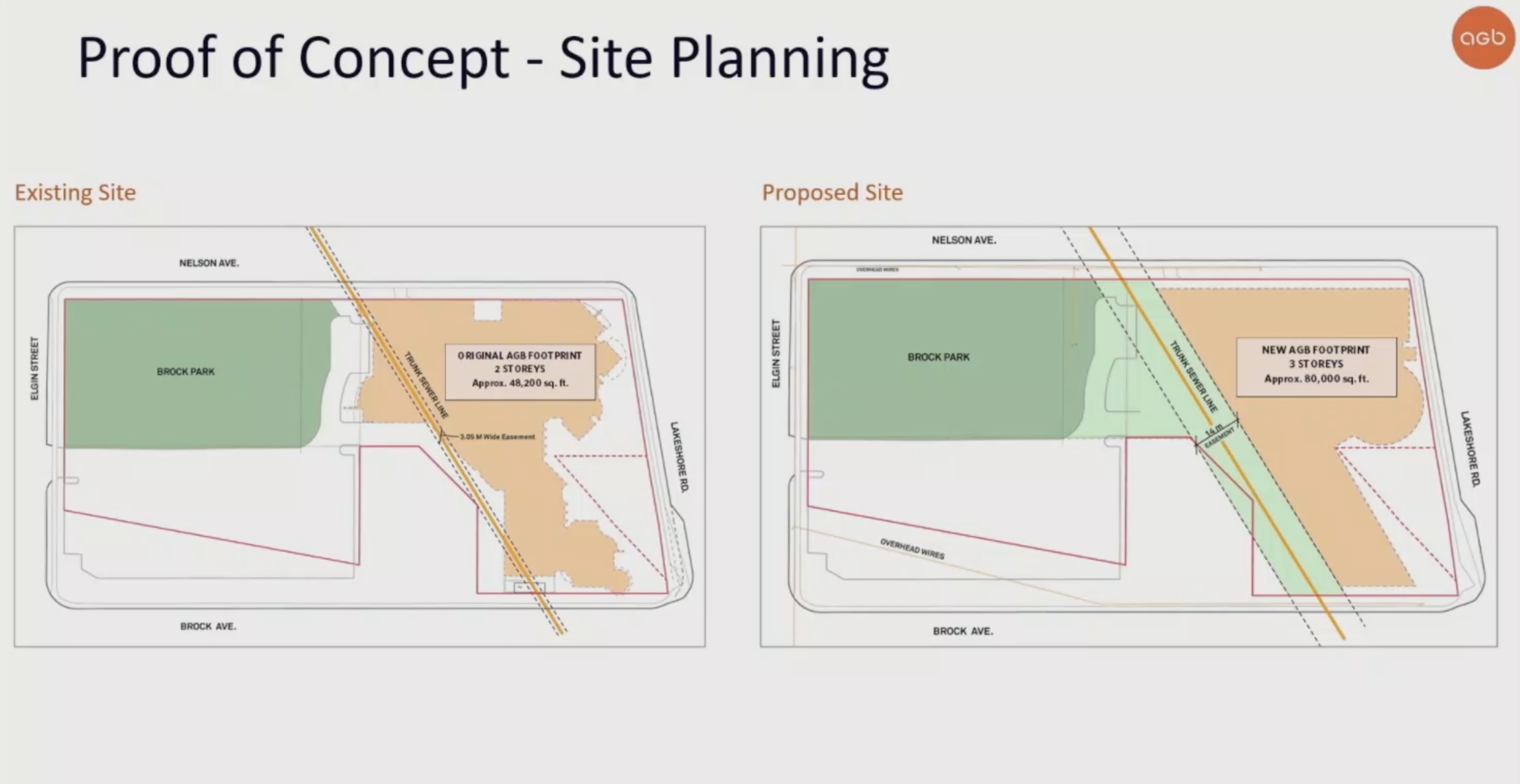
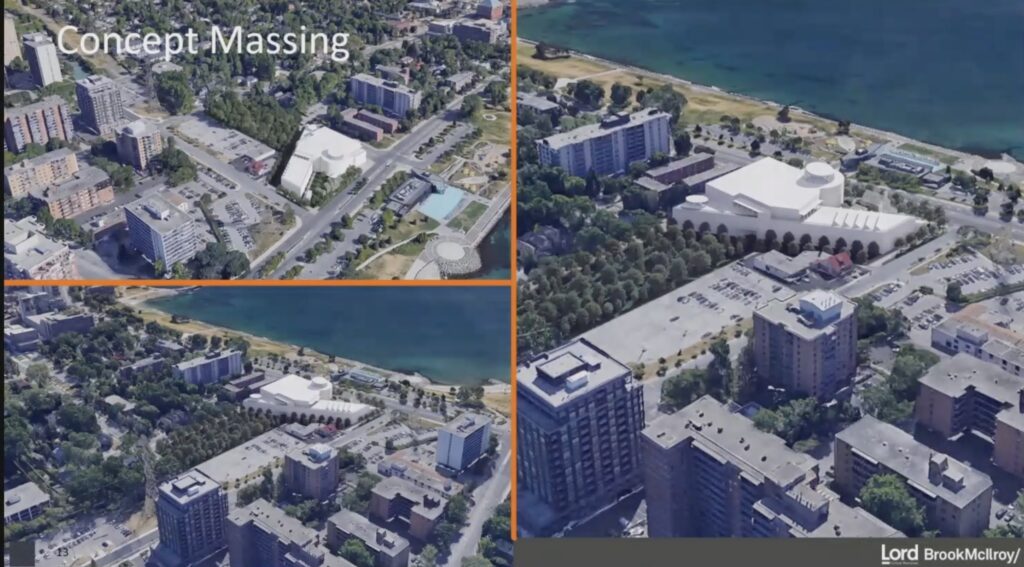
The redevelopment plan is based on the premise that a new gallery will be built where the current one stands, with a proposed size of 77,000 square feet. This would be an increase of about 29,000 square feet, or 60%, when compared to the current gallery.
According to the report, the new building will “expand public amenities” and “preserve craft maker/art studios.” The plan includes some reshaping of the building’s footprint, but not a major increase in its ground-level size; the primary expansion comes from the addition of a third storey.
Sankey spoke about why the decision was made to use the same site for the new building.
“There’s ample land for redevelopment,” Sankey said. “There is a proximity to major highways, which supports accessibility and visitor convenience. It aligns with the city’s goals for urban growth and redevelopment, and its location on the historic clay belt reinforces the gallery’s connection to material traditions and place-based identity.”
She also explained why a new building is necessary in the first place.
“The current building requires costly upgrades and could not easily meet modern gallery standards for collection care, and renovation is risky due to uncertainty around the underground trunk sewer,” Sankey said. “A new building would better utilize the site and enhance operational efficiencies overall.”
Sankey said that a bigger building is required to display the collections and attract major exhibitions. She also said that having a larger gallery to work with will ensure long-term sustainability through improved programming capacity, revenue generation, and adaptable design.
Sankey also touched on the Arts Burlington guilds’ role in the redevelopment.
“We must also rethink the relationship with the guilds, opening the door to new generations of makers while honouring the guilds’ legacy to create inclusive, flexible studio spaces that support a wide range of artists and community users while still sustaining the guilds’ creative presence,” Sankey explained.
According to Sankey, the current facility is significantly below industry standards when it comes to galleries, exhibits, and the exhibition and collection support areas. Sankey said that most galleries use 40% of their space for exhibitions, while the AGB only uses 13%.
“Space for support of exhibitions and collections should be at 20%, and we’re at 5[%],” Sankey said.
According to Sankey, the aim is for the AGB to be better suited for travelling exhibitions and eliminate competition for space between different facets of the gallery. While the current plan adheres to municipal boundaries, she indicated that the gallery would be open to exploring alternatives if council is interested.
The consultation determined that the proper 14-metre easement must be established over the major trunk sewer, which currently runs underneath the Lee-Chin Family Gallery and the pottery and ceramic studios.
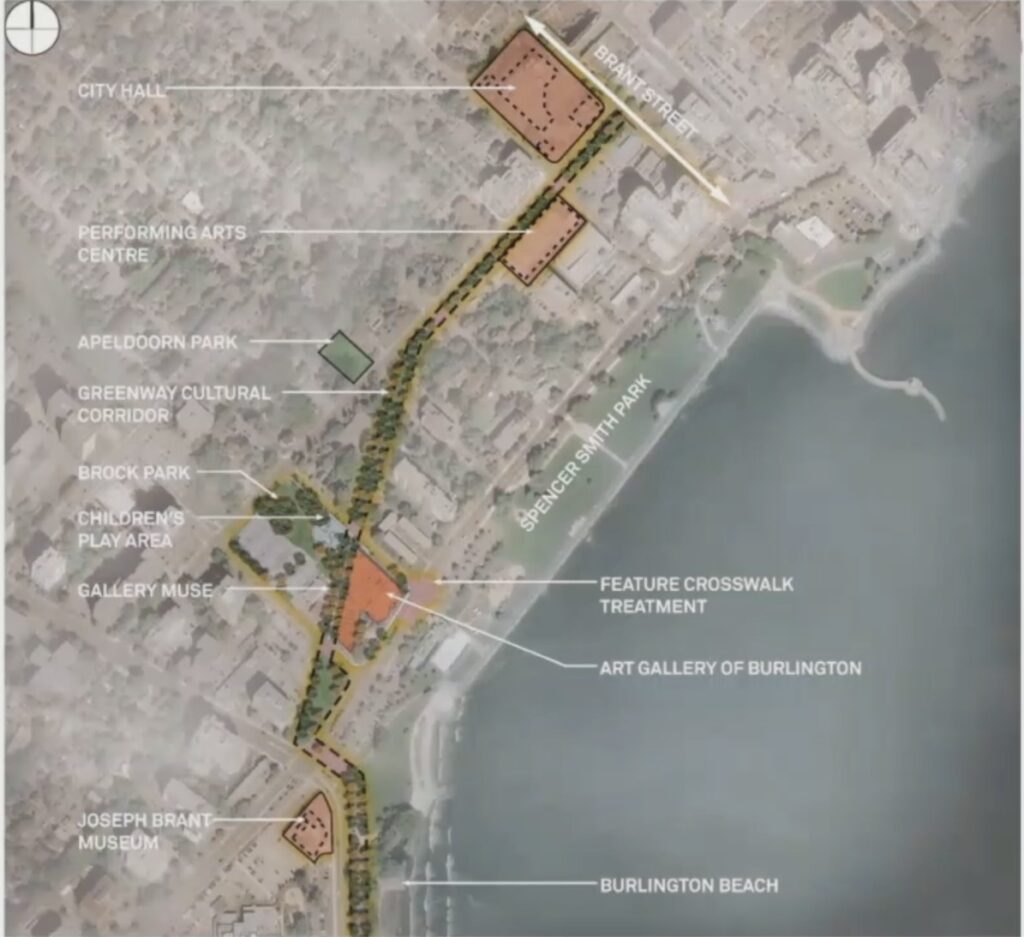
Sankey highlighted that the new building plan would increase green space by 59% and expand public access across the site. It proposes a new Greenway Cultural Corridor, which the presentation slide described as “a continuous pedestrian-friendly link from Burlington Beach through Spencer Smith Park, past the Art Gallery of Burlington and Gallery Muse, and onward through Brock and Apeldoorn Parks to City Hall.” A children’s play area was also labelled on the slide, located between Brock Park and the AGB (see image below).
The total project is estimated to cost approximately $116,380,000, of which $111,380,000 are facility construction costs, and $5,000,000 are allocated for demolition of the existing structure.
Shawna Stolte, Ward 4 councillor and deputy mayor for housing, asked whether housing opportunities could be considered, “given the fact that there’s a lot of conversation in the housing strategy about ensuring that any city-owned land includes housing from here forward.”
In response, Sankey noted that the consultants looked at potential mixed uses of the site, but that the decision lies with council to decide if that is a direction they want to pursue.
The AGB board adopted the plan following its presentation to council and will institute a Design and Development Committee to oversee the next phase and develop the project plan.