By Emily R. Zarevich, Local Journalism Initiative Reporter
The first-ever opera house, Teatro San Cassiano, was opened in Venice, Italy, on May 6, 1637. Since then, resplendent opera houses have appeared all around the world in major cities as part of their campaigns to be successful cultural centres of the world. These are facts that were put forward by Sabatino Vacca, the artistic director and founder of the Southern Ontario Lyric Opera (otherwise known as SOLO) at the Burlington Central Library last week. On Thursday, April 17, 2025, at 7:00 p.m., Vacca participated in Burlington’s Lyrics and Poetry Festival by delivering a gripping lecture that emphasized what makes an opera most memorable besides the setting in which it is performed: the lyrics sung by the performers.
There is boundless significance in what the characters in an opera have to say. There is Mimi’s pluck and kindness in the face of poverty in Puccini’s La Bohème. There is Violetta’s Earth-shattering romantic passion in Verdi’s La Traviata. There is Carmen’s boldness and societal defiance in Bizet’s Carmen. And there is the mournfulness of Cio-Cio-San in Madama Butterfly, also by Puccini. How do any of these fictional stars’ personalities shine through on the stage without the proper lyrics? That is the question that Vacca put forward in his hour-and-a-half address to the opera enthusiasts of Burlington during his slotted event.
Vacca, who has been the artistic director of SOLO since its startup in the fall of 2015, encouraged his listeners to share his profound appreciation for the unsung heroes of the opera world, the librettists — or the text/script writers — who collaborate closely with the composers to make an opera manifest. Amadeus Mozart, Vacca informed his audience, may have whipped up the music for The Magic Flute, but he didn’t write the libretto for it. That was done by Emanuel Schikaneder, one of the greatest German theatre talents of eighteenth-century Europe. But how many people in our modern age even remember Schikaneder’s name? Mozart is a household name, while Schikaneder’s is often only remembered in passing by students of music. Librettists are due their long-delayed recognition for their contributions to the canon.
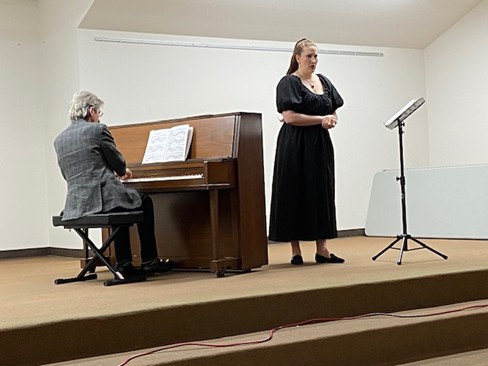
To emphasize his point on the reverberating power of opera lyrics, Vacca performed as the pianist on the Centennial Hall stage with mezzo-soprano Stephanie Yelovich, who is notable for performing as Alisa in SOLO’s recent production of Donizetti’s Lucia di Lammermoor. Yelovich, whose powerful voice was complemented by her expressive acting and assured presence, sang “Mon Coeur s’ouvre a ta voix” from Samson et Dalila by Camille Saint-Saens, and “Va! Laisse couler mes larmes” from Werther by Jules Massenet.
Both songs, Vacca explained to the audience, are momentous for being sung at turning points in their respective operas’ plotlines, and for moving forward character development and motivation. The aria from Samson and Delilah in particular is the critical checkpoint of Delilah’s seduction of Samson, in preparation for sabotaging his famous heroic strength. Yelovich spoke afterwards about the challenges and rewards of learning opera lyrics in different languages for her work, and how close studies of the lyrics in their most original forms help get their meaning across when she sings.
Following his lecture and his performance with Yelovich, Vacca agreed to speak further about the role that opera lyrics play in the world’s most revered masterpieces. Many of the storylines in operas are based on pre-existing poems, novels, or transcribed myths by other authors. La Bohème, for example, was inspired by French writer Henri Murger’s tales of bohemian Parisian existence in the nineteenth century, Scènes de la vie de bohème. Carmen is based on a novella by Prosper Mérimée. The tale of Lucia di Lammermoor comes from Scottish writer Sir Walter Scott’s novel The Bride of Lammermoor. Opera and literature are sister genres. Librettists often have to make creative choices on whether to stay completely true to the source material or take their own artistic liberties.
When asked if an individual requires extensive knowledge of literature before they can really enjoy opera, Vacca responded, “Not necessarily. I think opera speaks for itself, though if you do have a wider sort of knowledge base, maybe you are taking in more information. The more you know, the more the background, the understanding of the language, the text, the music, and the orchestration all play into how much enjoyment you can potentially get out of it. But even if you don’t have that wide background, opera is still a powerful experience.”
“There are schools of thought that divide music into program music or pure music that doesn’t necessarily have a program that goes along with it,” Vacca continued. “But you can still imagine that there is a drama within the piece itself, especially between the instruments. There’s a lot of tension and release, tension and release. It goes somewhere and it finishes somewhere. It’s a journey. It’s a story.”
And the stories continue as long as there are opera singers to perform and opera houses (or equally suitable theatres) to perform in. The Southern Ontario Lyric Opera invites the people of Burlington and beyond to attend their next performance scheduled at the Burlington Performing Arts Centre. This will be “Encore, An Evening With Gino Quilico,” on Saturday, May 10, 2025, at 7:30 p.m. Tickets can be purchased here. The evening promises to be an elegant affair with a well-seasoned star. Quilico has previously performed in global opera landmarks such as The Met, La Scala, and Vienna State Opera. As part of the initiative to keep opera thriving in Burlington, ticket prices have been reduced to a bargain of $25.
Anyone who has their own talent and appreciation for lyric composition is encouraged to attend the Lyrics and Poetry Open Mic Night, which will take place at Central Library in the Centennial Hall on Wednesday, April 30, 2025. The library welcomes poets/performers as well as listeners to participate in this celebration of fresh, new poetry. This will be the last event of the Burlington Lyrics and Poetry Festival this April.