
By Maisha Hasan, Local Journalism Initiative Reporter
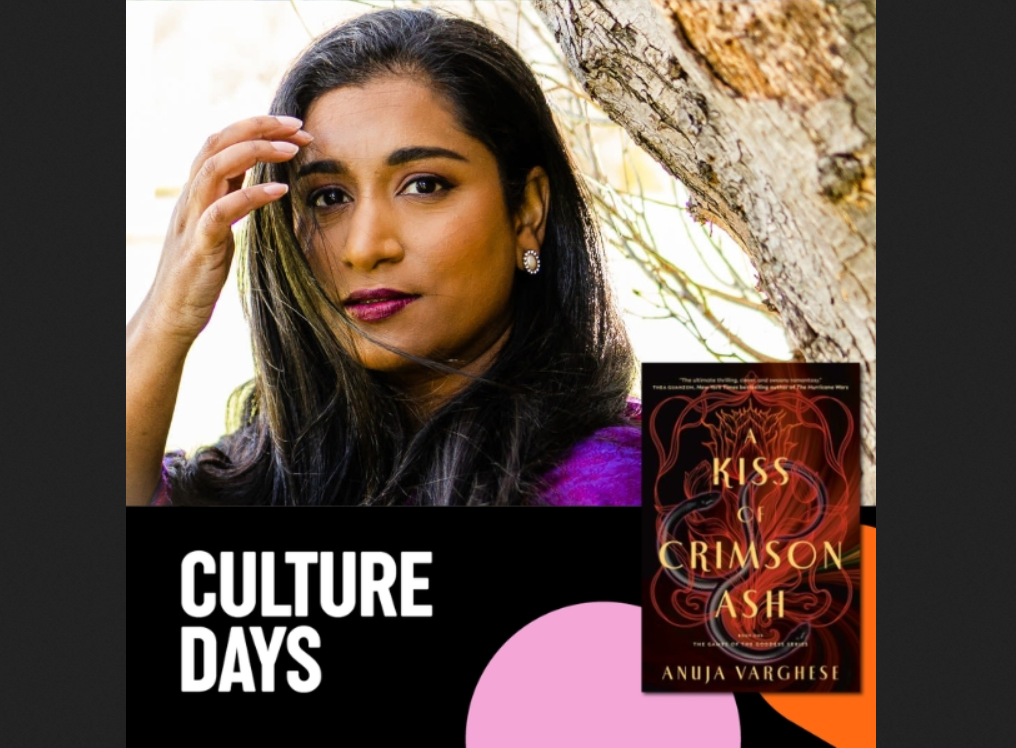
After binge-watching Bollywood films and playing Dungeons & Dragons, Hamilton-based author Anuja Varghese melded the two influences into her newest book, A Kiss of Crimson Ash, the first in a trilogy centred on three couples in a medieval India-inspired fantasy setting.
Varghese will speak at Burlington Public Library about her new novel on September 24 as part of its Culture Days programming, with registration now open.
Varghese previously wrote the Governor General’s Literary Award-winner, Chrysalis, a collection of short stories that centre the experiences of women of colour. While that was out on submission, she started drafting A Kiss of Crimson Ash, not expecting it to go beyond a therapeutic exercise.
“I was in this place of being very sad,” Varghese explained. To combat her mood, she wanted to write something that felt “very fun and sexy,” she said.
“I wasn’t planning for it to be a trilogy. I was really just writing it for my own fun and enjoyment, which I think says something about the kinds of things that take off, right? When you’re not writing with any sense of pressure or expectation, it’s just coming from a place of pure fun and what’s driving you creatively and sparking your imagination,” Varghese said.
Films like Devdas, a Bollywood melodrama featuring grand sets and costumes, inspired the world Varghese created in her book, but less so the romances. The romantic interludes in A Kiss of Crimson Ash do not shy away from sex and desire.
“I was really looking for something that centred brown women and queer characters and had a little bit of a higher spice level to it because [South Asian women] so often get the super slow burns or like no spice. I really wanted to see that. I couldn’t find it. So I wrote it,” Varghese said.
The book was first conceived as a standalone, but after Varghese showed it to her agent, they encouraged her to write a series.
Moving from short stories to a trilogy was quite a departure for Varghese, requiring her to build a much larger world while carrying multiple narratives and storylines.
“It is a fully fantasy world, not historical fiction, but it is a world based on the real-life Vijayanagara Empire,” Varghese explained. The Vijayanagara Empire ruled much of South India from the 14th to the mid-17th century.
“My partner and I went down this research rabbit hole of ‘What was the food like? What were the palaces like? What were the clothes like? What were the weapons like? What kind of things were they importing, exporting?’ There’s all these little tiny kingdoms kind of fighting each other…a lot of it got thrown into the book, and hopefully, that helps make it feel real and lived in,” Varghese said.
In the book, when the fictional city of Nandapore is in trouble, an ancient goddess seeks the help of the four main characters — Taara, the newly crowned queen of Abhaya; Garjan, her betrothed and the prince of Nandapore; Bhediya, his magical mistress; and Roland, a rogue thief. There’s also another love interest for Taara, a woman named Payal.
The characters and storylines create a carefully tangled web, requiring Varghese to consider how each fits into the larger story.
It was interesting, Varghese said, “to play with how all these different roles fit in. How do they come together to fight a common enemy?”
“The one that felt most important to get right for me was Taara and Payal. That central sapphic romance is the main one. We just see so little representation of sapphic romance, of brown women, queer brown love, and especially where it’s not from a place of trauma,” Varghese noted.
It was important that the women in this story had some sort of agency and power. Bhediya has worked as a courtesan for twenty years by choice, without the character’s backstory being rooted in trauma.
“It was [an active] choice to make that her role because so often we see if there are women in sex work positions, it’s often from a place of victimhood or trauma…I didn’t want that victimhood or trauma to be part of really any of the women in the book,” Varghese said.
Both Garjan and Taara have real sources of power, helping drive the story along.
“The goddess is a feminine energy, overarching everything happening in the book. Including physical desire, romantic desire, and then also [how women] get to move the story forward and aren’t sort of victims of circumstance, or how it’s the men battling it out with dragons or whatever. I think that sense of giving the women that real main character energy and giving them that power was really important in this book,” Varghese said.
Women’s actions, and especially their desire, are put at the forefront of this book. The romantasy genre (a portmanteau of “romance” and “fantasy”) can give women the ability to explore what desire means on their own terms in stories that value them.
Varghese noted that people sometimes think of romantasy as “fairy smut or whatever,” but there is much more to it.
“Realistically, you might have twenty pages of the smut — and we love the smut! Don’t get me wrong! — but then you have four hundred pages of this incredible world-building and beautiful character development and banter and magic political intrigue,” Varghese explained. “These powerful women are triumphing over oppressive systems.”
Already, Varghese has found that her new novel is making an impact on readers.
“It’s bringing communities of women and readers together. I’m just starting to go to some of these [book events], and they’re a huge deal. To be in a room full of women readers and we’re all talking about the same thing, and we all love the same thing, it’s just creating such a sense of empowerment and community and joy,” Varghese described.
Varghese is still writing the next two books, but has a pretty good idea of how things will play out.
“For book two, things get a bit dark, as sometimes sequels get, because it has to get dark before we find our way back to the light. [But] if readers were to decide book one is great, they’re done with the series, [they] can read it as kind of a standalone. Hopefully, if you do want more of the world, we do continue on to see what happens to these characters moving forward,” Varghese said.