By Maisha Hasan, Local Journalism Initiative Reporter
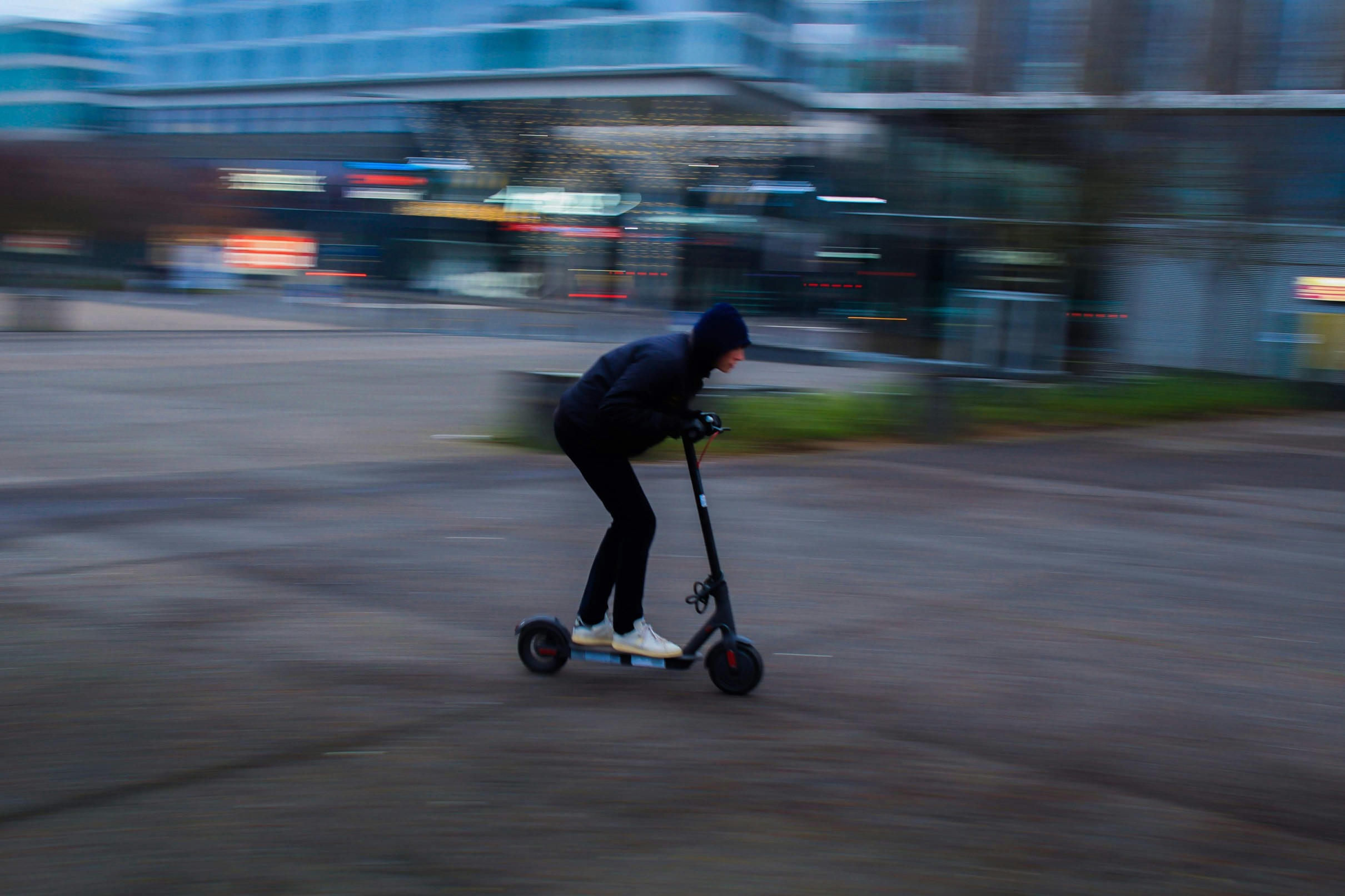
It’s a scene that has become familiar in Burlington’s landscape — akin to our charming stores and lakeside view. Four teenagers gather on the corner of Guelph Line and South Service Road, brought there by their electric scooters. Unlike our charming stores and lakeside views, e-scooters have stirred mixed feelings within the city.
Andy Garbas has been living in the Palmer neighbourhood for 25 years. He has witnessed bicycles, a brief quarantine revival of longboards, as well as hoverboards that now gather dust in basements in the technology graveyard next to Roombas.
Of course, e-scooters have been around for the better part of a decade, but it is only really in the last year and a half that Garbas has seen the uptick.
“I was headed over to the grocery store, and lo and behold, these three boys were doing wheelies down Upper Middle, not obeying any of the road or traffic signs,” Garbas said.
The cheapest regularly priced e-scooter sold at Canadian Tire is nearly $300. For a high school student working 20 hours a week at a job paying minimum wage, that amounts to about a week’s gross wages.
It isn’t simply the increase in e-scooter purchases that seems to be an issue, but the broader context of Burlington’s transportation system, Garbas points out.
“We’ve set up what I think is a system meant to fail…it’s the combination of the perfect storm. You got people already frustrated because if there were no e-bikes, you’re still having commutes that are excessively long for short distances,” he said.
Garbas, who runs his own electrical company, worked in a bicycle shop in his youth, but that doesn’t convince him that e-scooters should be legal — at the very least, he proposes a licensing process, similar to how people needed pedal licences in the fifties.
“It’s only, in my opinion, a matter of time before something really serious happens,” Garbas said.
Garbas is not the only person worried about the risk that comes with e-scooters: residents have brought their concerns to City Hall.
Just last month, Burlington council endorsed a motion calling for a coordinated, multi-agency approach to e-scooter safety. The motion includes requests for provincial review of existing regulations and licensing, standardized data on collisions and injuries, stronger point-of-sale education, and clearer municipal rules and enforcement across Halton. The issue is also relevant to the city’s ongoing Vision Zero Action Plan, which will guide future road safety investments, policies and programs, including those affecting people who use micromobility devices.
Under provincial regulations and municipal restrictions outlined by the Halton Regional Police, e-scooter riders must be at least 16 years old, with those aged 16 and 17 being required to wear helmets.
Even then, e-scooters are permitted only on Burlington’s Centennial Trail and are prohibited elsewhere in the city. Milton, Oakville, and Halton Hills prohibit their use in public spaces — they are permitted on private property — although the restrictions don’t appear to deter all users.
The Halton Regional Police have even put out videos aimed at letting e-scooter riders know that failure to follow rules can result in being charged.
The legal consequences of riding e-scooters are not the only risk, of course: accidents, injury, and even insurance claims are also possibilities. In a TikTok video, lawyer Matt Lalande shared his legal knowledge on the rising trend of e-scooter riding in Halton.
In the short clip, he explains the unforeseen consequences if a minor under the age of 16 were in an accident.
“A child is not held to the same standard as an adult…they would be able to sue, but parents [should be] ready for a counter-suit for negligent parenting.”
It is easy for the debate to end there, with e-scooters cast as dangerous, unregulated disasters, but concerns about e-scooter safety will not keep all riders off of them. On the other side, e-scooters offer relatively inexpensive and easy transportation compared to car ownership, with the licensing, upkeep, fuel, and insurance costs that come with it.
For some, e-scooters offer freedom.
Dr. Léa Ravensbergen, an assistant professor at McMaster University who specializes in sustainable cities and transport research, is well acquainted with the challenges of car-oriented urban environments. She grew up on a farm where going from here to there was as wide a stretch as the fences between properties. When she moved to Montreal in adulthood, the bus pass and cycling culture sparked a passion for micro-mobility.
“When you design your city for cars, by design, you’re excluding pretty big sections of the population who don’t have access to a car,” Ravensbergen said.
“Just because you have a driver’s licence doesn’t mean you can afford to own and maintain a car…most kids don’t,” Ravensbergen said.
But getting from point A to point B is still necessary, regardless of age.
“They want to meet their daily travel needs. They want to see their friends. They want to go out and do stuff. They want to get to jobs. That is a really important part of being a young person, developing that independence,” Ravensbergen noted.
Public transportation isn’t entirely reliable in most cities, not just Burlington. And if the buses are running forty minutes late, people may need to find other means of transportation.
The discourse around young people endangering the city or getting into accidents is rooted in victim blaming, Ravensbergen claimed. What is not helpful, she said, is “telling these [young people] that they are putting themselves in danger instead of what could be done so that they could use their scooters more safely.”
Safety campaigns often focus on not wearing black clothing at night or looking at phones while riding e-scooters.
“This emphasis is really on the person that’s getting hurt and what they need to do to change their behaviours, rarely about the fact that we live in a society where if you wear black at night, you might get killed because it’s so dangerous… people don’t deserve to get hit and killed just because they’re riding an e-scooter,” Ravensbergen said.
Focusing discussions on the dangers of riding e-scooters does not lead to productive dialogue with their users.
“It kind of reads ‘off,’ as older people being annoyed at kids,” is what Haniya Moid said of this type of risk- and rider-behaviour-focused conversation.
Moid is a senior who attends Dr. Frank J. Hayden Secondary School, where scattered across the parking lot are starter cars and e-scooters. She herself is the owner of the latter.
Her father purchased it for her on a whim over a year ago, but it has proved to be quite useful.
“It’s mainly for convenience; I wouldn’t say I would want to go far…I can’t see why I would take out my car, get it out of parking, to get something from the plaza. I would want to experience going outside rather than just going in a car really quickly,” Moid said.
She admits she only has her G1 driver’s licence, attributing it to time better spent studying.
And Moid isn’t the only teenager who prefers a smaller set of wheels.
“More than half [of the school] has e-scooters or e-bikes…you just see them piling up more, rather than regular bikes at this point,” Moid said.
That’s why the debate about e-scooters confuses her more than it angers her.
“I’ve been around a lot of people who use it, and I’ve used it myself, and I would just assume it’s how someone treats hoverboards when they were a thing… I’d say that [the fear of accidents] could be the same principle about car crashes,” Moid said.
Even if stricter regulations are passed early next year, she doubts they can be thoroughly enforced.
“Not many police are roaming around [schools and parks], and there aren’t many people who will stop you,” Moid said.
For now, there seems to be no end in sight for e-scooters in Burlington. That is, until winter freezes the streets and sidewalks, a new transportation trend comes along, or the e-scooter turns the corner and disappears from view.