By Chloe Teixeira, Local Journalism Initiative Reporter
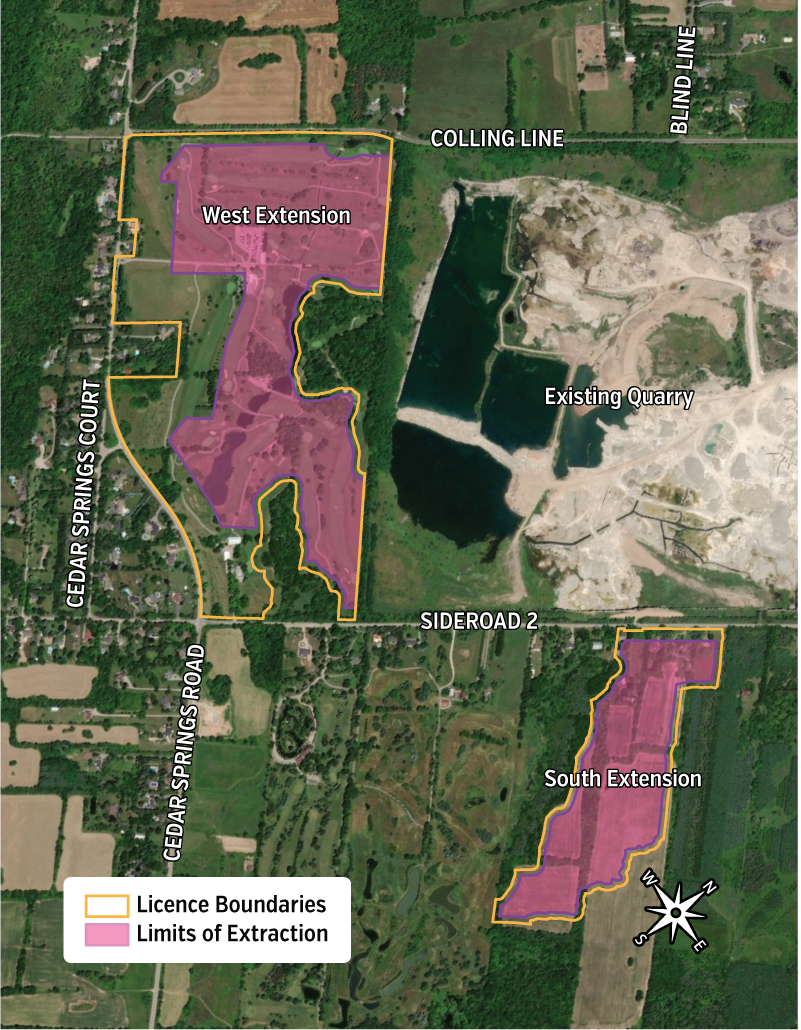
On August 18, the Ontario Land Tribunal (OLT), which adjudicates matters related to land use planning, approved the expansion of Nelson Aggregates’ quarry operations in Burlington.
The company’s Burlington site is located on the Mount Nemo Plateau section of the Niagara Escarpment, where it operates a quarry. Nelson’s website states that, in Burlington, “We provide high quality limestone aggregate for all ranges of products from home and landscape construction to road construction including asphalt/concrete plants.”
History of Nelson Aggregates’ Burlington operations
As stated in a 2012 municipal government document, Nelson Aggregates’ quarry has been operating in Burlington since 1953 under its former owner. Under Nelson, operations have been ongoing since 1983.
The company first filed an application to expand its quarry in 2004, which was then revised in 2006 and 2008. This application sought to amend the Regional Official Plan, “in order to re-designate lands and permit expansion to the south of the quarry,” according to the Halton government website.
The website further states that in 2009, “Regional Council did not support the Regional Official Plan Amendment application and advised the Joint Board,” who denied the application in a 2012 hearing.
All parties who commented during preliminary hearings were in opposition to Nelson, according to the document.
Nelson’s earlier applications were denied due to concerns about threats to the environment, including the endangered Jefferson salamander. The proposal did not meet certain policies or align with objectives from the Niagara Escarpment Planning and Development Act (NEDPA).
Their recent application was approved, as stated in the document on the OLT’s decision, because Nelson has “satisfactorily responded to the concerns raised by the City, the Region, and CORE/PERL.”
These concerns, as stated in the document, are related to ground and surface water, protection of natural heritage features, mitigation of fugitive dust, and safety concerns around blasting and flyrock.
“The Tribunal finds that the expansion of the Burlington Quarry represents a wise use of mineral aggregate resources and represents a balancing of public interest.”
Concerns about quarries and the expansion
The expansion has been controversial among community members, many pushing back against Nelson’s proposal since the company’s first application and expressing disappointment following the OLT’s recent approval.
Conserving Our Rural Ecosystems and Protecting Escarpment Rural Land (CORE/PERL Burlington), an environmental advocacy group led by community volunteers, has been vocal about the proposed quarry expansion for years. On the day the OLT’s decision was made, the group posted their official statement on Facebook.
The statement says the group is “extremely disappointed” with the OLT’s approval of the proposed quarry expansion.
Gord Pinard, president of CORE/PERL, mentioned various concerns in the statement, including “dangerous” air emissions, threats to drinking water, and people being exposed to “unregulated blasting and flyrock.”
“Nothing in the decision addresses these public health and safety concerns, except to say ‘trust’ the Ministry of Natural Resources (MNR) with the enforcement of standards that the Auditor General reports MNR systematically ignores.”
Tony Sevelka, president of International Forensic and Litigation Appraisal Services (InterVal), has been researching quarries for seven years. Sevelka says he has been “retained as a flyrock expert in the United States,” specifically “on a file” in Pequot and Waterford Township.
He has written numerous papers and articles regarding quarries and their negative effects, including flyrock debris from quarry blasting. Blasting uses explosives to reduce the size of a solid, such as rock.
The following definition of flyrock is by Sevelka, written in a June 2026 journal article published by Grassroots Institute:
“Flyrock means any debris, including but not limited to rocks or gravel; vegetation or tree trunks; construction materials or equipment; or soil, mud or water; propelled by a blast and that is actually or potentially hazardous to persons, animals, aquatic life or property, whether located onsite or offsite and regardless of travel distance.”
Sevelka says he has documented 277 flyrock incidents across various regions, with 156 of those incidents including a documented distance travelled by the debris. He says some flyrock incidents include debris travelling up to 3,000 metres from the aggregate site.
“The industry says…that they’re rare events. Well, that statement just is not true.”
Sevelka discussed the Aggregate Resources Act, whose purpose is managing, controlling and regulating aggregate operations, and minimizing their adverse impacts.
Sevelka says “they have no protocols” regarding flyrock, other than a requirement that it not “leave the property,” and that “flyrock” itself is not defined. He says flyrock has the potential to damage property, injure, disable, or kill human and non-human forms of life.
Sevelka discusses the potential dangers of blasting, which causes flyrock, including vibration damage, noise, toxic plumes, fumes, and more. Vibrations from quarry operations are mentioned in another piece by Sevelka, where he writes they can result in “structural damage.”
Sevelka also listed other concerns in an email, including the lack of guarantees regarding property values, structural damage, and well replacement. He wrote that damage to structural foundations might not be obvious right away, and that cracks may allow for water to seep through, causing mold.
“Every impacted owner will be forced to seek remedies through the courts, which is costly, time-consuming and the result unpredictable,” Sevelka further wrote.
Sevelka says his biggest concern regarding the Burlington quarry is the dismissal of evidence presented by the city, the region, and CORE/PERL: “[T]hey seem to say, well, if the Ministry of the Environment was satisfied, or if the Niagara Escarpment Commission was satisfied, then anybody else’s concerns were irrelevant.”
People have expressed their views on the quarry approval online. Under CORE/PERL’s Facebook statement, a user commented, “This outcome is intolerable,” while another wrote, “Yes, the decision was disheartening, but not surprising,” thanking CORE/PERL and others for their contributions.
Under a Facebook post from Mayor Meed Ward regarding the OLT’s decision, a user commented in reply to another user. Part of their comment reads, “Residents will have to endure endless days of trucking in this rural area.”
The City of Burlington said it was “disappointed” with the OLT’s decision in a news release.
“Council’s position has been clear: the City opposed the proposed expansion because of the potential impacts to the natural environment, wildlife, groundwater, the rural community and the quality of life of residents directly affected by the proposal.”
Meed Ward said, “This is not the outcome we wanted for Burlington or for Mount Nemo, our world biosphere reserve.”
Rory Nisan, deputy mayor of the environment and Ward 3 councillor, also expressed opposition to the approval of the quarry expansion. “This is a difficult decision for nearby residents and our rural community who have raised concerns about groundwater, the natural environment and impacts on their community for years,” he said.
Perspectives supporting the proposed expansion
Although community members and city council have expressed opposition to the quarry expansion, some people online have also expressed support for it.
Under the mayor’s Facebook post, a user commented, “The city needs to realize it needs this quarry[;] it creates jobs[,] it supplies stone for critical infrastructure.”
Another user commented, “There’s no stopping progress. Burlington is a wonderful community that has created a wonderful place for folks to live and with that comes change. There will be wins and los[s]es with the changes.”
Going forward
Another recent Facebook post from CORE/PERL details the environmental risks that are still of concern after the OLT’s approval. CORE/PERL wrote they believe the decision made by the OLT “effectively and improperly puts a ‘blank cheque’ and ‘trust me’ system in place.”
The post also states, “David Donnelly, one of Canada’s leading environmental lawyers representing CORE and PERL, said the decision raises fundamental concerns about how future environmental and public-safety risks are being addressed.”
The city’s news release states that it will “review the full decision with legal counsel and technical staff to understand its implications, including any conditions, staging requirements, monitoring obligations, further approval steps, and any legal or procedural considerations.”
The release states that it is “too early to confirm” what the OLT’s decision means for “timing, implementation, enforcement or future City involvement.” The city also states it “remains committed to protecting nearby residents, groundwater, and natural heritage features.”
Further information about the implications and the city’s role in the “next stages of the process” will be provided once “the decision has been fully reviewed.”