By Maisha Hasan, Local Journalism Initiative Reporter
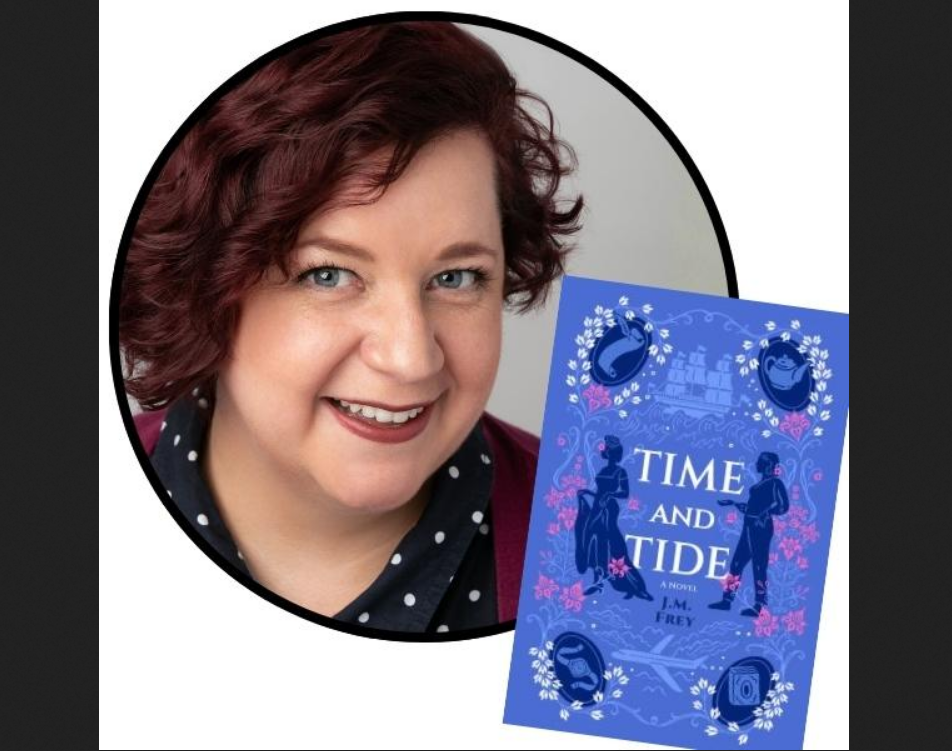
The literary genre of fantasy is regularly associated with mythical realms, superpowers, and heroic story arcs. But for some, fantasy offers the opportunity to imagine who gets to love. In author J.M. Frey’s work, the fantastical and queer love are intertwined components, allowing her to reshape historical possibilities through storytelling.
Frey, author, actor, and screenwriter, will be speaking at the Burlington Public Library this Tuesday, June 23, from 7 to 8 p.m. at the Central branch. The talk will explore the ideas and stories behind her novels Time and Tide and Nine Tenths.
In Frey’s most notable work, Time and Tide, the main character, Sam Franklin, travels back in time to the 19th century after a plane crash and falls in love with a world-famous author reminiscent of Jane Austen, who is writing a novel that will contain the first lesbian kiss in literary history.
The premise may sound unusual, but it is rooted in historical inspiration.
In 2008, Frey was invited to the University of Cardiff to give a presentation on Doctor Who, which she avidly loves, and ended up exploring the city of Bath, where Austen lived from 1801 to 1806, and learning more about her life.
That is where Frey learned of the large number of letters between Austen and her friend and speculated lover, Martha Lloyd, now lost or destroyed.
“Jane turned down a proposal [and] everyone says she turned it down so she could focus on her writing, but what if she turned it down for other reasons? I was like, what if Martha Lloyd and Jane Austen were in love?” Frey said.
She underlines the speculative nature of this question: “No one can look at a historical figure and say this person was definitely a lesbian. We can’t apply modern labels to historical figures, but I can write a fictionalized version where Jane Austen was totally a lesbian.”
Frey’s love of transforming historical what-ifs into book plots comes from a long-time love of historical and mythological learning and the dramatic arts.
Her parents put her in drama club at four years old, which transitioned into voice acting and convention-going.
“[Acting] helps push me out of a block or get me back into the character’s headspace. It’s made me a stronger storyteller, and it’s made me a stronger character-builder because I have the ability to imagine myself as these people and not just as somebody who’s writing these people,” Frey continued. “I’m not afraid to stand up and start waving a prop sword around to figure out the choreography. I’m not afraid to start jumping around like a fool in my own apartment.”
In recent years, shows like Bridgerton have generated both excitement and debate around reimagined historical narratives featuring people of colour and 2SLGBTQIA+ characters. These retellings often place marginalized communities into historical settings where they were present but often left out of dominant written histories.
Even when there is no magic in this kind of storytelling, it remains a powerful act of imagination to tell stories of marginalized groups of people existing, thriving, and falling in love in times and spaces into which they weren’t historically accepted.
It began about a decade ago, with queer filmmakers and writers asking, said Frey, “‘What about the queer stories? What about us? What about our happy endings? Do we have to die at the end of every episode?’”
Frey also spoke of the importance of diversity within 2SLGBTQIA+ stories: “It’s very important for people to actually read the spectrum, not just read the male-male romances.”
It is ironic that there has been a cultural push for queer media at a time when 2SLGBTQIA+ rights are facing renewed challenges in the United States, alongside ongoing policy debates in Canada.
“It’s the political pendulum, right? Anytime a marginalized group gets ‘ahead of themselves,’ they have to be squashed back down. I think this is the dying gasp. I think that’s why it’s so violent right now. I think that’s why we’re getting people like the ‘Tangerine Tyrant’ doing the things that he’s doing…a cornered animal is always at its most violent when it’s about to die,” Frey said.
Frey has been a writer for a long time and has no shortage of advice for those just starting out; she is always at the ready to answer any questions. She even has a section called “Words for Writers” on her personal website.
“The biggest piece of advice that I ever got is ‘finish,’” Frey stated. She noted that she frequently hears a statistic that a large number of people who begin writing books never complete them.
“If you don’t like it, put it aside and start a new one…I see this a lot on social media, and I just want to grab every baby writer by the head and [tell them] not to worry about publishing or market trends or tropes or finding an agent. Don’t worry about any of that until the book is finished…write what makes you happy. Do it just for yourself. Do it because it sparks joy,” Frey instead advised.
Her own works have not only sparked joy but have also served as a saving grace, helping her develop self-compassion. And indeed, Frey’s characters, often messy and finding themselves caught between worlds, mirror her own experiences.
“I graduated university, had a bad breakup, lost a friend group, and had no idea what to do with my life. All I had ever wanted to be was an actor, and I came out of an acting degree with no acting because I didn’t cut it in the program. So I moved to literally the other side of the planet, and I lived in Japan for two years because I didn’t know what to do,” Frey explained.
In a sense, Frey’s work gives her the opportunity to nurture her younger self and the very human experience of feeling lost.
“I feel like a lot of my characters start in that same place I was in for a decade, [asking] ‘What do I do? What am I worth? What good am I? What joy am I bringing to the universe? What’s the point of my existence?’” Frey said.
Frey has found some answers to those questions in her life’s path and by looking at diverse perspectives.
“I read this really great article about the Indigenous philosophy of the point of existence. Westerners think that we’ve been put on the earth to be productive,” Frey described.
From the Indigenous view, though, Frey read something different: “We are like the plants, we are like the flowers and the sun, and the point of our existence is that we exist. That is the beauty of us. I try to get my characters, by the end of their stories, to have found their place in existence.”
Frey’s upcoming talk at Burlington Public Library takes place this Tuesday, June 23, from 7 p.m. to 8 p.m. at the Central branch. To register and for more information, visit the BPL website.