
By Maisha Hasan, Local Journalism Initiative Reporter
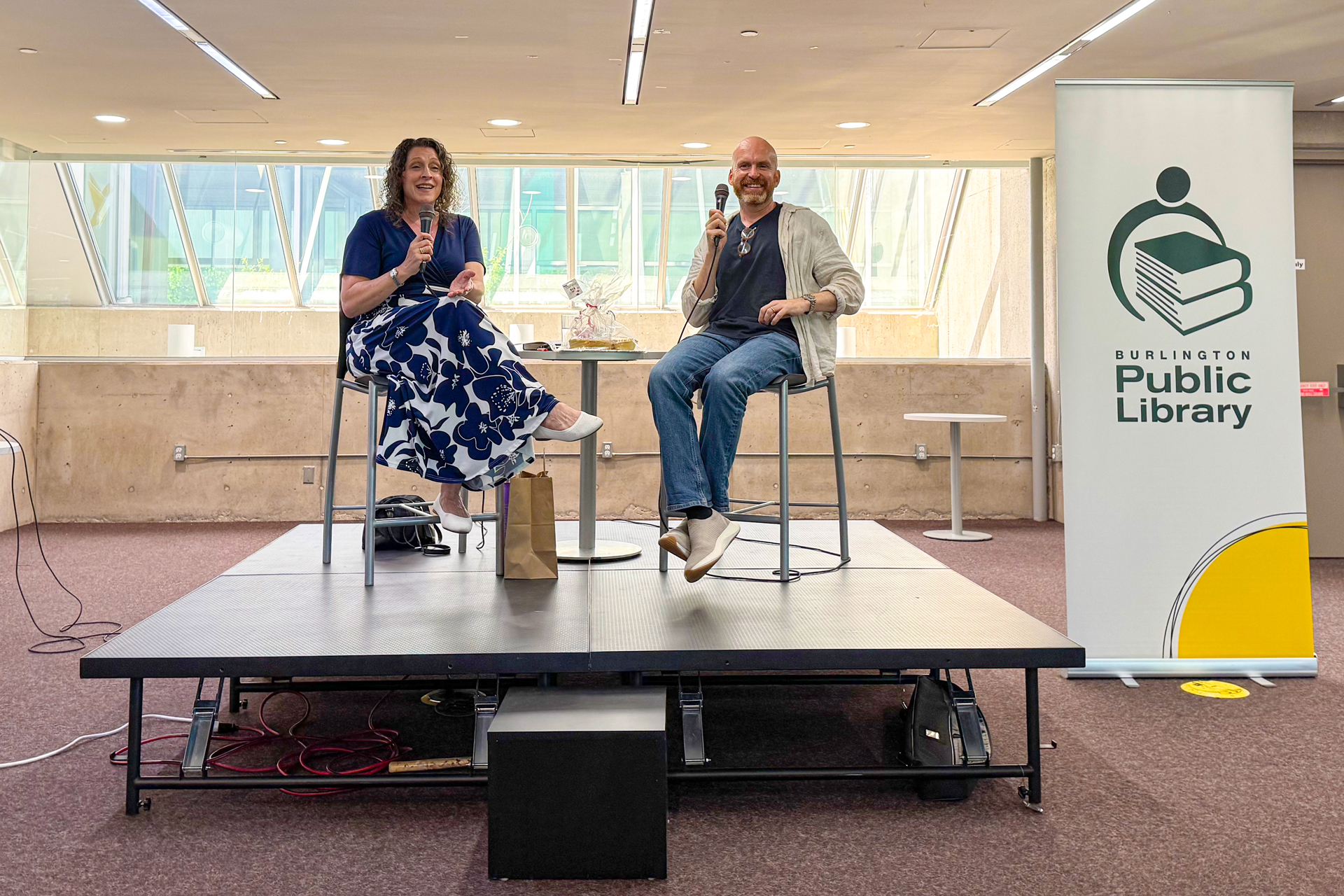
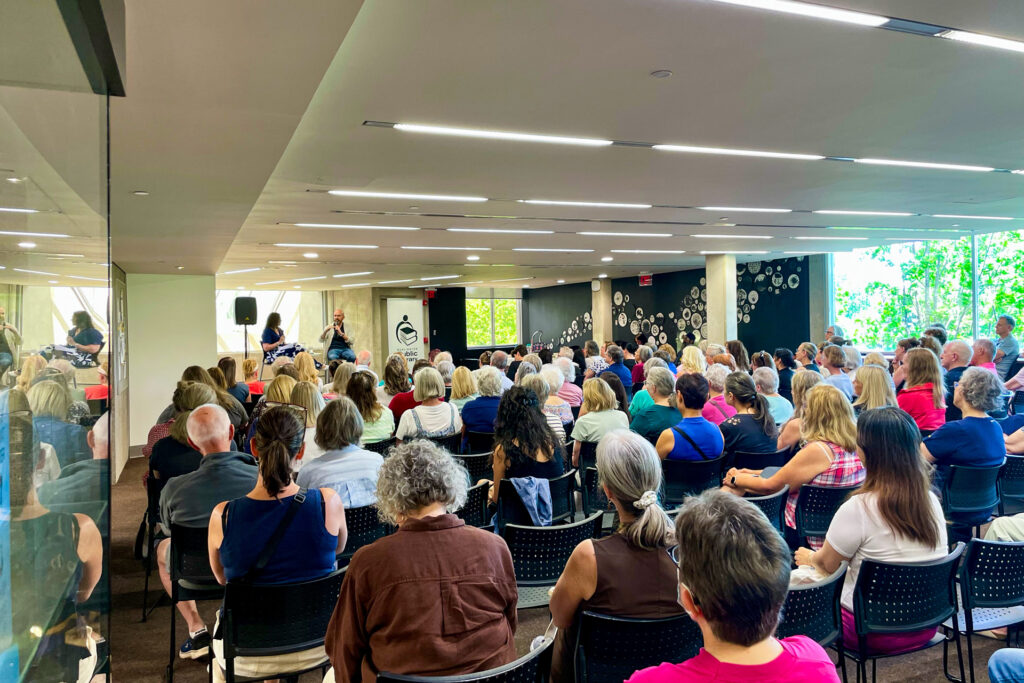
With another global bestseller and an upcoming movie adaptation of his book, The Midnight Library, starring Florence Pugh, underway, Matt Haig knows he has reached commercial success. If the sales figures, translations, and awards weren’t proof enough, the crowd gathered at the Burlington Public Library certainly was.
The second floor of the library’s Central branch buzzed with excited conversation, sounding more like a high school cafeteria than a library on Friday, June 12. The Burlington event marked the final stop on Haig’s tour for his new novel, The Midnight Train.
However, Haig is firm in pointing out that although the two books share the same ‘Midnight’ universe, The Midnight Train isn’t exactly a sequel, but rather a sibling to The Midnight Library.
“They’re kind of having an argument. I feel like The Midnight Library is very sort of passive, and it’s very much about acceptance. [The] Midnight Train is a bit of a tougher lesson about [how] sometimes, you have to change your life at a certain point.” Haig says.
The book centres on protagonist Wilbur Budd, a bookstore tycoon who has just died. He boards the titular train and is forced to revisit the most important moments of his life, especially the most painful. Wilbur examines his life and where he went wrong in a very Ebenezer Scrooge way.
“Both books are saying, what looks like a shinier, better, external, career-driven life isn’t necessarily the one that fulfills you. Midnight Train is looking at life from a perspective of your future self and thinking, ‘Have I got my priorities right?’ And very often, the answer is no. If we ever stepped off our own train, would we change things?” Haig says.
When writing The Midnight Library, there was no original intent for a sequel. Now, Haig sees himself introducing a third book in the future.
However, a question often arises whenever an author follows up with a sequel after a well-received book: was the sequel written in good faith, or is it a cash grab?
“I know I won’t be believed, but genuinely, with this, it was kind of the opposite. We were worried about it being called The Midnight Train…it was [originally] called The Memory Thief, then it was The Yesterday Train,” Haig continued. “My editor was really not liking the title, I wasn’t liking it — I just thought, if it wasn’t for The Midnight Library, I would be calling this book The Midnight Train. So it kind of happened accidentally. My editor, unlike most people in publishing, is very uncommercial. I’m a bit more commercial, so I wasn’t seeing so much of a problem, but it did happen genuinely,” Haig explains.
When Haig first began writing the book, his father was undergoing cancer treatment. Although he has recovered now, it prompted Haig to reflect on life and death in general, as well as on his father’s life. Indeed, the romance between Wilbur and the love of his life, Maggie, was inspired by Haig’s parents’ own love story. Both couples were based in 1960s Sheffield.
Not only does Haig pull from his own life and family, but also from the literary influences that are mentioned throughout the book, including The Grapes of Wrath by John Steinbeck.
Haig cites one line in particular from that book: “There ain’t no sin and there ain’t no virtue, there’s just stuff people do.”
“I love that quote because it’s the most empathetic quote. You can try to be a good person, you can try to be a moral person, but sometimes, actions happen as a result of circumstance,” Haig says.
A character who appears to hang over much of Wilbur’s life is his older brother Dougie, who finds his reprieve in crime and bad behaviour.
“The interesting thing for me, writing this book, is the two paths that the two brothers went down…on paper, Wilbur’s [life] looked like a sensible path, but this book asks [if] you can lose yourself in ‘acceptable’ ways as well as unacceptable ways. Sometimes that desire to be a good person can lead to bad actions if you don’t understand yourself.” Haig says.
Haig has also, somewhat reluctantly, become one of contemporary fiction’s most recognizable voices on mental health and characters who struggle to grasp the bounds of their morals.
“Years ago, I wrote a book about this called The Possession of Mr. Cave, where it’s a man who is trying to protect his daughter. He was very moralistic. But in being moralistic, he was actually endangering his daughter and being overpossessive and overprotective. You see it with governments and in war situations as well, people dressing up bad actions as sort of good moral deeds. Sometimes it’s actually better to admit that we’re all animals and to not be so arrogant and human,” Haig reflects.
No one character in this book is necessarily in the right, especially not Wilbur. Readers are invited to find empathy in all of them, a trait that can feel uncommon in contemporary public discourse.
There is a point in the novel where Wilbur, despite owning a chain of bookstores, can no longer find the time or desire to read. Haig sees that part of the story as reflecting the novel’s broader discussion of empathy.
“I think the not reading thing was definitely conscious, and he lost who he was. I think in losing who he was, he lost the empathy side of him. [It may be] corny now to talk about books and empathy, but I think it’s never been more apparent,” Haig says.
Last year, fellow acclaimed author John Green spoke on how reading can shrink the empathy gap that exists nowadays. Speaking to Haig, it sounds like he is of the same opinion.
Haig continues, “You see young men, you look at the figures of these right-wing podcasts going up, and then you look at the reading rates going down. I have masses of sympathy with young men. I feel like if I was a young man now, with low self-esteem as I had then, I’d be worried. I wouldn’t necessarily say that that person would stay reading or want to be a writer.”
The sentiment is especially pertinent now, with more and more reports of decreasing reading rates not only amongst young men, but in younger students.
“I’m fortunate the books were there for me, and the library was there for me. I genuinely think if people read a lot of fiction, a lot of the problems we have would still be there in some sense, but I feel like people would have enough empathy and understanding to be able to talk through them a bit more and work through them,” Haig notes.
Haig has been an avid critic of the larger negative structures that permeate society — not only toxic masculinity, but also hustle culture, something that Wilbur heavily leans into.
“I see a lot of other people overcome addiction, or they overcome something that’s outwardly very toxic. They think they’re better, but what then happens is you have to watch what [that] addiction turns into. It often becomes a social media addiction, or a work culture, a hustle culture. People aren’t going to intervene with that because it looks from the outside like success. Inwardly, that’s all you’re thinking about, and it’s getting in the way of your relationships, getting in the way of your life, and it’s not a good thing,” Haig says.
Haig says that he had his own taste of overworking, but found his way out. Wilbur seems to serve as a cautionary tale for if he hadn’t.
“In a consumerist, late capitalist society, it’s very easy to lose ourselves and become this unit of the economy that’s always pushing forward, always striving for more, and never actually in the present, being a living, thinking animal-person,” Haig notes.
There is a tension in Haig as a champion of independent bookstores and the people behind them, as depicted in The Midnight Train, when he exists as a very commercially successful author who benefits from capitalism by way of his book sales, which he is incredibly aware of.
Haig describes that tension as it appears within himself, “I have my own guilt around it, I’m naturally quite a self-critical person anyway, and always have been because of depression. I’m more or less aware of participating in it, and I’m aware that I’m imperfect. I go through phases of thinking, ‘It’s not really being an arch-capitalist if you’re earning lots of money by writing a story and people reading that story.’ It’s not Elon Musk, but at the same time, you’re still in an industry, you’re still in a very capitalist system, and you’re still possibly taking up space.”
He went on to suggest that it may not just be the workers and wage-earners who are losing out to capitalism.
“I suppose what I’m saying, and it might be a bit unfashionable, is that the supposed beneficiaries of the system are still at the mercy of the system. One way we dismantle systems is by saying that they’re not good for anyone within the system. You might be better off, you might have more power, but there’s still some sort of hidden cost, it’s just harder to see,” Haig adds.
Although there are valid critiques of certain books and authors being spotlighted over others, there are benefits that come with the broad promotion of books in a general sense: reading is made more widely accessible, lowering the barrier that can sometimes exist for people who want to get into reading but find it intimidating.
“[In the United Kingdom] especially, I feel like the book industry snobbery is kind of related to class snobbery. We have a sort of three-tier class system, and we have a three-tier book system. I am very grateful that I am with a publisher who ignores all that and lets me do what I want,” Haig says.
The book especially illustrates and dismantles this “class snobbery” through Wilbur, who loves books, even when he can barely afford them.
It’s a part of what makes Haig’s works so widely adored.
“I like happy endings, I like accessible prose. I’m ADHD, so I like short chapters, I like short sentences. I did an MA in literature, and I’m grateful because I read a lot of books which were important for me to read, but afterwards, trying to get into a place of accessibility was a bit hard. I had to unlearn some stuff about what the university teaches you about what good literature is and all these rules,” Haig says.
It’s certainly paid off, to say the least.
As for a happy ending in Haig’s latest offering — without giving too much away — this one is somewhat open to the reader’s interpretation of happy endings. But if Haig could choose a lesson to stay with readers after the book, it would be to hold a lot more wistfulness about now.
“We need to be nostalgic about the present. These are the good old days, this is the first draft of life, and we’re living it right now,” Haig says.
Boarding a train might also work.
For more author events like these in Burlington, visit the Burlington Public Library website.