
By Emiliy R. Zarevich, Local Journalism Initiative Reporter
It’s the groovy sixties, and the City of Hamilton is thriving. Two successful career people named Janet and Dean feel financially secure enough to throw away lucrative positions and chase their real dream: opening an antique store in the heart of Hamilton’s bustling downtown. Everything seems in place for the perfect life, but there’s a problem. A big, big problem. The local mafia wants their slice of the pie, too, and will stop at nothing to get it. Janet and Dean soon find themselves caught in a relentless criminal web, having to rely on the quick wits of a talking stuffed swordfish for help to swim out of this fishy situation.
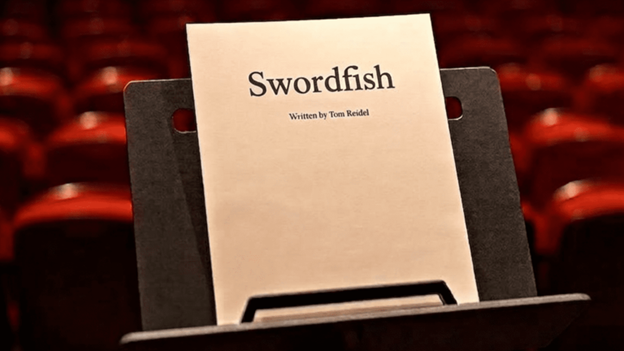
This is the premise of a celebrated Canadian play scheduled to have a staged reading by the company of Dundas Little Theatre, who recently enjoyed a major critical success with their run of the domestic tragedy Late Company. On Saturday, June 6, 2026, the theatre will be presenting playwright Tom Reidel’s outrageous two-act comedy Swordfish at the Garstin Centre for the Arts, located on 37 Market Street South in Dundas. The performance starts at 7:30 p.m. sharp and will run for 130 minutes. Admission to this event is completely free; this is an opportunity to take part in a unique and low-cost theatre experience. A talented cast has been assembled to bring this hilarious and absurd story to life, directed by local luminary Nicholas Ruddick.
Playing the two main leads, the optimistic but unlucky married couple Janet and Dean, will be local thespians, Rebecca Durance Hine and Tyler Brent. Both actors have impeccable credentials. Hine’s previous acting roles include Brigid Blake in The Humans at Dundas Little Theatre, Caliban in The Tempest at Tottering Biped Theatre, and Honey in Theatre Burlington’s production of Who’s Afraid of Virginia Woolf? Brent trained as an actor at the University of Waterloo and has been participating in performances in Hamilton theatres for two decades, including twenty stints in Hamilton Fringe Festival productions.
Bringing Janet and Dean’s story to life will be a rewarding challenge that involves vibrant time travel, surreal fantasy, and subtle commentary on the social and economic circumstances of the 1960s that saw regular, everyday people entangled in such scenarios. Hine and Brent both agreed to speak out about their acting craft and the connection they feel to Reidel’s tale of crime, farce, and fish friends. Answers have been condensed and lightly edited for clarity and flow.
What is your process for getting into character?
Hine: I start my script work by identifying my character’s meta objective, followed by their goals and tactics for achieving those goals for each beat of each scene. This helps me to establish patterns of behaviour for the character. I can start to understand and then identify with the character. It is also the path into starting to build the backstory for them. What has happened to them in their past that would result in this pattern of behaviours emerging in their present lives?
I can then use the backstory to create memories for them, and then it’s those memories that I revisit to get myself into character before and during a performance. One of the best pieces of advice I’ve ever gotten from a coach is not to play an emotion. Emotion comes organically in the moment from understanding your character and, therefore, how they would react in that moment.
Brent: Getting into character starts with the script and mapping out who this person is. How they see themselves, how others see them, and how they impact the story being told. Before walking out on stage, I like to focus on the moment before they enter. What was this person doing in the time leading up to their first entrance? That approach gets me into the headspace of the character, then the focus becomes staying present in the moment and listening closely to fellow actors. The more I can be an active listener, the more I feel authentic in how I respond to others in the scene.
What is it about the play “Swordfish” that appeals to you most?
Hine: I describe it as slightly chaotic fun, in a good way. The setting is fantastic and creates the opportunity for a lot of humour, as do the characters. You never quite know what’s going to happen next. The potential this show has is great, and I’m really looking forward to hearing what people think of it and what feedback they have for its development.
Brent: The sudden and serious trouble that normal people find themselves in with this play is hilarious. A typical married couple with a new business isn’t an uncommon setting for a play. But after a few twists of fate and some extraordinarily good timing — or bad timing, depending on how you look at it — the characters, along with the audience, are immediately thrust into a story heading in an unexpected direction.
As an actor, what are the differences between a staged reading of a play and a full production?
Hine: There are the more obvious differences. There is less pressure because you don’t have lines or blocking to remember. It often involves a less involved approach to the script work. The other key difference for me is in the relationship with the audience. A staged reading is usually a preliminary look at a new or newer work, often with the aim of getting feedback from the audience and working out kinks to develop a script further before it’s staged in the future. It feels like a more active exploration with the audience versus solely a performance for them. This brings a fun energy of curiosity and co-creation to the event that I really enjoy.
Brent: The main difference is the limited physicality. Stage directions are often read in place of the actors’ movements, so I tend to put more focus on voice and facial expressions with staged readings. The other big difference is that for a staged reading, the actors do have scripts, so the long hours of memorizing dialogue are vastly reduced.
The staged reading will include a talkback session with the cast, playwright, and audience following the performance. Such sessions can help with a play’s development while giving audience members an opportunity to ask questions and share feedback. The event begins at 7:30 p.m. on June 6 at the Garstin Centre for the Arts and is free to attend.