By Maisha Hasan, Local Journalism Initiative Reporter
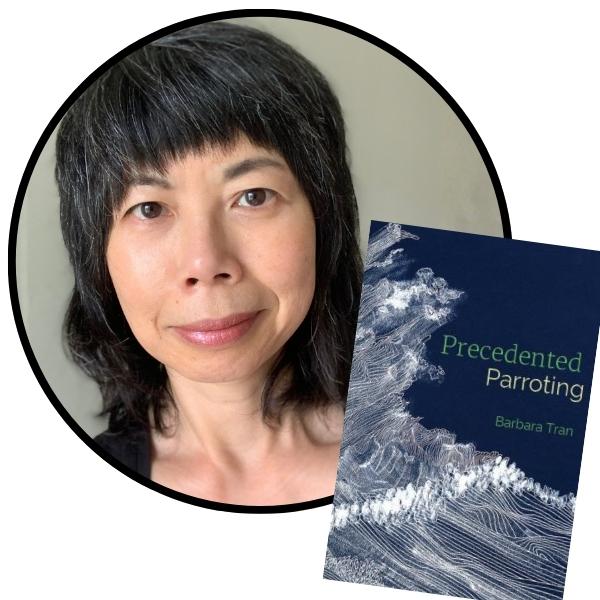
With Earth Day rounding the corner, Burlington Public Library is hosting an author talk with Barbara Tran on her debut poetry collection, Precedented Parroting. The author talk will take place Sunday, April 19, from 2 p.m. to 3 p.m. in the Central branch’s Centennial Hall; registration is still open.
Precedented Parroting is critically acclaimed, a finalist for the Governor General’s Literary Award, and a CBC selection for Best Books of 2024. This work centres on birds taking flight, how their migration speaks to and parallels human migration and a broader sense of injustice and challenges that Tran herself and others face. Praised for its creation of a sonic landscape through its avian narrative, themes of memory in diasporic populations are evoked. Tran’s visit comes at a moment when National Poetry Month and Earth Month converge in April, with her poetry and its focus on the natural world aligning with both.
On her website, Toronto-based Tran is described as a “poet, writer, and cynophile” (a person who loves dogs), evidenced by photos of herself and her pet on the site; her short fiction and poetry have been published in The New Yorker and The Paris Review, among other publications.
Below, Tran shares her thought process behind Precedented Parroting.
This interview has been edited for clarity.
Your collection uses birds to explore themes of racism and migration. Where did that idea originate?
I was living temporarily in LA, pre-COVID, pre-George Floyd, pre-all the wildfires, and it started to occur to me that the animals were acting bizarrely, so I was paying more and more attention and taking notes. As things started to happen, it kind of made sense to me because in SoCal [southern California], there are feral parrots, and they came screaming through the skies one day. Then the ravens were acting oddly and leaving carcasses in the street. It just felt like the air was charged. When COVID hit and George Floyd was murdered, and the wildfires were taking off, it [made] this energy in the air.
What did your research into bird behaviour and movement involve?
I’m blanking on the title of two books in particular [that are] in the book notes… I’m nowhere near an expert, but just from being surrounded by them, I was so fascinated with the way they move and that idea of flight — a joyful flight, a flight from trauma, a flight for your life, and feathers were appearing to me over this period. I think that so often, it’s easy for us to make up our minds about things. I think this is where the birds really helped me reach a different level…[when] we think about it in terms of birds or some other issue or being that we haven’t considered before, I think it opens us up to seeing more clearly.
This collection had been in the making for years. Did you expect themes such as migration and displacement to remain as relevant today as when you first began developing it?
It kind of goes back to the energy in the air. I don’t really know how to explain that; it didn’t feel like I had to write about this. It was more like, this is infiltrating my mind, and I’m responding to it, and because it’s in my subconscious and my conscious, it kind of worked its way into all the different metaphors, like the murder of the Asian women and Asian-American women in Atlanta. I had already been writing about these kinds of issues, and then that happened. I was definitely not conscious at that point of writing a book about these issues, but because they’re so entangled, I felt like the work just interwove.
How do you approach incorporating these issues, including colonial stereotypes and historical representation, into your work?
I feel like it’s empowering and kind of rewarding. So much of what North Americans know, and I include myself, because I was born in the U.S., about the Vietnam War comes from the media images and the media on this side of the world. I feel like Vietnam is so defined by a bunch of iconic photographs and some films. It’s interesting to kind of reference and try to reframe. There’s that famous photograph of the monk self-immolating, where he’s in orange, and then the flames break out. The photograph that most people see is black and white. In my book, I take that orange and turn it into a blossom. I’m trying to think of these things in a way that’s not the norm for the West.
I actually have a piece coming out in Brick [a literary journal] that talks about how we, even for those of us who didn’t live directly through a war, are affected through the generations. There’s an experiment that I’ve been carrying out in my mind that was on rats and on mice, but they exposed mice to the smell of cherry blossom and then shocked their feet. The next generation of mice actually had a sensitivity to cherry blossom, even though they had no traumatic experience with it. I found this experiment so fascinating. Since now, so many people are affected by war, what are we carrying, and how do we undo this?
Your use of lineation is very deliberate. How conscious are you of form as you write?
Form is actually really crucial to me; I feel bad for the book designer because I was so particular about where things went. When the line breaks and changes meaning or interrupts a thought, or interrupts an emotion, it’s kind of my intention for the reader to experience that discomfort that I’m trying to get at in the poem. Both that and the way that things look, I think, affect the way we interpret it, and it plays with the emotion as you’re reading. Sometimes those two things work in concert, but sometimes I’m trying to play the things against each other, so you might be thinking one thing as you’re reading, but because of the way it’s laid out, it’s a little uncomfortable.
What was most meaningful to you about bringing these works together into your debut collection?
Having a unified piece was really gratifying, and it felt like such a specific time period to me, because it was such a time period of loss. Being able to do something positive with that time, and remembering all the people who were lost during that time, it goes back to what we were talking about, undoing that trauma. This is why nature is so important to me in the writing, because when we go out into nature, we remember how tiny we are in the cosmos. That is our true place.
Tran’s second poetry chapbook will be published later this year by knife | fork | book; other current projects include a screenplay.
Barbara Tran will speak at Burlington Public Library’s Central branch on Sunday, April 19, from 2 p.m. to 3 p.m. Registration is available through the library’s website.