By Jack Brittle, Local Journalism Initiative Reporter
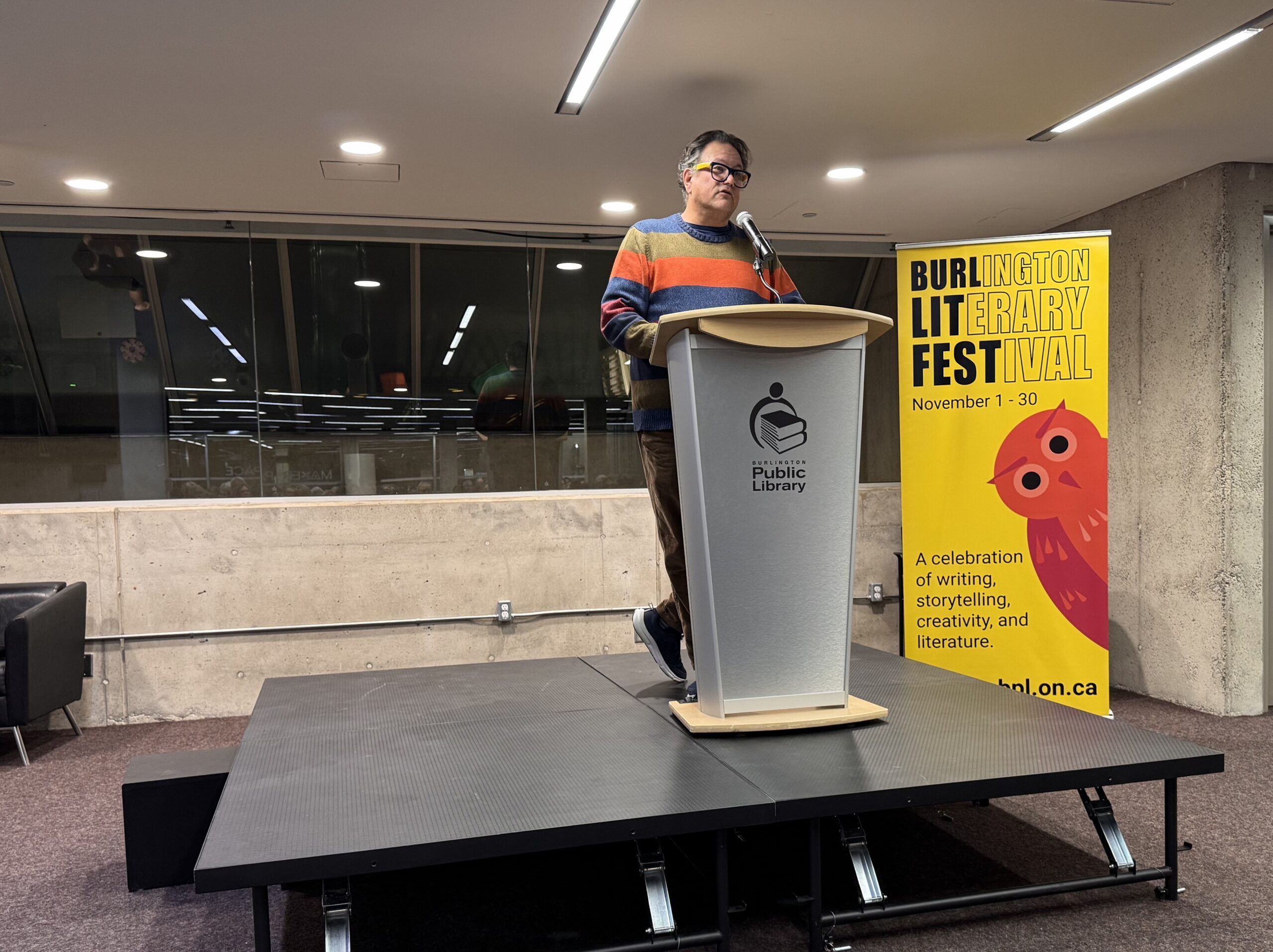
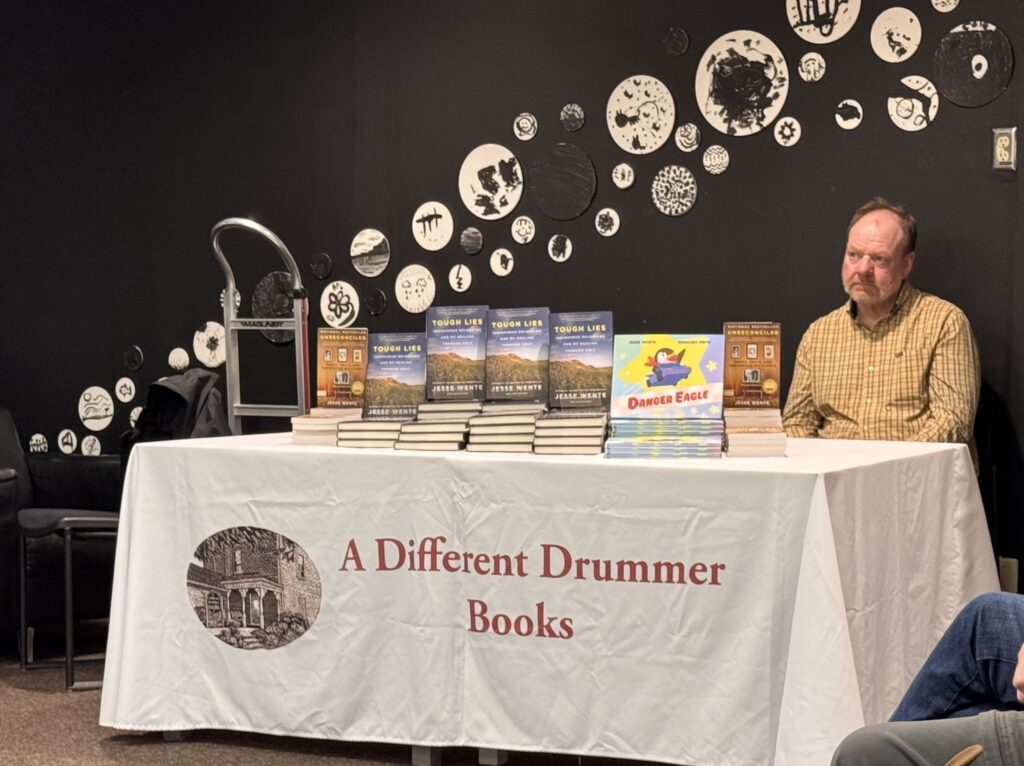
On November 16, the Burlington Public Library (BPL) hosted a talk with author and former CBC Radio Metro Morning columnist Jesse Wente about his new book, Tough Lies: Indigenous Belonging and My Healing Through Golf, which was published last month.
The event was part of the sixth annual Burlington Literary Festival (BurlLITFest), which the BPL website calls “a celebration of all things literary.”
Wente’s first book, Unreconciled: Family, Truth, and Indigenous Resistance, was written while he was also producing his first feature film, an adaptation of Thomas King’s book The Inconvenient Indian.
After the film was released, it was revealed that neither King nor the film’s director, Michelle Latimer, had any Indigenous ancestry, despite their claims.
The Inconvenient Indian was subsequently pulled from distribution, and Wente decided to step away from public life.
“I stopped being on the radio really suddenly,” Wente said. “I went away on Christmas of 2020 and never came back. I ended up stepping back from running the Indigenous Screen Office, and I didn’t stand for a second term as chair of the Canada Council for the Arts. I had to just back away in order to heal myself, because what happened had really gotten me to a very, very dark place, and I needed to really work on it.”
READ MORE: Jesse Wente on Colonialism, Indigenous Identity, and the Journey to Healing
In an excerpt from his book, Wente explained how the misidentification of Indigenous peoples hurts those with legitimate ancestral claims.
“There’s the obvious issue of non-Indigenous people taking opportunities that have been provided for Indigenous advocates,” Wente said. “It’s important to point out that the settler colonial societies haven’t offered up grants, bursaries, awards, and academic and governance positions for Indigenous people out of the goodness of their heart. These opportunities exist only after decades of advocacy by Indigenous people who fought for ways to redress the huge losses inflicted on them by the colonizers.”
Wente said that giving non-Indigenous individuals “authority and decision-making power over Indigenous policy and issues” is harmful because they lack “any of the lived experience that would provide context and wisdom for these decisions.”
Wente said that growing up in Toronto with a non-Indigenous father meant that he was disconnected from his Anishinaabe culture. The fallout from The Inconvenient Indian reopened those wounds.
Wente said that while he still regularly attends therapy sessions, golf has also been incredibly important in his healing journey.
“I found a lot of similarities between golf and therapy,” he said. “Especially the teachings you learn around mindfulness and being present, as well as a lot of Anishinaabe teachings around humility and how we live with the land.”
Wente also explained the title of the book, which is a golf metaphor.
“It’s a golf term referring to a scenario in which your ball has landed in a spot that will make your next shot difficult, maybe even impossible,” Wente said. “Quite often, these ‘tough lies’ have nothing to do with your original shot, which may have landed right where you wanted it. But a ‘tough lie’ might mean it has come to rest in a divot or a pitch mark made by another golfer, making recovery hard.”
Wente said that he found the phrase to be a “useful way to describe the current state of Indigenous affairs in Canada.”
“It’s a phrase that works both figuratively and literally,” he said.
Wente also said that his therapist is an Anishinaabe woman, which was “hugely important” for him.
“One of the things with therapy, as it’s held in the Western, colonial world, is it doesn’t really acknowledge colonialism as maybe the central thing we’re all healing from, certainly for Indigenous people,” Wente said. “So I was worried when I started, thinking, would I have to explain this to a therapist who didn’t already know that? But with Rhonda, I don’t, because she’s the daughter of a residential school survivor.”
Wente said that she also incorporates a lot of ceremony in her therapy and unpacks many of the techniques in traditional therapy.
While his mental health was improving, Wente suffered a heart attack, which he took as a message.
“I like to say that it was my ancestors reaching out to tap me on the chest,” he said. “They recognized that I’d healed a bit, but there was a part I was missing. For Anishinaabe, there’s mind, body, and spirit, you need to heal all of those.”
Wente closed the talk with a story from his youth in which a BMX bike he received for Christmas was stolen from him by some neighbourhood kids.
When he and his father confronted the bike thieves, Wente recalled, they didn’t simply ask for an apology — they also asked for the bike back.
He said that in the story, he represents the Indigenous peoples of Canada, and the bike represents their land.
“By the bike, I mean everything taken from us since the introduction of the Indian Act,” Wente said. “The reserve system, and the residential schools. That includes our languages, our cultures, our pride, our communities, our sovereignty, and yes, our land.”
He said that it’s only by giving the land back that Canada can truly heal itself.
Wente invoked another golf analogy about pitch marks to describe the act of repairing damage for those in the future.
“When you play golf, you’re on the land,” Wente said. “And when you play, you hurt the land. You’re swinging clubs on it, balls are landing on it, things happen. When you damage the playing surface, you fix it. And you fix it so the person behind you doesn’t land in your divot and now have a tough lie.”
Wente said that this is also a deep Anishinaabe teaching.
“We don’t do anything to the land that would mean our relations coming in the future wouldn’t have the same experience that we have,” he said. “Canada has to fix its pitch mark.”
Wente said that reconciling with Canada’s colonial past is an opportunity to establish a unique Canadian identity, at a time when threats from the United States call into question what it means to be Canadian.
“Canada is uniquely positioned to do this healing journey because it has the resources,” Wente said. “It’s a country with enormous wealth, a vast place, and comparatively very few people.”
“Imagine what we would be able to unlock together if we actually understood each other and were pedalling in the same direction for the first time in our history,” Wente continued. “That is more possible here than at any other place in the world.”
Both Tough Lies and Unreconciled are available for loan at the Burlington Public Library.
For a deeper exploration of Wente’s thoughts on Indigenous identity, colonialism and healing, read our interview, Jesse Wente on Colonialism, Indigenous Identity, and the Journey to Healing.