By Emily R. Zarevich, Local Journalism Initiative Reporter
What if Agatha Christie wrote a serious play, and the Looney Tunes tried to perform it?
Dundas Little Theatre has the answer to that question with The Play That Goes Wrong, which opened earlier this month. Directed by Elaine Hale and produced by Brian Morton, The Play That Goes Wrong is a catastrophic endeavour by an utterly hopeless British theatre company, disguised as one of Dundas Little Theatre’s greatest comedic triumphs. Henry Lewis, Jonathan Sayer, and Henry Shields of Mischief Theatre Company tag-teamed to write a play that applies Murphy’s Law to every second of a pathetic attempt at staging a theatre production, and the results are outrageously funny.
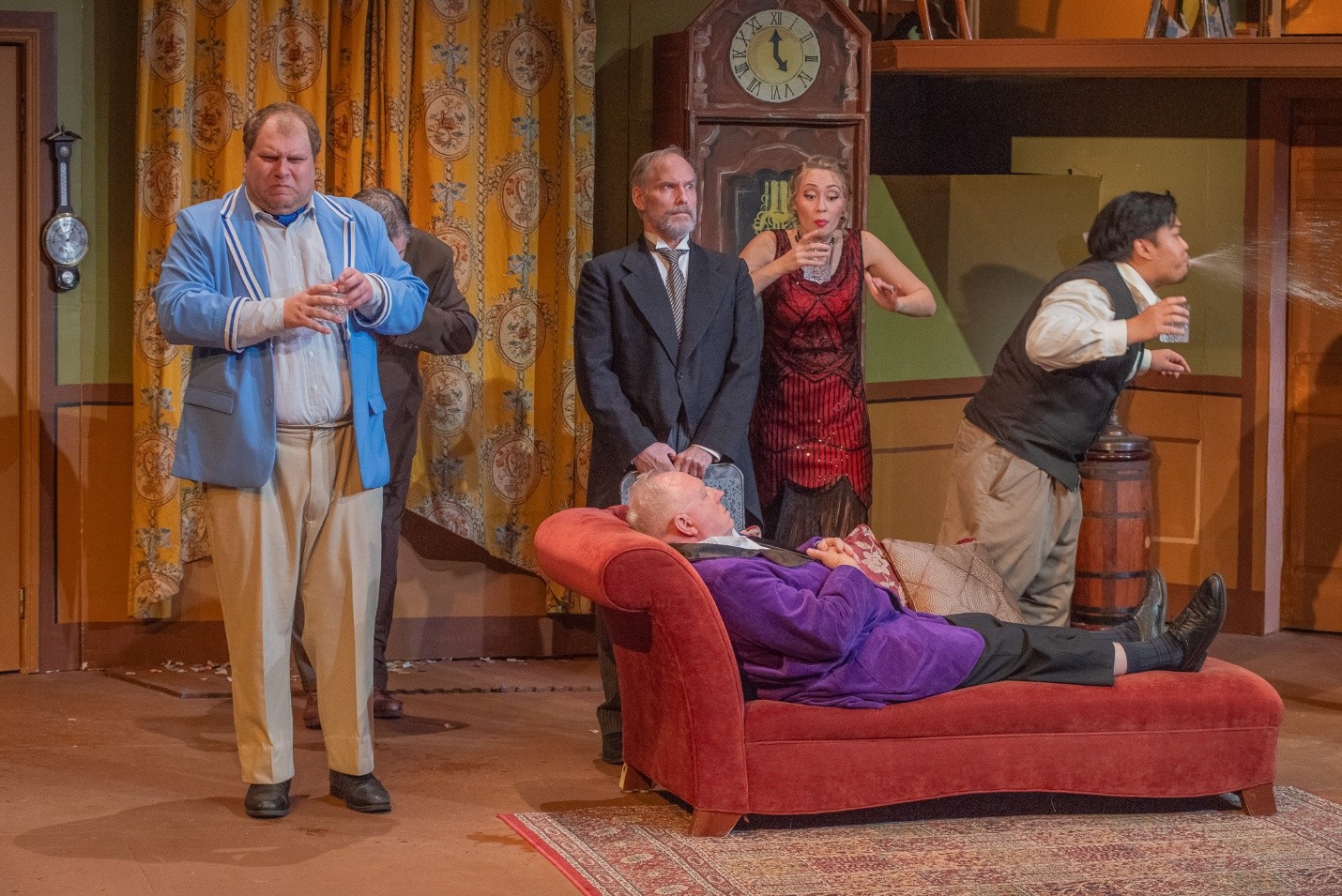
The Cornley Polytechnic Drama Society is all ambition and no merit. Short on members, funds, resources, and general talent, the Society has put on many far-fetched flops such as James and the Peach (no budget for fruit) and Cat (there was only enough money to costume one person). Now with more troupe members and a sudden injection of cash, the Society wants to stage a 1920s murder mystery in an attempt to improve their reputation on the English theatre scene. Too bad not a soul involved can recite lines correctly, put props in the right place, time lighting or sounds right, or even build a set that holds itself together.
The play within the play is The Murder at Haversham Manor, a story written by an earnest playwright that doesn’t stand a chance against this circus of buffoonery. The cleverly rendered playbills give the backgrounds of the Society’s “actors” with their questionable acting credentials. They all have experience…sort of. Flip the playbill upside down, turn it over, and you’ll get the real names of the cast and their (and frankly, more impressive) backgrounds in theatre. This review uses the actors’ real names to avoid confusion.
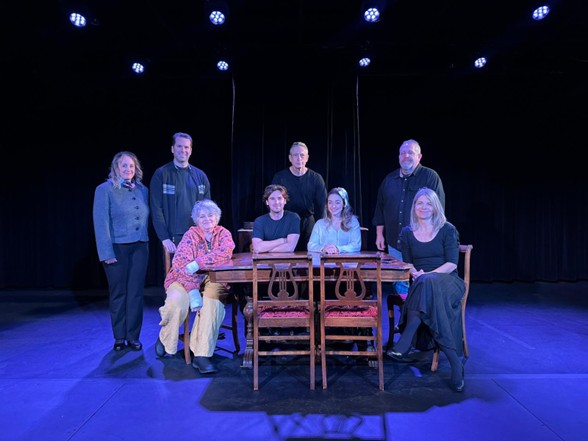
Andrew Finnigan plays Charles Haversham, the wealthy murder victim whose murderer was clearly after his fortune. Inspector Carter (Chris Cracknell) is on the case. The suspect list includes Charles Haversham’s seductively beautiful fiancée Florence Collymoore (played by Trinity Ozimok), his jealous brother Cecil (David Gibel), Florence’s overprotective brother Robert (Johnny Thirakul), and the bumbling butler Perkins (Michael Wilmot). Their lives are all intertwined by romances and conspiracies, and it’s meant to be a classic, straightforward “whodunnit.” What happens instead is two acts filled with slapstick, on-set accidents, misreads, bonkers mix-ups, and hammy overacting by the Society “actors” wanting their roles to be their big breaks. Unfortunately, the only “breaks” are everything on set.
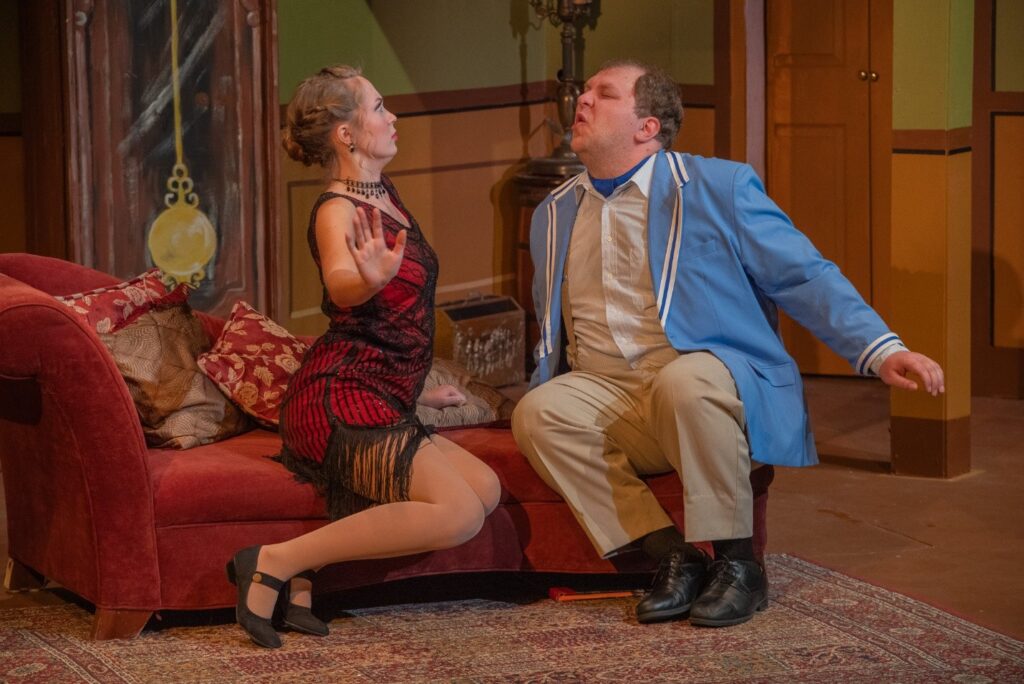
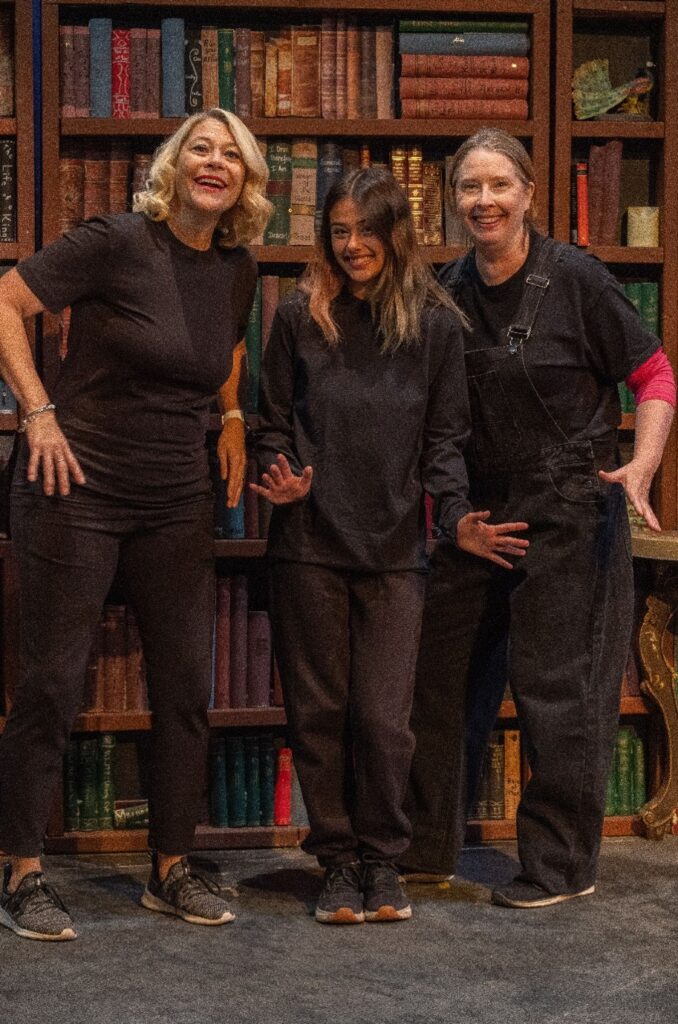
All of the actors are hilarious as a band of comically bad amateurs who are trying their very best but cannot overcome the trickster god who seems to have cursed their set. The set itself, designed by John Bello, Roy Carroll, and Michelle Chin, is a brilliantly engineered booby trap that the stage crew (some of whom are involved in the show as actors) have to operate with precise timing in order for the gags to land. Audiences will laugh out loud and gasp in shock as the set unravels like a shoddily-assembled school project thrown together at the last minute. Luckily, these malfunctions are intentional, but for a set designer who hadn’t intended things to go wrong, every construction failure would be an absolute nightmare.
The stage crew who are part of the show’s storyline commit to the bit even during intermission, where they stay strictly in character and interact with the audience. A particularly funny performance comes from Trevor (Luis Arrojo), the show’s nonchalant lighting and sound operator who is clearly just there for a paycheck. One of the funniest scenes is when he’s roped in as a last-minute actor because both the main actor and the understudy are unavailable. Trevor did not sign up for this, but he rolls with it anyway. The whole cast stumbles their way through this complete trainwreck of a play, and the audience howls with laughter the whole way through.
The Play That Goes Wrong is perhaps one of the funniest meta, self-aware productions to ever be staged. Every mistake or accident that happens is an affectionate love letter to all of the theatre people who have ever experienced unspeakable stress and worry about what could happen while trying to stage a perfect play. But there is really no such thing as a perfect play. These things do happen, and everyone can have a good laugh about it. What’s important at the end of the day is that whatever goes wrong, the show must go on, and these characters and their crew in The Play That Goes Wrong heroically blunder their way to the end.
Performances of Dundas Little Theatre’s The Play That Goes Wrong will continue until November 22, 2026. Tickets can be purchased here, although they are already nearly sold out due to the show’s popularity.
Those who miss this experience can look forward to Dundas Little Theatre’s next two upcoming productions. The first will be a production of Kate Hennig’s The Last Wife, a drama about King Henry VIII’s sixth and most intellectually accomplished wife, Catherine Parr. An astute politician and a scholar, Catherine must rely on her wits and education to survive in Henry’s court, a notorious, dangerous cesspool of corruption. The play opens on Friday, January 29, 2027, at 7:30 p.m.
Following The Last Wife will be a production of Paradise Lost by Erin Shields, a reimagining of John Milton’s epic poem about the fall of Satan from paradise. Paradise Lost reinterprets the Bible from the point of view of the figure always cast as the villain. The play opens on Friday, April 16, 2027.