
By Emily R. Zarevich, Local Journalism Initiative Reporter
If furniture had eyes and ears, it would have a lot of stories to tell. In A.R. Gurney’s comedy of manners, The Dining Room, an elegant dining room set consisting of a table, chairs, and a cabinet has exactly eighteen different stories to tell.
Eighteen different upper-middle-class families across a hundred years have all bought, or are considering buying, the same high-end dining room set from an American furniture manufacturing company. In the dining rooms of their upscale mansions and apartments, where they’re waited on by slouching, tired-looking maids, they live sheltered, privileged but complicated lives in which romantic love, parenthood, friendship, and the arc of life all play a part.
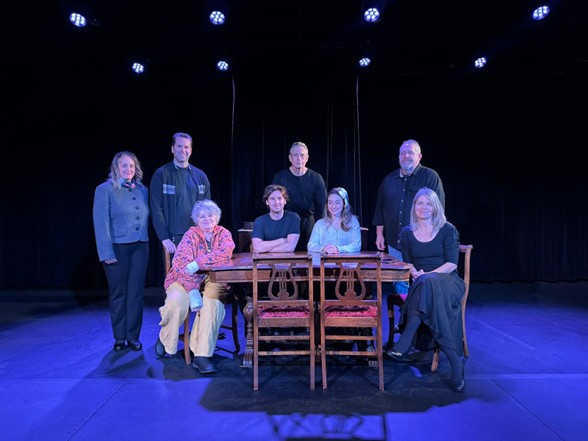
The Dining Room recently held a series of performances at the West Plains United Church located on 549 Plains Road West. Directed by Yo Mustafa, the company of the West End Studio Theatre brilliantly came together for an assortment of smooth, fast-paced stories in which cast members all took on various roles with impressive versatility. They slip in and out of personas, all of them members of the White-Anglo Saxon Protestant (WASP) contingent. They change their personalities, body language, and voices to depict every strand of family drama one can think of — save the issue of poverty, as all the characters are rich enough to afford the nice dining room set. The admirable cast is made up of Susan Applewhaite, Mischa Aravena, Roxanne Hill, Brian Melanson, Chris Reid, Linda Spence, Kayla Whelan, and Jason Swenor.
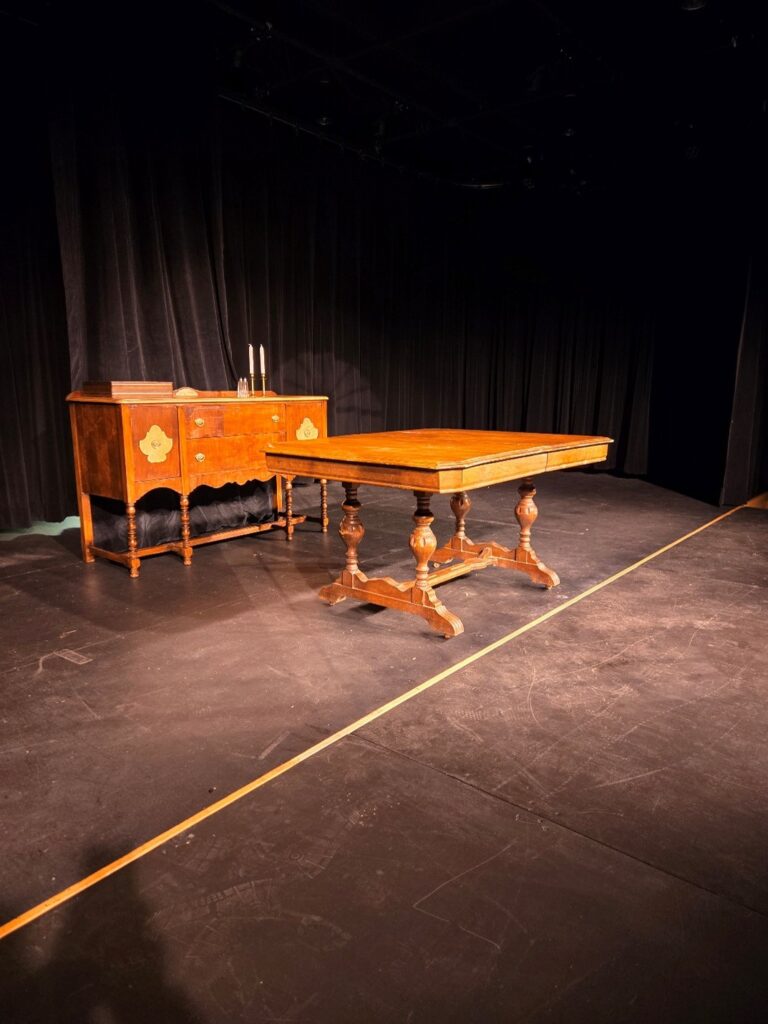
The set, designed by Karen Henning, is pointedly simple and minimalist. The stage doesn’t need to be elaborately decorated to indicate that the households being depicted are luxurious; the actors do that themselves with their character depictions, adopting snobbish mannerisms, naiveté about problems in the real world, and conservative attitudes that set the scene and supplement the audience’s imagination. The dining room table itself becomes something of a character as the flow of The Dining Room progresses. It witnesses so many conflicts, its chairs hold so many bodies for fancy sit-down meals, and it carries the weight of high societal expectation with every plate of fine china, candlestick, and arrangement of flowers that adorns it. The characters in The Dining Room expect themselves and their family members to present themselves a certain way, and this intense pressure extends to the dining room table as well.
The Dining Room, as a play, distinguishes itself with its excellent writing. The domestic scenes it presents are so realistic that each audience member is bound to recognize one of their everyday happenings within the context of at least one of the skits. In one scene, a control freak husband berates his wife, a mother and homemaker, for using the dining room table as a study desk for her college work. This scene occurs during the Second Wave of Feminism between the 1960s and 1980s, when there was significant pushback against women trying to exit the home sphere for education and work experience. It’s a clever metaphor for everyday mid-twentieth-century sexism, as what makes the husband so angry is the wife placing her typewriter, her tool for obtaining a life and status in the outside world, on a table meant for hosting dinner parties. He’s (indirectly) communicating that he wants her focus to be on activities on the home front. The dining room table is just an excuse.
In another scene, an authoritarian father lectures his young son at breakfast about the Great Depression they’re currently living in. The son has been learning about the disastrous state of the world economy and the uneven social classes from his schoolteacher, and is beginning to question the wealthy lifestyle he and his family are leading. His father promptly puts him in his place and defends the status quo. This skit captures both the wide generational and wealth divide that was taking place in a significant moment of history in North America. Other notable scenes with terrific acting include a narcissistic mother manipulating her daughter into unwanted ballroom dance lessons and isolating her from her relatives, as well as a hilarious, hammy, exaggerated bit about a whole family (save the confused son) having a complete meltdown because an obviously gay relative was outed at a country club.
The stories of The Dining Room seamlessly blend together like a mixture of colours to make something layered yet cohesive. While two characters are playing out a scene, the characters for the next scene are quietly setting up their own skit on stage without causing even a tremor of interruption. This takes incredible, careful coordination on the actors’ part, and for that, they can be commended. They have to tiptoe around each other so they don’t intrude on each other’s space and lines. In one scene, a father and adult son set up chairs at the front of the stage to discuss the father’s funerary arrangements in dim, grim light. In the background, a character intended for the next scene, a domestic servant, has to set the table cheerfully for an unrelated, intimate, celebratory gathering of friends. At times, it can be distracting for the audience, as they may not be entirely sure who they’re supposed to be watching. That’s why it’s imperative to pay close attention to the dialogue. In The Dining Room, the audience’s attention belongs to whoever is speaking in the present.
The Dining Room had its last showing on Sunday, May 18, 2026. The next entertainment show at the West Plains United Church will be on June 6, 2026, at 7:30 p.m. This will be “Twilight Blues with Dr. Ben,” a concert fundraiser for the Halton Compassion Society. Tickets for this event can be purchased here. On October 15, 2026, West End Studio Theatre will premiere its production of Matt Murray’s The Myth of the Ostrich at West Plains United Church at 7:30 p.m. This production will also be directed by Yo Mustafa; tickets for The Myth of the Ostrich can be purchased here.