By Maisha Hasan, Local Journalism Initiative Reporter
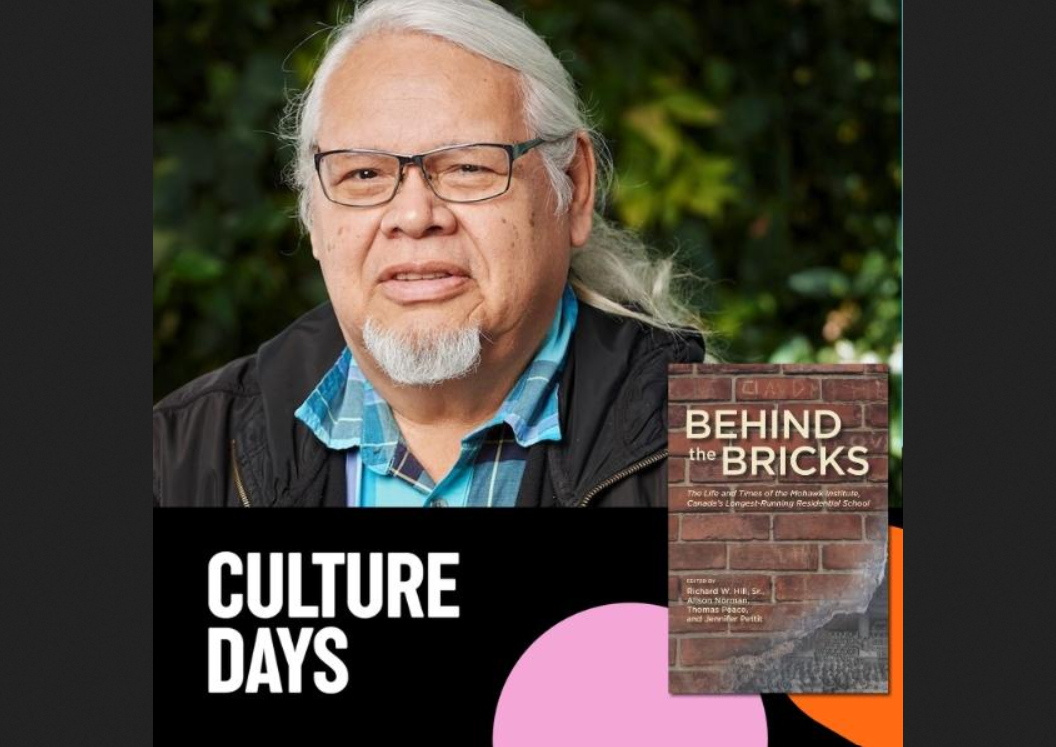
As part of the Burlington Public Library’s Culture Days events, author Rick W. Hill Sr. will be speaking about the collection of essays in Behind the Bricks, an exploration of the history of the Mohawk Institute, a former residential school in Brantford and the longest-running residential school in Canada. Hill, a historian and museum curator, co-edited the collection alongside Alison Norman, Thomas Peace, and Jennifer Pettit.
Hill, a member of the Beaver Clan of the Tuscarora Nation of the Haudenosaunee at Grand River, has a personal connection to that history: his great-grandfather attended the Mohawk Institute in the 1870s, and one of his aunts later attended the school.
Ahead of his appearance in Burlington on Sept. 30, 2026, Hill spoke with Local-News.ca about researching the Mohawk Institute, what he learned from survivors and historical evidence, and the lasting effects of the residential school system.
This interview has been edited for clarity and length.
Your great-grandfather attended the Mohawk Institute in the 1870s, and you also had an aunt who attended. What was it like to delve into that history firsthand, and how has it shaped you?
It was quite an emotional journey, not only discovering what happened to the children who were there, but then realizing I had this family connection to that. It helped to explain a lot of things about my family…how relationships can be harmed because of what took place there.
Were these stories you heard growing up?
Well, the funny thing is, like most people at Six Nations, we never talked about this place. We didn’t know its story. The people who went there kept those stories hidden. Sometimes they didn’t even tell their own family. Some families learned a little bit about their parents or grandparents, but it really wasn’t until the whole lawsuit and the Truth and Reconciliation [Commission] that we began to learn the stories of our neighbours and our relatives. We have many, many tragic stories in our history, and I think the nature of our people is not to dwell on them, but always to move forward. That’s what allowed, I think, our generation to survive.
Did you encounter any resistance to revisiting this history and telling these stories?
There were a few people who refused to be interviewed, didn’t want to talk, or there were those who said, “None of that bad stuff ever happened; people are just making it up.” So it’s almost like you’re a historical detective. You’re examining the evidence, the physical evidence, the written evidence, the oral evidence. I could draw upon those already collected interviews [from the 1970s], balance them off of what survivors were saying today. But I had to learn: the Mohawk Institute has a long history, many generations from 1828 to 1970. So you can’t take the last 30 years of what happened there and apply that backwards, assuming that that was always true.
Here’s a good example: when my great-grandfather went there, his name was Richard Hill as well. The Mohawk Institute was the place where the Christian Haudenosaunee wanted to send their children to get that kind of education. It’s hard to say, but it doesn’t appear that it was as strict a place as it became. When he was there, Mohawk was the language of instruction.
Later, by the time my aunt went there, it was a more abusive place.
What can archaeology and physical evidence tell us about the Mohawk Institute that written records sometimes cannot?
As you can imagine, not too many government or church officials are going to say, “Oh, we abused this child today.” But the record would show that a number of kids died. Sometimes in the registry, there would just be a cross at the end of their name. They died. We don’t know the circumstances in which they died. Some of them were listed as dying from illnesses there or some accidents that took place.
What did your research show about how institutions like the Mohawk Institute were able to operate for so long?
Racism was at the core of government thinking and church thinking. That somehow Indigenous people just weren’t good enough. They had to be changed. Even though I didn’t go to school there, my dad didn’t go to school there, our lifestyle really reflects what the intention of the Mohawk Institute was: to get us to be wage earners or to, you know, till the soil according to their standards.
Unfortunately, that old Christian philosophy of spare the rod, spoil the child was alive and well during this era. The use of corporal punishment, not only for Indigenous students, made school a horrific experience in early Canada because of that idea that you could beat somebody into submission, assuming then they’re gonna be magically transformed into some kind of a productive citizen.
That was the fallacy of it, that they didn’t take into account: even though somebody graduated from the Mohawk Institute, even though maybe they went to church, even though they were fluent in English, they still had to face the racism of the local society.
You’ve spoken about the use of corporal punishment at the Mohawk Institute. What are some of the lasting, intergenerational effects of residential schools and colonialism within Indigenous communities?
Three things hit me when I ask survivors today about that very question. What did it do to you to go to this school? Some would say, I hated my parents for leaving me there. One fellow in particular was there for 10 years, and he never saw his parents during that time, never went home. So, understanding the severe isolation and then internalizing all of that. You grew up with a different mentality about yourself and your family and therefore your community.
Others said, we had no memories of the past. Or nobody gave [them] a loving touch. They were touched, but they were touched in a bad way. So they grew up thinking that, as a lot of abused children do, there’s something wrong with me. I’m the one who caused this.
Some of the survivors surprisingly said, when I had children, I treated my children the way I was treated. I didn’t know any better. And they were physically abusive to their own children. And a lot of them had to come to the light through therapy and through counselling…to understand what took place and why Grandma acts the way she does, I think that’s been quite helpful for our community.
Despite greater awareness of the harms caused by residential schools, Indigenous communities continue to experience systemic inequities, including disproportionate rates of violence and incarceration. What do you think Canadians still misunderstand about residential schools, their lasting effects and the systems surrounding them?
Well, I think the lasting effect is that they haven’t reconciled the truth within themselves. The church’s apology has been issued, but I think most Canadians somehow seem to resent the settlement. They resent the money that went to survivors. They seem to resent the fact that we are a mirror to their lives; we reflect their moral consciousness, and they have a tough time with that. And as you probably realize, nine times out of ten, then they blame the victim, no matter what it is. So that you have a lot of latent hostility coming out.
But there’s another matter. If you take a look at murdered and missing women, you take a look at how many Indigenous children are in the care of provinces across the country, how many Indigenous men and women are incarcerated, particularly in Manitoba, Saskatchewan, and Alberta. The numbers are disproportionate…we’re lucky to have Indigenous studies programs and that, but it is kind of telling that there are so many people growing up wanting to know, “What does it mean to be Indigenous? What are my responsibilities? Who are my people?” I’m glad we were able to provide that.
But unfortunately, it never ends because there are so many children, grandchildren, and now great-grandchildren of Mohawk Institute survivors, that it never ends. I feel like it’s left this whole generation that’s kind of looking for an identity outside of the pain that’s been caused.
Behind the Bricks is available to borrow from Burlington Public Library or for purchase from the University of Toronto Press or Indigo. For more information on Culture Days, which runs until Oct. 4, 2026, and other library events, visit the Burlington Public Library website.