By Jack Brittle, Local Journalism Initiative Reporter
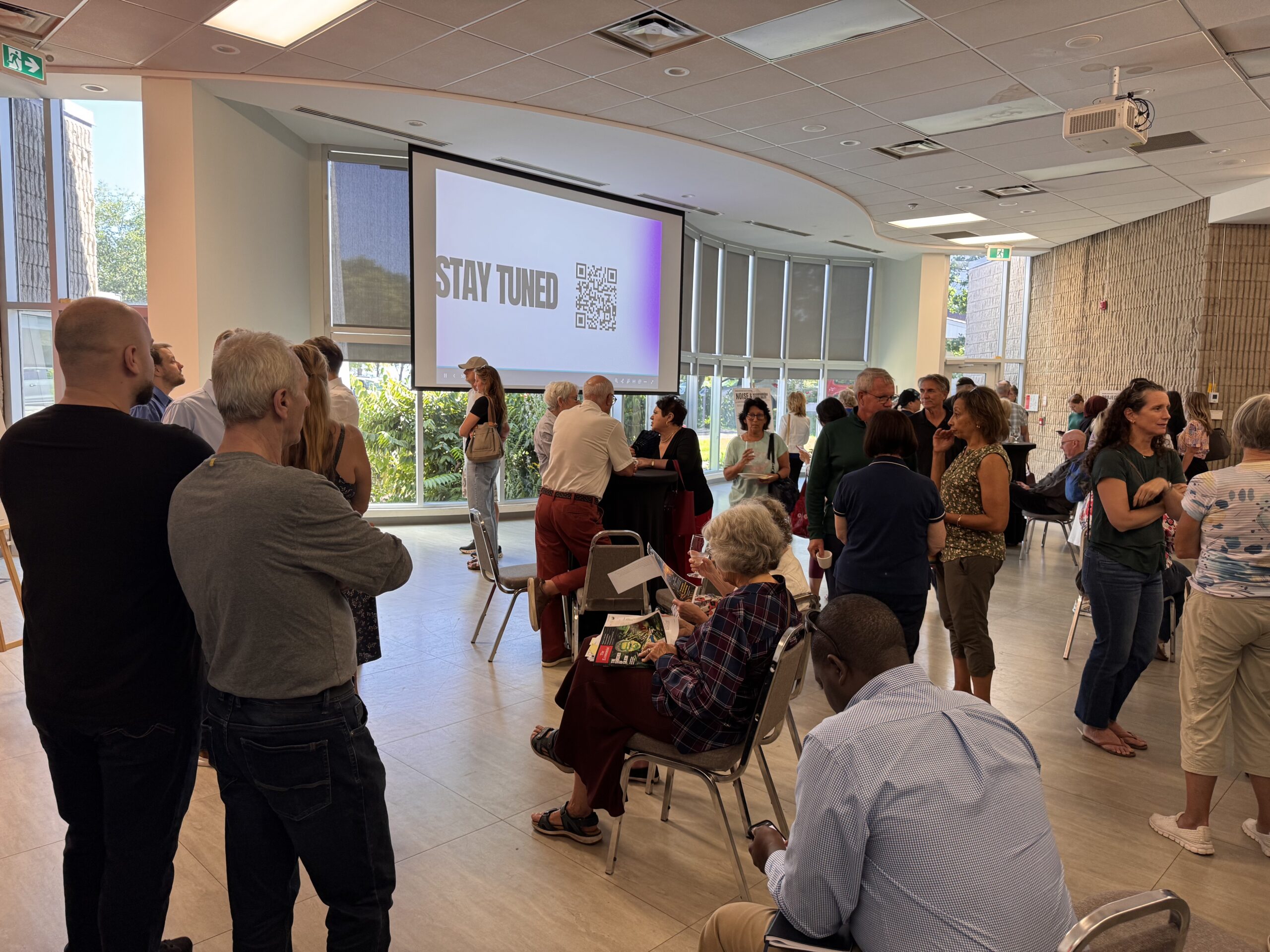
Residents gathered at the Art Gallery of Burlington (AGB) to learn more about a proposed 20-megawatt data centre at 3110 South Service Rd., with questions ranging from the format of the open house to the facility’s energy use and potential role in artificial intelligence. Powell Planning and Associates, the applicant behind the proposal, hosted the Sept. 11 open house.
Mikayla Woodward, a project management professional and CEO of Three Rivers Strategic Solutions, roamed around the AGB’s presentation room to speak to and field questions from attendees. Woodward is an independent contractor hired by Powell Planning and Associates as a consultant on the project.
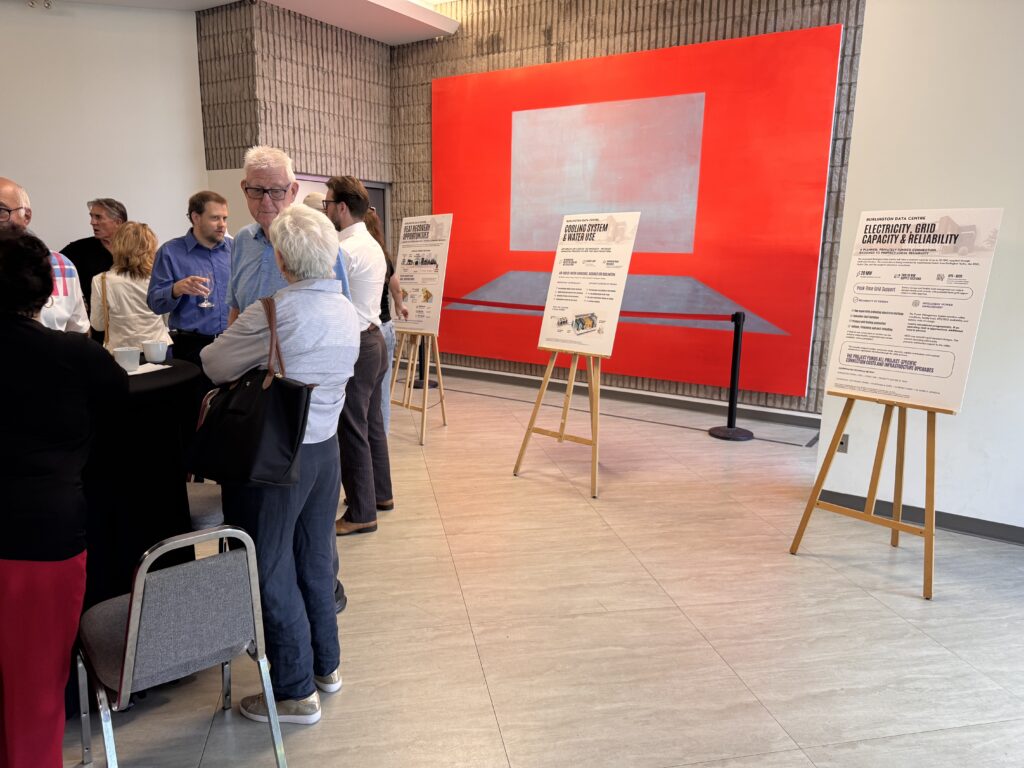
Many attendees were disappointed by the lack of a formal presentation at the event, which was instead populated by posters and a slideshow featuring facts about the proposal.
Woodward commented on the format.
“The reason we did it this way was that we really wanted to encourage more informal, one-on-one conversation,” Woodward said. “Rather than someone standing at the front of the room with a microphone giving a presentation that has the same information as everything that’s online and everything that’s already been shared with the public.”
Woodward said that the planning group wanted to invite more open and honest conversations and allow residents to give direct feedback on what their concerns are.
Representatives from the city were present at the event, including Planning Commissioner Stephen Robichaud, Ward 5 Councillor Paul Sharman, and Mayor Marianne Meed Ward.
Meed Ward, who arrived late to the event due to an emergency, said that while there are benefits to the format, she suggested that the applicant have a formal presentation and said that residents’ frustration was valid.

“People didn’t really know who was who in the room,” Meed Ward said. “Who was the planning staff, who’s the applicant, who should they talk to. I did think that the community would want a presentation style followed by questions, but the applicant wanted to host this. I’m just glad that there was an opportunity for the community to come out.”
Woodward said that there is a lot of misinformation online about the details of the development.
“I’ve had multiple people come up and ask me if we’re draining the water from the lake,” Woodward said. “And the fact is, in this project, it’s an air-cooled data centre, closed loop, everything like that. We want people to understand that this data centre is very different from the hyperscalers that they’re building in the U.S.”
“This one’s very small, only 20 megawatts,” Woodward continued. “It has multi-use co-location options and opportunities to work with local universities. We want to prioritize local businesses and give back to the Burlington economy, rather than being a large-scale AI training data centre company.”
Woodward said the data centre isn’t powerful enough to train large language models and would not be purpose-built for AI.
“A lot of people use AI in their everyday lives for doing day-to-day work and things like that,” she said. “And if it’s in their data, it has the opportunity to be stored in that data centre, but it’s not training AI or anything like that.”
Woodward said that data centres are “essential” to the community and that it’s “important for us as Canadians to be building our own data centres.”
“As of right now, there are data centres in Canada, but not to the extent that there are in the U.S.,” Woodward said. “A lot of your data is being housed in the U.S. and in other countries. This provides the data sovereignty piece for Canadians. Would you not feel more comfortable having your data stored here in Burlington rather than in the U.S. or China?”
Meed Ward said that all levels of government need to be involved in the regulation of AI.
“We have limits on our legal jurisdiction,” Meed Ward said. “Our staff are required to process applications that come in and review them. That’s what they’re doing. The provincial and federal governments…that’s where the power for significant action is. Especially as both levels of government are really inviting data sovereignty and wanting innovation in the use of AI.”
Meed Ward said both the provincial and federal governments have a “corresponding obligation” to make sure that AI infrastructure is “safe for our community, appropriately located and regulated in a consistent manner.”
Meed Ward said that staff are reviewing everything that has been submitted by the applicant and can “turn this down if they are not satisfied that proper information has been provided.”
The city says data centres are already a permitted use at the property and that the site plan review focuses on technical details of the proposal.
“They can accept it if they feel that it meets guidelines and is an appropriate use, or they can attach conditions,” Meed Ward said. “Any of the three is possible, and that’s true of any application. This is reviewed as an industrial use, so there are significant standards around noise, environment and other matters.”
Meed Ward said that there are more than 22 studies that staff will be reviewing, which have also been posted online for residents to read.
Meed Ward said that although council rejected a moratorium on data centres, which she supported, they did pass a motion prioritizing regulations and policies regarding data centres in the city’s next Official Plan review in 2027.
“Council also unanimously supported my advocacy to the province and the federal government that we can’t do this in a piecemeal way,” Meed Ward said. “Our energy use and draw will affect people around us and vice versa. We all share the same air. We’re all in this together, and we know that while this is the first one in Burlington, and relative to the hyperscale, it’s small. But we can anticipate that there will be more coming, whether in Burlington or in the region. So we need to be prepared.”
Meed Ward said that one of her biggest concerns about the development is the draw on power.
“Do we have enough for all the demands?” Meed Ward asked. “We’ve got electric vehicles and buses, and we have to transition from gas to electricity to reduce our carbon footprint. These are all things that are priorities to us in an era of climate change. So we really have to be careful about how we are allocating and prioritizing our energy use.”
Meed Ward said that if residents didn’t get satisfactory answers to their questions, they could follow up directly with her, the city’s planning staff, or the applicant.
“We want to make sure that people get their questions answered about this specific use, what comes next, where we are in the process, and how they can provide their input,” Meed Ward said. “Questions and concerns that residents have raised are really valuable to this process.”
Council hopefuls Sean Campbell, running in Ward 2, Tony Brecknock in Ward 4, and Rowen Fraser in Ward 6 were also in attendance.
Fraser said he is very supportive of the data centre and that the way news of the development was disseminated to the community was “very irresponsible.”
“First of all, it was billed as an AI data centre, which it is not,” Fraser said. “It is an enterprise co-location centre for data storage and data services. And secondly, it was brought up as, ‘We should be worried because they’re trying to sneak this AI data centre into our city without telling us anything about it.’ And the reality is that no one really asked. Because when I contacted Powell Planning and Cuadro Arch, the first question I asked them was, ‘Did anyone from the local government or any of the candidates for local government contact you about this project?’ And I was the first one to do so.”
Fraser also said that he believes that there is a lobby with a vested interest against data centres that is “contributing to that noise.” He said that the data centre will represent roughly “two to three hundred homes worth of residential taxes for the city in one facility.”
“It’s a step towards offsetting our very high residential tax increases of late,” Fraser said. “It also signals to the investment community that Burlington is a place where they can come and have their projects’ growth supported. I think it would be a very big mistake to say that this type of project is not welcome here, just as a blanket. Instead, what we should be doing, like we have with this project, is evaluating it based on its merits and the behaviour of the planning and architectural firm.”