By Jack Brittle, Local Journalism Initiative Reporter
Last week, the Burlington Public Library hosted a speaking engagement as part of Burlington’s annual Heritage Week, exploring the history and stewardship of the waters surrounding Burlington and Hamilton.
The event, entitled “Special Presentations on the Water Around Us,” featured two speakers: Mark McNeil, a retired journalist with The Hamilton Spectator, and Kellie McCormack, acting senior director of watershed management and climate change at Conservation Halton.
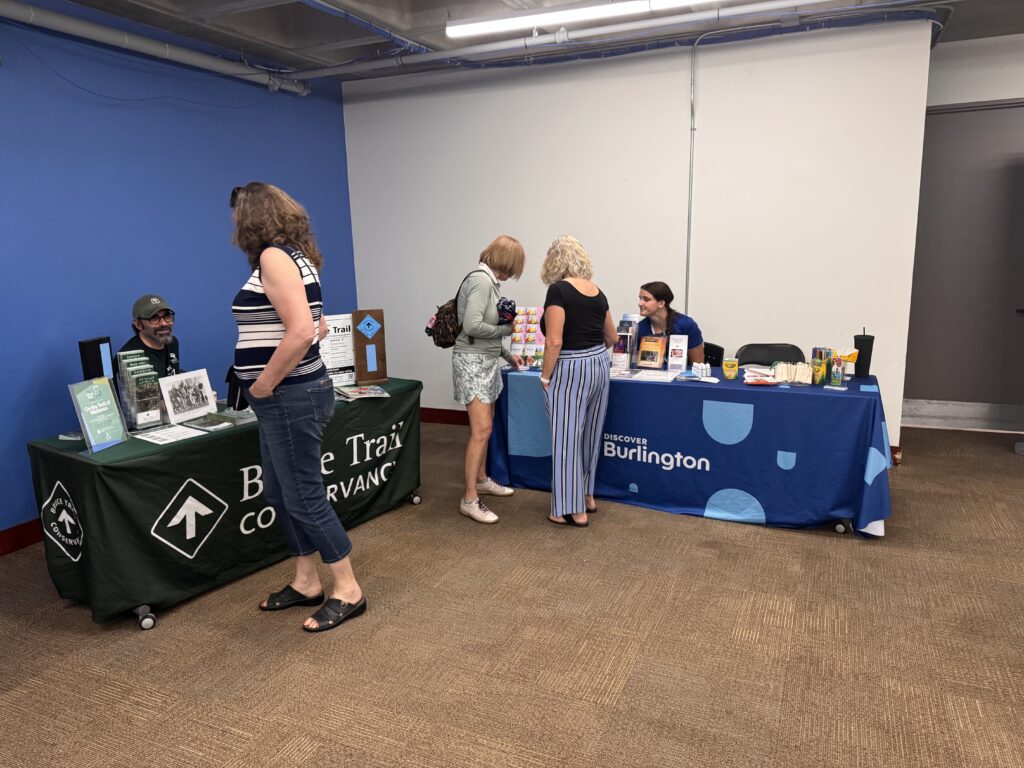
Various community organizations also had booths set up around the library’s Centennial Hall, including Bruce Trail Conservation, Discover Burlington, the Burlington Historical Society, Conservation Halton, Heritage Burlington, and Burlington Public Library itself.
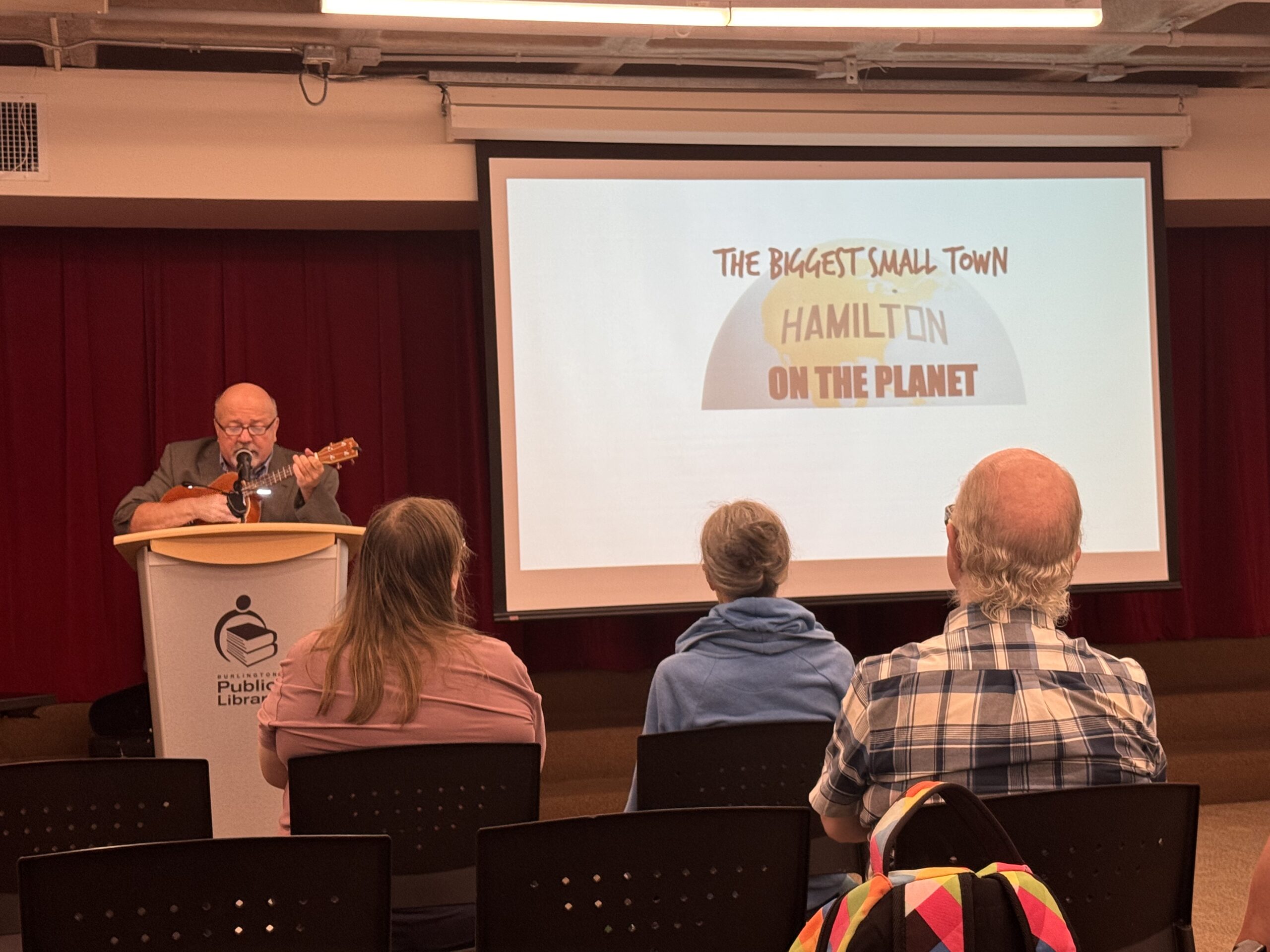
In his presentation, McNeil told various stories about events in and around Burlington Bay and Hamilton Harbour.
McNeil spoke about Ben Kerr, a prominent rum-runner in Hamilton during Prohibition, who lived on Bay Street North, and Rocco Perri, the bootlegger who many believe to be associated with Kerr’s murder, who lived on Bay Street South. Perri went missing after he went for a walk in 1944, and many believe his body is in the bay.
According to McNeil, there was a 1954 RCMP report that contained the statement, “Won’t find his body until the bay dries up.”
He also spoke about the Hamilton mayor’s chain of office and its connection to the bay.
“It went missing back in 1992,” McNeil said. “The mayor at the time, Bob Bowman, used to wear it all the time, and then suddenly it disappeared. He said that it got stolen, but many think he got mad one day and tossed it in the water. So the chain of office may be out there with Rocco Perri somewhere in the murky waters of Hamilton Harbour.”
In the 1970s, the bay was labelled an area of concern by the International Joint Commission, a designation that it still carries to this day.
“There were three interesting high-profile swims in the harbour between 1975 and 1994 that became national news,” McNeil said. “The idea was to show that the harbour waters had vastly improved. But the scientists did not go along with this. The first [swim] was Burlington South MPP and Minister of Environment George Kerr in 1975. Bob Morrow, the mayor of Hamilton at the time, went in in 1985, and Sheila Copps in 1994. Now, they all survived, but it came out later, in Bob Morrow’s case, he actually went out and got several vaccinations beforehand. He liked the symbol of it, but he wanted to be protected. And it was particularly funny with Sheila Copps. She showed up in a wetsuit. That kind of changes things a little bit, I think.”
McNeil spoke about a community called Shacktown located in Cootes Paradise.
“It was a makeshift community of more than a hundred ramshackle shacks and boathouses in Cootes Paradise, where people lived kind of on the fringes of society. I think it’s kind of reminiscent of today. It was tolerated for a long time because there were a lot of concerns about fire, disease, and social disorder, and many wanted to close it down, especially through the Depression years. Eventually there were plans to beautify the area, but it never came to be, and it was removed by the 1950s.”
In the 1990s, McNeil was on a committee to name what is now known as Bayfront Park.
“The City of Hamilton decided to have a contest to come up with a better name,” McNeil said. And the Spectator was involved in that. We reached out to readers to make submissions.”
“There were three of us: a Colborne police chief named Colin Miller, a columnist from the city named Bob Sutcliffe, and I,” McNeil continued. “Some of the names that came in were ‘Hamilton’s Heavenly Haven,’ ‘Sheila Cox Memorial Park,’ ‘Stelfasco,’ and ‘Pud’s Point.’ We debated for hours to come up with a name; it was kind of like that movie 12 Angry Men. Finally, out of desperation, I said, ‘I think we’re trying too hard to be clever here. There’s a bay behind the park and a Bay Street in front of the park. Just call it Bayfront Park.’”
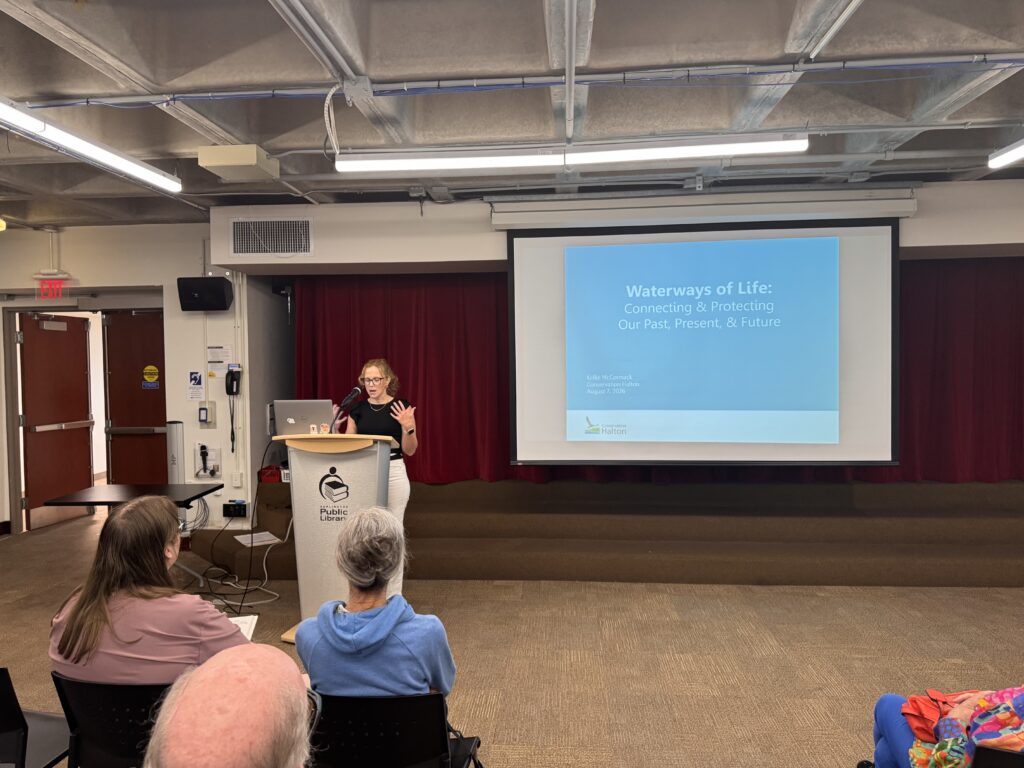
McCormack then spoke about the management of Burlington and Hamilton’s bodies of water. She described water as a “shared responsibility.”
“It takes a lot of people and a lot of partners to work together to manage and protect these resources,” McCormack said. “It takes Indigenous partners, municipalities, community groups, landowners, businesses, and residents.”
She noted that most conservation authorities in Southern Ontario were established after Hurricane Hazel hit Canada in 1954.
“It displaced about 4,000 families, 81 people lost their lives, and entire streets and homes were swept away. And I think that disaster really exposed the truth that development had been allowed in places that nature wanted to reclaim. It mobilized the need for managing water on a watershed basis, and it’s the foundation of the work that we do.”
Together, the presentations offered both a look back at the stories that have shaped Burlington and Hamilton’s waterways and a reminder of the ongoing work required to protect them.