By Maisha Hasan, Local Journalism Initiative Reporter
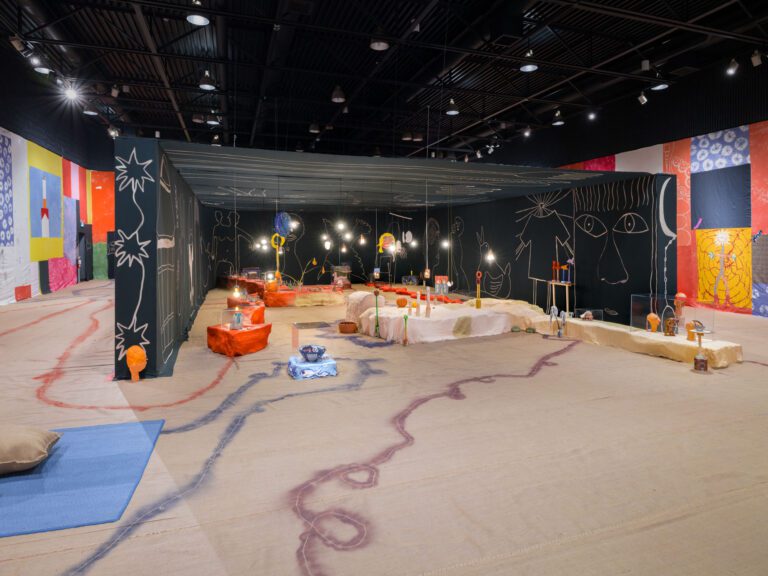
Some artworks remain static, unchanged with each viewing — untouched and undisturbed. Celina Eceiza’s exhibition “A material called Earth, Volume I: The life of corners” confronts these ideas. It is a world unto itself, spanning from the ground up to the ceiling, with every inch sewn, stitched, and crafted. The audience becomes a part of the exhibit, encouraged to thoughtfully touch and explore.
Eceiza emphasizes the idea of collaborative work, not only through the large-scale fabric books she created and incorporated into the exhibition, one titled El artista nunca piensa solo (The Artist Never Thinks Alone), which examines the multiple artists who influenced Eceiza’s style, but also through sculptures from the Art Gallery of Burlington’s own collection — and, according to the artist, literal trash from Burlington itself.
The exhibit is on view at the Art Gallery of Burlington (AGB) through August 16, when it will then travel to Halifax, going to the Mount Saint Vincent University Art Gallery.
In this interview, Eceiza and independent curator Sylvie Fortin, the curator behind “A material called Earth,” speak about the AGB exhibition and break down the behind-the-scenes work and themes.
This interview has been edited for length and clarity.
The exhibit feels like stepping into a new world. How did that sense of immersion come to be?
Eceiza: I’m always building a work that responds to the previous one. It’s always something that grows. It has this fertility. In this case, there were two things that were the main starting point. One was the space itself, which has this shape in the middle. I thought this would be a whole room experience. The second thing was, when I started to talk with Sylvie, she told me that it [AGB] was well known for its collection of ceramics. I [became] really interested in working with ceramics because in all my latest works, I try to start also with something that is already there…the idea that the artist never thinks alone. I chose the pieces that I would love to do, if I could. Fortunately, other people could do it, so I’m not alone in the world. Other people are also connected to my work and to my practice.
Collaboration is central to this exhibition — from recycled materials to local contributions. What does that collaborative process look like?
Eceiza: I worked for almost a year in my studio, and I’ve been here for almost one and a half months. I’m also working with recycled materials. That is something that I love to do. Not only because of the political action of recycling in this world that is generating a lot of trash, but especially [because] art generates a lot of trash. When you dig into the trash, you also understand how other countries consume. It’s really different — the packaging, the sizes — from where I come, Argentina. At the end, one whole piece is always united, always connected. Everything leads to the other. You know, sometimes when I take the pieces out, it’s like they lose something. And when they come back, they rebuild. I think it’s a work also of connection in every meaning, connection also with the other, because it’s a work that allows you to do almost anything you want. You can touch it…you’re going to be on top of the paints. You’re going to touch books. But that also requires a commitment of care.
Every time you open this exhibit, you invite other local artists and works to participate. How do you balance that newness with the solid vision you want to present?
Eceiza: If you asked me 10 years ago, I would tell you it’s impossible for someone else to do my work. I know how to do it. It’s not transmittable. I had to learn that the other [artists] had a lot to give, and it’s really part of that nutrition. I learned a lot about my work in this last year by working with others, and at some point, be conscious that I’m the one who gives the directions, but the others also have [input]. I think it’s also really important to take care of the energies of others. Their energy has to be put also in their personal work. It’s good to set the limits of what the other [artists] can do. I learn a lot of techniques. Everything I know of sculpture is because I did everything bad in the beginning and I started to work with someone that helps me and teaches me. I try to be as conscious as I can in terms of everything, of the materials that I use and also the people that I work with.
What was the behind-the-scenes process of putting the exhibit together?
Eceiza: I do almost a rough collage in SketchUp that allows me to know how the work will be, how much material I need. The first thing to do is the dirty work, then the sculptures with the plaster and the water. You start to hang the fabrics and then enter the people who sew. So it’s always a process that starts to cross [over and mix together], but it’s important because there are a lot of things to do. It’s also important when people come to know what show they are assigned to.
What has taking on this project been like as a curator?
Fortin: Celina and I had worked together on two occasions before. I really wanted to bring her work to Canada. I wanted to bring it here now because Celina works in a way that is very, very different from the ways in which Canadian artists work. I was particularly interested in bringing the ways in which her work operates in different economies. Making an exhibition is world-building. With Celina, each exhibition is welcoming people into a possible world, one that is very different from most exhibitions and showing us an approach that is humble in terms of its materiality. I mean, the work came here in suitcases. So you saw the scale of the project, and that’s coming out of five or six suitcases versus usually big trucks and everything that goes with art shipment. As a curator, I’m always thinking, “What does this project do to the field of curating?”, which matters to me. While we use the term “touring” show, I’m using the term “moving” rather than “touring.” A touring show [is] parachuted in and it is lifted out, it leaves no trace. It’s just filled with real estate and time without really granting or giving anything. I think the kinds of projects that we do are very careful about what brings in and really careful about how this will impact for some time, the people that have experienced it. Bringing these questions into a curatorial conversation at this moment, for me, is a really important political move. It puts a little bit of pressure on institutions, which I think is really important.
Your exhibition occupies the gallery in such a physical, immersive way. What does it mean to create a space that audiences move through rather than simply observe?
Fortin: I don’t think that we’re taking up space, I think that we’re opening up space. This is not a world in the future. It’s the world that is here now, but maybe sometimes we can’t see it. I think that Celina’s work brings together this notion of the collective in a way; having the collection artists, the artists that she has in one of her books, all the people putting the exhibition together, this is what is making this world, this exhibition possible. It’s opening a world but the world that is here now. It’s kind of aligning things in a different way to create possibilities.
Eceiza: It seems more complicated than it actually is. This institution, in particular, has been quite free in terms of what we can do, but usually, institutions are super restrictive. Sometimes you just have to push a little bit in order to do something new. In terms of bonds, I try not to take for granted what I already have. It’s not just provoke to provoke. Yes, we can do this, but what if we also bring the idea of something new to the institutions? I love to work with institutions. I think that institutions like this, or museums, make sense to the artists, or at least to my practice, because when there is more of a commercial project, it has another mission. But this, it tries to connect to the community.
For Eceiza, the exhibition is not a finished object, but a constantly evolving space shaped by the materials, artists, institutions, and audiences that encounter it. At the AGB, A material called Earth offers visitors the opportunity to step inside that process and experience art as a collective act. The exhibition remains on view until Aug. 16.