By Jack Brittle, Local Journalism Initiative Reporter
Burlington council approved a framework to guide future data centre development and rejected a proposed one-year moratorium at its July 21 meeting, which saw an unusually high level of public interest, with 16 delegates speaking to council about the issue. The proposed centre remains in the site plan approval phase.
The city has received a proposal from Powell Planning and Associates to build a data centre on the former Mother Tucker’s/Tucker’s Marketplace site at 3110 South Service Rd.
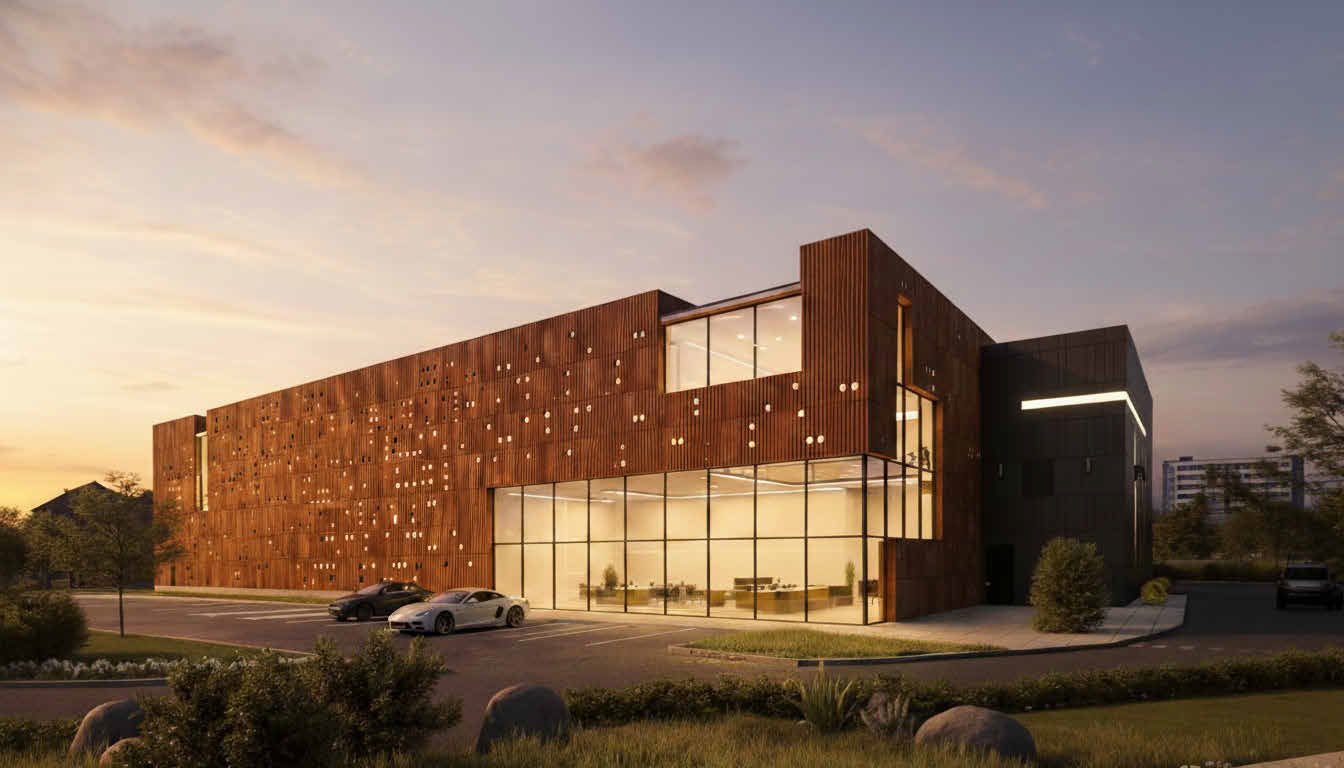
According to the city, the proposal includes a two-storey data centre with a gross floor area of approximately 5,163 square metres, and will require approximately 20 MW of electrical capacity.
The city’s website outlined the part that staff and council play in the development process.
“The City’s role is to review the application against applicable planning policies, technical requirements and municipal standards,” the website read. “Staff will assess the proposal and supporting technical reviews before making any decisions.”
Amy Schnurr, co-founder and executive director of BurlingtonGreen, delegated to council and shared information from an article entitled The Future of Data Centres in the GTHA and Ontario Project, co-authored by Mantle Climate and MaRS.
“The article highlighted that Canada ranks fifth globally in data centre density, with the GTHA [Greater Toronto and Hamilton Area] as the epicentre of this growth,” Schnurr said. “The authors emphasized a defining question: Can we build this infrastructure to strengthen our energy system and communities, or will it work against them? The report indicated yes, but only if we design for low-carbon outcomes and build trust from day one.”
Schnurr said data centres could triple their emissions by 2035, potentially accounting for 7.3% of Ontario’s electricity-generation emissions, with the GTHA accounting for about 10% of regional emissions.
She also outlined community costs, such as “ strain on local grids, air quality, housing affordability, and energy bills for residents,” as well as “backlash and growing scrutiny.”
“Decisions made in the next three to five years will therefore, unless major new clean generation comes online, determine whether AI infrastructure growth strengthens or strains Ontario’s energy systems and communities,” Schnurr said.
Schnurr said that she looked over many letters submitted to the city about the data centre and quoted one from a resident, which said, “Burlington should not allow its first AI data centre application to become the precedent simply because the city has not yet created the rules required to regulate it.”
Schnurr said that without regulation, data centres could negatively impact the city in many ways.
“Without rules, data centres could lock in fossil fuel dependence and strain our grids, making it harder to hit the established net zero targets,” she said.
Schnurr said that although the city has three separate climate plans, they were all written before the proliferation of AI data centres.
No AI features are currently planned for the proposed development, which would also be air-cooled.
Nathaniel Arfin, a digital consultant who previously worked as a special assistant in the Office of the Prime Minister and an AI product manager for DraftKings, voiced his support for the development.
“I’m really frustrated that I felt the need to come into council today,” Arfin said. “A lot of people feel that they don’t have the information, and I don’t think that that is their fault, but I do feel that they were unnecessarily made to panic about a situation that would have been resolved had it gone through the normal channels. Now, Burlington staff have had to step up and put out emergency communications in response to public outcry.”
Arfin said that if Canada doesn’t invest in AI infrastructure now, we will be left behind.
“The United States has already used an export control measure to prevent state-of-the-art models from being used in Canada and elsewhere in the world,” he said. “China is discussing raising prices on their open-source models that they serve through inference. The United States is now again talking about preventing companies from processing those Chinese open-weight models on their servers. If that happens, the impact to Canadian businesses will be immediate and severe.”
“AI is integrated into our economy already, whether we like it or not, and we need compute,” Arfin continued. “Right now, Canada is last in the G7 for publicly available compute.”
Arfin said that because sufficient regulations already exist at the provincial level, council should not be getting involved.
“The federal government has set out on a mission to make Canada AI-native,” Arfin said. “Burlington is part of that, and I’m frustrated that we are here trying to push back against a business that has followed all the rules.”
Later in the meeting, council discussed item 18.1, a motion memorandum on “Policy Framework for Municipal Decision-Making regarding the Deployment of Data Centres in Burlington,” which was brought forward by Ward 2 councillor and mayoral candidate Lisa Kearns.
“This motion is about preparedness,” Kearns said. “As council, we’re often called upon to make decisions on emerging industries and technology that are evolving much faster than policies that govern them. Data centres are becoming essential infrastructure in our digital economy, and the communities around Ontario are already grappling with what they mean for land use, energy, water, infrastructure, and long-term economic development.”
“Burlington has an opportunity to be proactive about what’s ahead,” Kearns continued. “The motion is about ensuring that when and if more applications are set before us, we have done our homework, that we understand the scales, opportunities, the challenges, and the expectations of our residents who have indisputably shown that they want a voice on the matter.”
The motion directs staff to report back in December 2026 with a comprehensive framework including potential guidelines, policy amendments, compliance measures, bylaw updates, public engagement strategy, and advocacy, as well as with an interim information update outlining the city’s role in reviewing and evaluating data centre development applications, including applicable planning and zoning considerations, infrastructure requirements, environmental considerations, and any existing or potential standards related to energy and water consumption and community impacts.
It also directs staff to report back during the December 2026 Committee of the Whole meeting with a preliminary information report on the option of passing an Interim Control Bylaw
(ICB) motion imposing a one-year moratorium on new commercial data centre developments city-wide, including artificial intelligence facilities. The report would outline the estimated cost, scope, staff resources, and legislative considerations of such a bylaw, with an intended purpose of allowing the city to complete a municipal study and develop robust regulations, guardrails and standards around environmental, noise, and energy impacts, as well as definitions of both small-, medium-, and large-scale data centres.
Kearns explained the reason for the motion.
“The province has not established a dedicated regulatory or planning framework for data centre development,” Kearns said. “As a result, municipalities are increasingly being asked to consider proposals for a land use that presents unique planning, infrastructure, environmental, and community considerations. As planning for data centres represents relatively new territory for the City of Burlington, council would benefit from a clearer understanding of the city’s role, authority, and responsibilities in reviewing and evaluating future proposals.”
While the first four provisions of the motion passed unanimously, the clause regarding the moratorium failed 3–2, with Kearns and Mayor Marianne Meed Ward voting in favour. Ward 3 Councillor and mayoral candidate Rory Nisan and Wards 5 and 6 Councillors Paul Sharman and Angelo Bentivegna voted against.
Nisan said that an ICB would create further misinformation and set “unrealistic expectations” about stopping data centres.
“The federal and provincial governments are entirely in favour of having these data centres,” Nisan said.
Nisan also said that Burlington Hydro has confirmed it only has 20 megawatts of capacity available for a data centre and no capacity for more.
“There is not going to be another data centre,” Nisan said. “There’s not going to be a hundred-megawatt data centre. There’s no need for us to put in a job-killing interim control bylaw that will create an environment where people do not want to invest in our community.”
Item 18.2, another motion memorandum, this one brought forward by Meed Ward, was also passed unanimously.
The motion calls on the federal and provincial governments to work with municipalities and municipal associations to establish a coordinated regulatory framework with environmental, human, and community health safeguards, and infrastructure capacity and priority-setting for energy and water use, along with public disclosure requirements for the AI industry growth and development.
The debate continued after the meeting, with councillors issuing statements on July 22 outlining their positions on the framework and failed moratorium.
In her statement, Kearns said she was “incredibly proud of the Burlington residents and business owners who showed up in record numbers at Council,” and that council “owes residents confidence that investments deliver lasting value for Burlington.”
“That means balancing economic opportunity with fiscal responsibility, protecting neighbourhood liveability, and ensuring growth strengthens our local economy while respecting the character of our city,” Kearns said.
In Nisan’s statement released the same day, he called the approved portion of item 18.1 a “common sense framework governing data centres in Burlington,” and the failed clause a “costly one-year moratorium on data centre development.”
Nisan said that the framework will ensure that any data centre proposal in Burlington must “not cause community harm, impose no costs on taxpayers, not strain local resources; and provide tangible value for residents.”
Nisan claimed that Meed Ward and Kearns “turned their backs on the best interests of this city.”
“That is not leadership,” Nisan said.
Meed Ward said in her statement that the city’s top priority is “protecting our quality of life, and the public health and wellbeing of our entire community.”
The issue has also generated substantial discussion online, with hundreds of comments appearing on social media posts about the proposed development. An online petition supporting evidence-based planning for data centres and consideration of a one-year moratorium received 345 signatures before closing July 24.
The proposed development is currently in the site plan approval phase of the planning process.
The city’s website describes this phase as a “technical review process and not a public process,” during which the city reviews the proposed building’s location, servicing, parking, landscaping and other technical considerations.