
By Emily R. Zarevich, Local Journalism Initiative Reporter
Here is an ice-piercing question: How far would you go if your livelihood was threatened, your resources were depleted, and you were desperate?
This fall, Theatre Burlington opens its 2026/2027 season with Icemen by Vern Thiessen, a one-act theatrical stand against the oppressive soullessness of capitalism that has had people ruthlessly divided since labour and industry have existed. And this time, it’s so Canadian, it’s set in ice. Director Tim Denis teams up with producer Maureen Dwyer to carve out this compelling drama that dissects inequality down to its very veins.
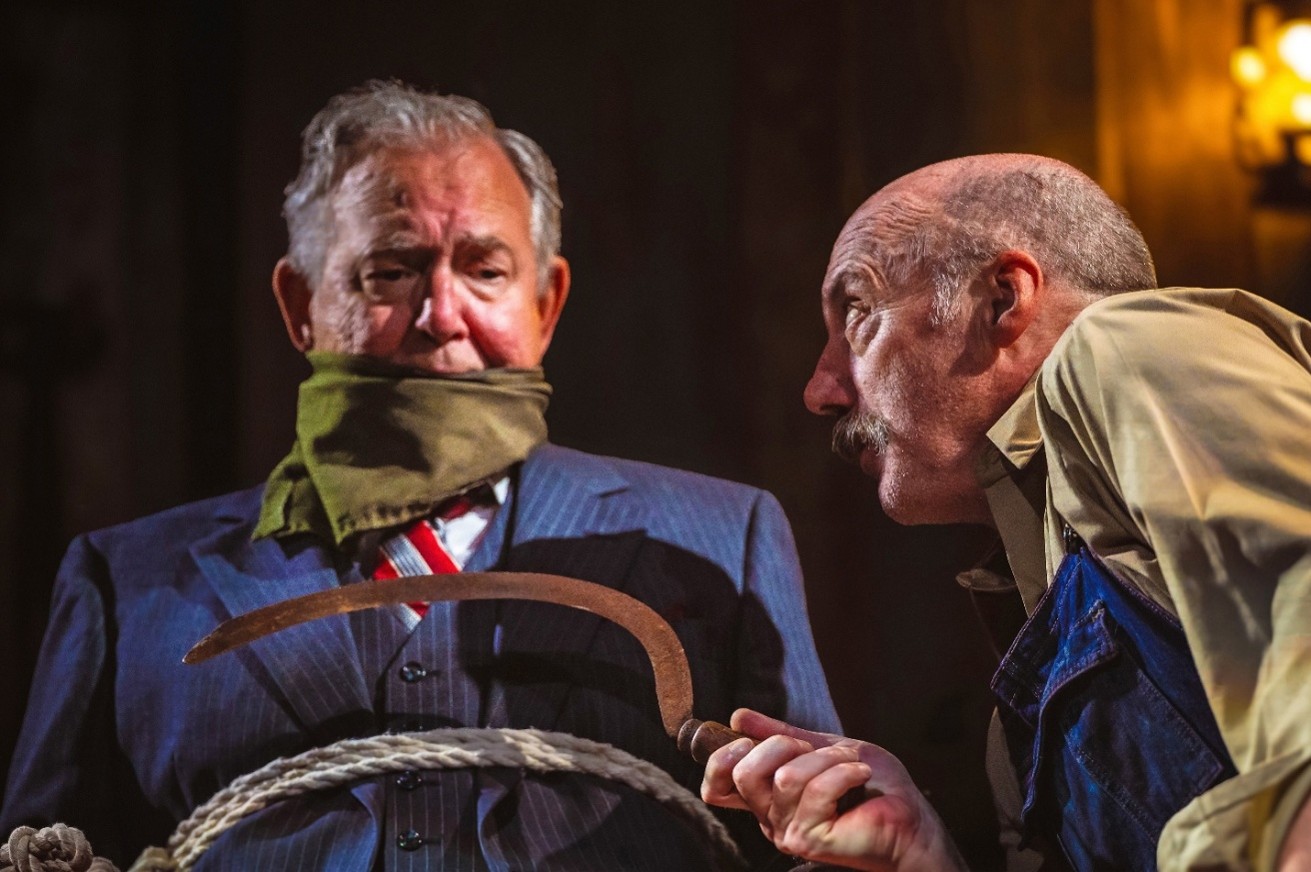
In the frozen Kempenfelt Bay in Simcoe County, two ice harvesters hatch a plot to take revenge on their rich boss, who is scheming on his side to replace them with new technological advances. Who needs ice anymore when the miracle of refrigeration is on the horizon? The workers will be okay. They can always find new jobs if they pull up their bootstraps. This line of thinking, incredible wealth, and professional prestige do nothing to save businessman Franklin Forsyth (F.F.) from being kidnapped and held hostage by his irate employees, brothers Joe (James Vezina) and Rennie (Brian Melanson).
Gagged and bound to a creaking chair in a derelict utility shed built by set designer Graham Clements and crew, F.F. has nowhere to run as the two vengeful working-class men force him to stand trial for all the sins of the greedy elite. Inside the shack, F.F. is stripped of all power and is just an ordinary man. Accusations are made, scores are settled, and if F.F.’s family and wealthy peers value his life, a hefty ransom will be paid. This is all set during the Great Depression, when the rich have a lot to answer for after the crash of the stock market. But the play continually asks its audience: Is the brothers’ extremism justified? A kidnapping is still a kidnapping. Threatening the life of another human being is still a crime. Audience members may feel unsure which moral stance to take.
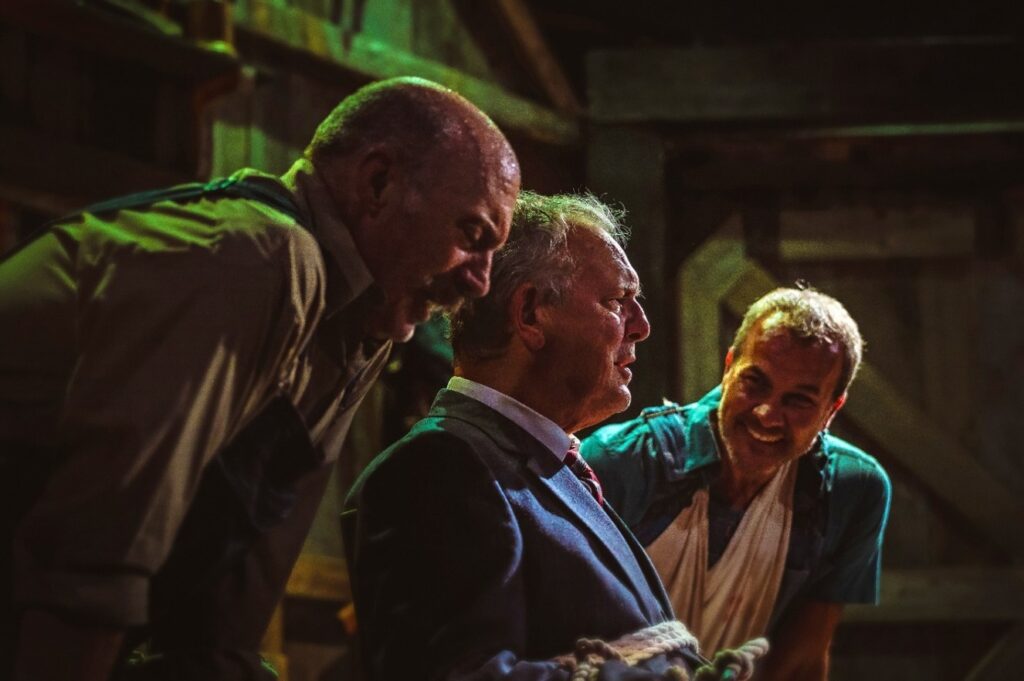
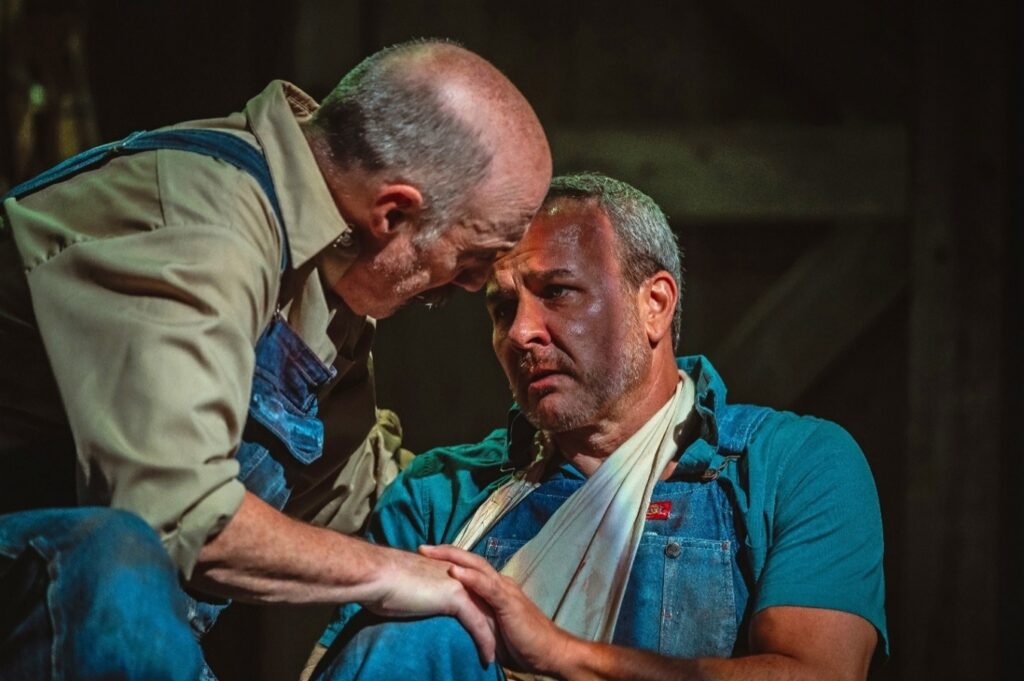
Thiessen’s heavy script, combative as a courtroom drama, doesn’t hold back. The writing is intense and hot-bloodedly confrontational. It presents a powerful radical agenda with only a little wiggle room for pro-capitalism arguments. Vezina, Melanson, and Flis match the brutality of the text with fierce, emotionally charged performances. They become their characters, slipping into opposing sides of the class war like lifelong enemies. Denis’s directorial style takes advantage of the acting trio’s talent for portraying complexity, especially Vezina as Joe, whose character undergoes some deeply unsettling sanity slippage. These characters are all villains in some way, and yet through twisted logic they’ve all cast themselves as the heroes of their own stories.
Playwright Thiessen’s creative decision to have F.F. tied to a chair for the majority of the play is more than just practical theatre blocking. It’s symbolic. A character who takes immense pride in his upward social mobility is forced by the script to stay seated, grounded, and finally meet his subordinates at eye level. He learns through involuntary means that the people whose jobs he’s eliminating overnight have names, families, and fears for the future.
Flis does a commendable job playing F.F.’s ambiguous empathy as he tries to connect with the brothers on a human level and strategically negotiate his way out of his predicament like a businessman. It’s a tactic that usually works for making money, but not necessarily for convincing financially struggling people that he deserves to hoard it.
Costume designer Helena Adamczyk outfits each of the three actors according to their characters’ social and economic status. F.F. was abducted off the street after drunkenly leaving a champagne-and-whisky hotel party, so he’s in a fine but rumpled tailored suit. Joe and Rennie are dressed as though they’ve just finished their shifts on the ice, in dampened, dirtied overalls and work shirts. Rennie, who is a much gentler soul than his more ferocious brother Joe, has been rendered disabled by a gruesome workplace accident, making him yet another forsaken worker in the Depression era who traded his physical health for pitiful wages. His stained sling, Adamczyk’s handiwork, carries more than his horrifically mutilated arm. It also carries the grief of a whole generation.
Icemen as a play scares its audience, as late-stage capitalism is scaring everyone right now. As workers face uncertainty over the rise of AI and the cost of living skyrockets, people are clinging to their current livelihoods for dear life. Thiessen’s stark writing serves as a warning. This extreme scenario, this climactic and violent stand-off between the classes, represents a possible dystopian future if something doesn’t change soon.
Attendees should be aware that Icemen is 90 minutes long with no intermission and should plan accordingly. Theatre Burlington is also pleased to announce that they are now offering assisted listening technology called Bettear for theatregoers with hearing impairments. Courtesy of a grant from the Slaight Family Foundation, Bettear streams a stage play’s audio directly into devices such as headphones and earbuds. It’s another positive step towards making live theatre accessible to all.
Theatre Burlington will be holding the final three performances of this chilling tale on October 9 and 10. After Icemen concludes its saga and the ice has melted, Theatre Burlington will prepare to stage its annual pantomime Sleeping Beauty and a production of the true-crime murder mystery How Could You, Mrs. Dick? Tickets for all the shows can be purchased directly on Theatre Burlington’s website.