By Kezia Royer-Burkett, Local Journalism Initiative Reporter
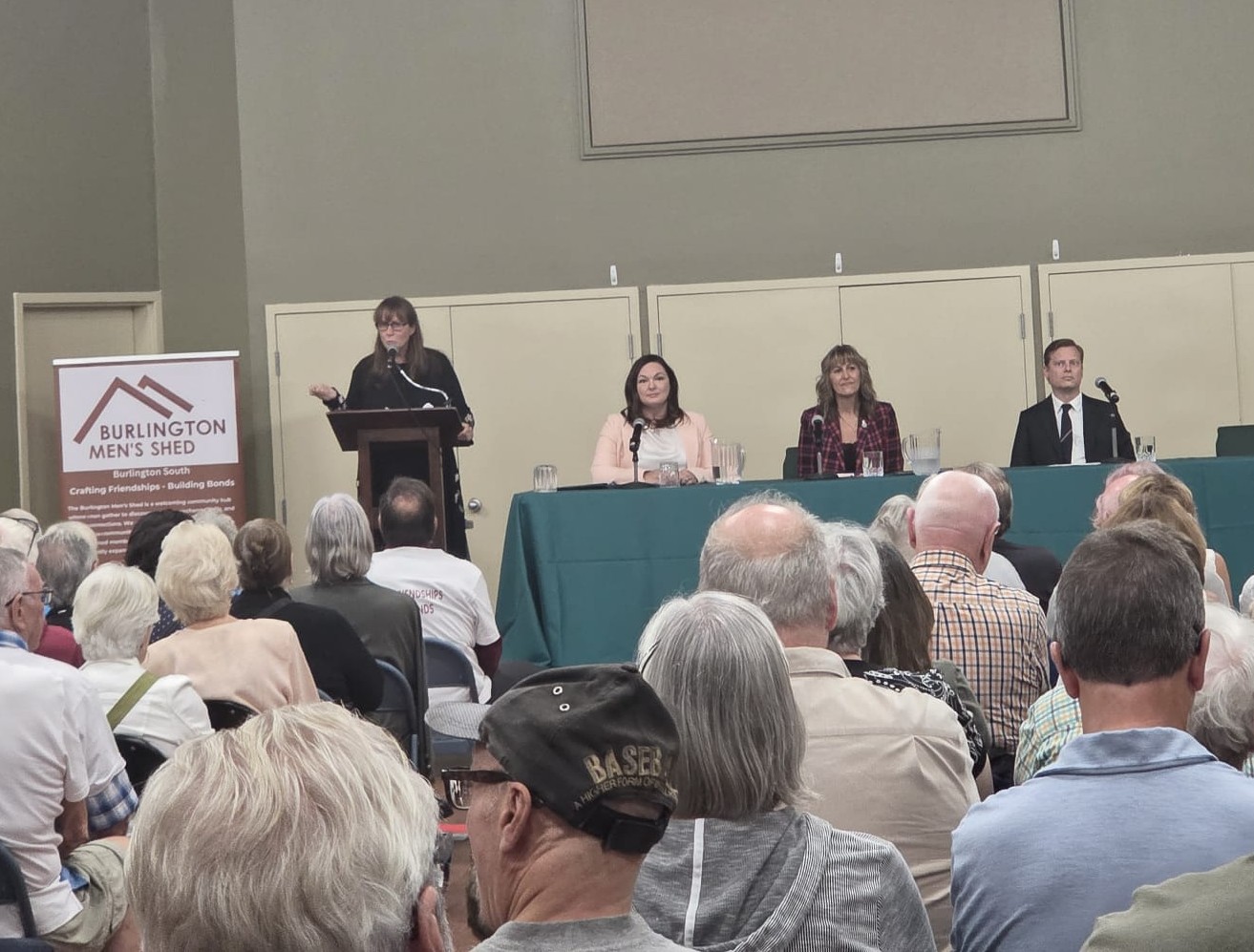
Burlington residents filled St. Christopher’s Church on Thursday, Sept. 17, for the first mayoral debate of the 2026 municipal election season, hosted by the Burlington Men’s Shed. The evening brought three of the city’s five certified mayoral candidates together, incumbent Mayor Marianne Meed Ward, Ward 2 Councillor Lisa Kearns, and Ward 3 Councillor Rory Nisan, to answer questions about Burlington’s budget, infrastructure, transportation, housing, economic development, public safety, and governance.
The Burlington Men’s Shed organized the event as an opportunity for residents to hear directly from candidates ahead of the October 26 municipal election. The group, which brings men together to build connections, develop skills and contribute to the community, also provided volunteers who helped with seating, sound, timing and other event logistics. The evening began with a ward candidate meet-and-greet, followed by the mayoral debate in the church’s main hall.
The September 17 event was the first of several opportunities for Burlington voters to hear from the mayoral candidates before the October 26 election. The City of Burlington has confirmed five certified candidates for mayor: Meed Ward, Kearns, Nisan, Keith Demoe, and Yugalkeesor Ramdhonee. Demoe and Ramdhonee were invited to the Men’s Shed debate but did not attend. According to Men’s Shed representative Lawson Hunter, Ramdhonee sent his regrets because of a conflicting event, while organizers said they received no response from Demoe after two invitations.
Rishia Burke, executive director of Community Development Halton, moderated the debate. Candidates were given two minutes for opening remarks before moving into a series of preselected questions, with additional questions submitted by members of the audience. The format did not include designated rebuttal time, meaning candidates who wanted to respond to another candidate’s comments had to use their own allotted answer time to do so.
Kearns was first to deliver her opening remarks, introducing herself as a councillor seeking to take on the role of mayor and outlining several themes she said would guide her campaign.
“Some of the things that we’re going to be talking about in my platform are critical to our path forward in Burlington,” Kearns said. “We want to preserve our past while being ready for the future; we want a budget for fiscal accountability and drive up that value. We want safer neighbourhoods. We want to see a reset at City Hall for sure.”
Meed Ward followed, focusing her opening remarks on collaboration, civic participation and her record on council. She pointed to what she described as a high level of agreement among council members during her time as mayor.
“Thank you so much for coming tonight and being part of a thriving democracy,” Meed Ward said. “One of the things that I know for a fact about the people of Burlington is that you show up, you care, you stand together, and we get good things done together.”
Meed Ward said that 91% of council votes over the past eight years had been unanimous and described collaborative government as an important part of her approach to leadership. She also spoke about her commitment to governing with respect, saying she entered politics with other women who believed “politics should not be a blood sport.”
Nisan was the final candidate to deliver his opening statement, centring his remarks on affordability, taxation, housing, and what he described as the need for greater fiscal responsibility at City Hall.
“Burlington’s promise is simple: if you work hard and play by the rules, you can get ahead and build a great life here today,” Nisan said. “That promise is slipping away.”
Nisan pointed to higher taxes, housing affordability, and the growth of the municipal budget as concerns, while highlighting several council votes where he said he had opposed spending or decisions he disagreed with. “That is my record,” he said. “I fought for fiscal responsibility every single time.”
One of the first major areas of discussion was the province’s Strong Mayor legislation, which gives Ontario mayors additional powers, including the ability to appoint or dismiss the city manager, propose the municipal budget and, in certain circumstances, veto bylaws connected to prescribed provincial priorities.
Kearns argued that the powers have created an imbalance at City Hall and said the relationship between the mayor and the city manager needs to involve council more directly. She pointed specifically to the turnover in the city’s top administrative position, saying Burlington has had four chief administrative officers during her two terms on council.
Nisan also criticized the concentration of authority, arguing that allowing one person to hire and fire the city manager represents a significant use of power. He said he supports removing Strong Mayor powers from Burlington and emphasized his view that municipal decision-making should involve council.
Meed Ward defended her approach to governance and pointed to her record of working collaboratively with council. She said the powers exist under provincial legislation and discussed how she has used her role while emphasizing the importance of working with council rather than governing in isolation.
The candidates also addressed the city’s budget and infrastructure needs, with the discussion highlighting different approaches to municipal spending. Meed Ward said Burlington needs to continue investing in infrastructure and maintaining assets in a state of good repair, arguing that delaying necessary work can result in higher costs later.
Nisan questioned the scale and pace of municipal spending and raised the cost of major infrastructure projects. Kearns said she was the only member of council to vote against the city’s budget and proposed greater scrutiny of spending, including reviewing consulting costs and establishing mechanisms for residents to report potential fraud and waste.
Transportation and traffic were another major point of discussion, particularly the timing of traffic signals and the city’s transportation planning. Nisan argued that better traffic light timing could help reduce congestion and improve residents’ quality of life, while acknowledging that infrastructure investments would still be required.
Kearns also supported changes to traffic signal timing and spoke about continuing community conversations through transportation town halls. She said Burlington’s transit plan has expired and suggested exploring pilot projects focused on first mile and last mile transportation options.

Meed Ward attributed some of the city’s transportation challenges to changes brought on by the COVID-19 pandemic, while saying traffic signal improvements had been part of her plans since 2018. She also pointed to a traffic congestion cost plan that received unanimous support from council.
Economic development and employment were also discussed, with the candidates offering different perspectives on what City Hall can do to support businesses. Meed Ward said Burlington has averaged approximately 500 new jobs a year and pointed to manufacturers and other businesses operating in the city that she said do not always receive public attention.
Nisan argued that attracting jobs and businesses needs to become a greater priority for City Hall. He connected lower taxes and faster development approvals with making Burlington more attractive to businesses.
Kearns proposed creating another Business Improvement Area and a 30-day business resolution program focused on addressing permitting issues. She said businesses need greater certainty and responsiveness when dealing with the city.
Data centres were also raised during the debate. Kearns said she was not prepared to give a simple yes or no position on data centres and wanted additional conversations about their potential impact. Meed Ward said she had concerns about the energy requirements associated with data centres and pointed to a motion she brought forward on the issue.
Nisan used the discussion to raise concerns about Burlington’s relationship with the provincial government, saying he believes the city needs to rebuild its relationship with the province to have greater influence on issues affecting Burlington.
Public safety and homelessness also generated discussion. Nisan said he supports having more police officers on Burlington streets while arguing that wraparound services can address some issues at a lower cost than relying exclusively on emergency responses.
Meed Ward pushed back on what she described as inaccurate claims being made about Burlington’s safety, saying the city and Halton Region remain among the safest communities in the country.
Kearns spoke about her desire for a reset at City Hall and raised the issue of transparency, including a lobbyist registry. The final portion of the evening gave residents an opportunity to ask questions, bringing the discussion back to issues directly affecting Burlington communities. Homelessness was among the topics raised, with the candidates outlining different approaches.
Kearns described her approach as compassionate but firm, while Nisan said homelessness requires both housing and wraparound supports. Meed Ward described homelessness as a state of emergency and said the response needs to focus on helping people move off the street through a compassionate approach.
With the debate complete, the three candidates left residents with different messages about the direction they believe Burlington should take, ranging from continued investment and collaborative governance to greater fiscal restraint, changes to municipal decision-making and a reset at City Hall.
More debates are scheduled before residents cast their ballots on October 26, 2026.