By Chloe Teixeira, Local Journalism Initiative Reporter
Burlington Performing Arts Centre’s annual Jazz on the Plaza series returned last week, bringing Canadian jazz artists to the outdoor plaza — and, through one performance, a message about peace, humanity and the ongoing war in Sudan.
This year marked the event’s 15th anniversary, with BPAC deciding to feature 10 artists in total over the three-day run, making it the biggest event of the series so far.
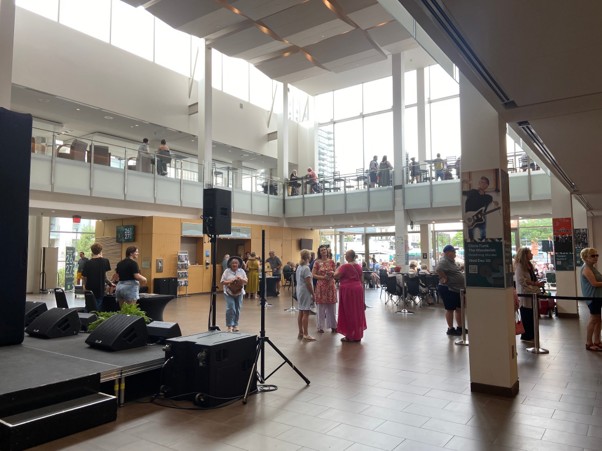
On the second day of the jazz event, crowds sat in the outdoor plaza area, while others enjoyed the performances from BPAC’s air-conditioned facilities and sipped drinks from the bar.
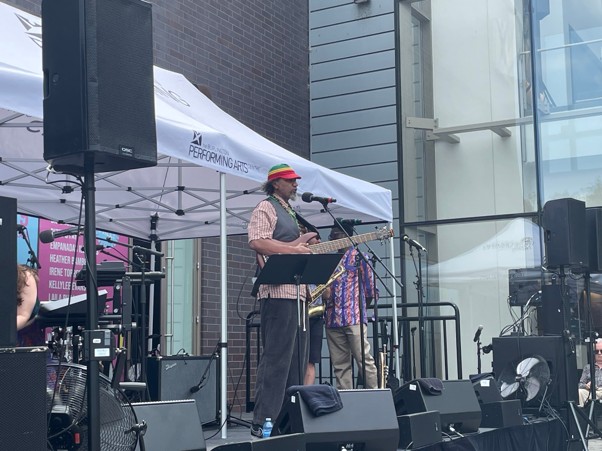
Among the five performers of the day was an ensemble called Waleed Kush. The band’s creative vision, according to their website, is to “combine ancient rhythms from Africa with modern jazz harmonies.”
The group delivered a passionate performance consisting of both original songs and covers, featuring instruments including the saxophone and trumpet.
Music and applause filled the air on Locust Street throughout the band’s set, with people also gathering outside the plaza’s barricades.
Bassist and vocalist Waleed Abdulhamid used the time between songs to speak about issues that surpass the city they were performing in. He expanded on the lyrics from their songs to speak on various topics, from peace and love to the war happening in Sudan.
He began by discussing peace and love in the context of the band’s 2023 song “Bora,” a word in Swahili, which Abdulhamid defined as “we believe the best of us,” or “we believe in the best of humanity.”
Abdulhamid also said that each person has a “department” inside of us, called “the department of humanity.”
“We just need to unlock that department and practice…every single day. [B]eing kind is the…easiest thing to do. And being outraged and upset and angry is a lot of energy.”
Abdulhamid emphasized his point by saying, “[Y]ou shorten your life,” going on to mention various studies he has seen in regards to how being kind and peaceful positively affects oneself.
Humanity was a topic frequently featured throughout the band’s set, through both the lyrics of the songs they performed and the words Abdulhamid spoke to the crowd.
Later on in the band’s set, Abdulhamid introduced the next song they’d be performing, called “Malaika.” People in the crowd got up to dance to this particular song, one that many recognized and seemed to connect with.
He explained that the Swahili word “malaika” means “angels,” and that its meaning remains the same among various languages.
Abdulhamid said the song was “made famous by two very important people, not only to the Black community or African community but also to humanity.”
One of these people, Miriam Makeba, Abdulhamid calls the “Queen of Africa,” because she was “exiled from her own land” and lived throughout the continent in addition to the United States.
According to U.S. National Archives, Makeba, also nicknamed Mama Africa, was a South African singer and civil rights activist “known for becoming the first African artist to globally popularize African music.”
The other person was Harry Belafonte, who Abdulhamid called “the king of the civil rights movement.” He also named prominent figures Martin Luther King, Malcolm X, and Muhammad Ali, in relation to Belafonte and the civil rights movement.
The crowd was united in this particular moment at the Burlington jazz event, as people applauded at the mention of the figures who were named.
Abdulhamid acknowledged the romance of the song “Malaika,” but said he was going to sing it in honour of both Makeba and Belafonte, who are “idols” for not only himself but for “young Black men and women.”
“They [were] freedom fighters. They march[ed] on the street, they fought, they did not back down, they never [were] shy about expressing and reporting what was going on in the U.S. with African Americans, or with the Africans on the continent as well.”
Toward the end of Waleed Kush’s set, Abdulhamid got more personal with the crowd, bringing a more local perspective to issues that lie beyond our borders.
He spoke about being from what he called “the most troubled country on the planet,” Sudan.
“I’m a child of war. I’m almost fifty-eight. I [was] born in the war, and [Sudan is] still [in] war as I’m entertaining you. It’s going on at this moment.”
Abdulhamid attributed this conflict to the country’s gold and uranium supply.
According to the Swissaid 2025 African Gold Report, “Sudan is one of the most important gold producers on the African continent.” In 2024, the country exported 31 tonnes of declared gold, equivalent to more than 6,000 pounds, according to the report.
The report also states that Sudan’s gold sector is “largely under the control of state apparatus and military factions” and that gold revenues have been used by both the Rapid Support Forces (RSF) and Sudanese Armed Forces (SAF) to finance the conflict since the war began in April 2023.
Sudan’s conflicts date back over 70 years, when the first Sudanese Civil War began in 1955.
In the current war, which began in April 2023, the BBC and Al Jazeera have reported that tens of thousands of people have died, while millions are displaced, experiencing food insecurity, and violence.
For up-to-date information on the war in Sudan, Global Conflict Tracker provides a comprehensive profile, including sources for the information they post.
Earlier in the band’s performance, Abdulhamid discussed two opposing generals in Sudan who he said used a phrase that means, “Let’s move forward.”
Abdulhamid said that for the two generals, the phrase, “Let’s move forward” means “destroy this village and go to the next one.” He described that when the two generals appear on national television, they talk about how much they “love this land,” Sudan.
“How, if you love the people, how [do] you kill them?” questioned Abdulhamid
He discussed the difference in his use of the phrase in comparison to theirs, saying, “I say, ‘Let’s move forward’ to build peace. Let’s have one goal, which is to generate and to construct loving for one another.” The phrase was repeated throughout the lyrics in the next song in their set.
Abdulhamid briefly discussed the diversity of Sudan, saying the country has over 350 ethnic groups, making it “very complex.” Despite the country’s ethnic diversity and complexity, Abdulhamid is sure of one thing: “Sudan mean[s] a lot to Black people.”
“We need it to be safe, we need it to be beautiful.”