By Jack Brittle, Local Journalism Initiative Reporter
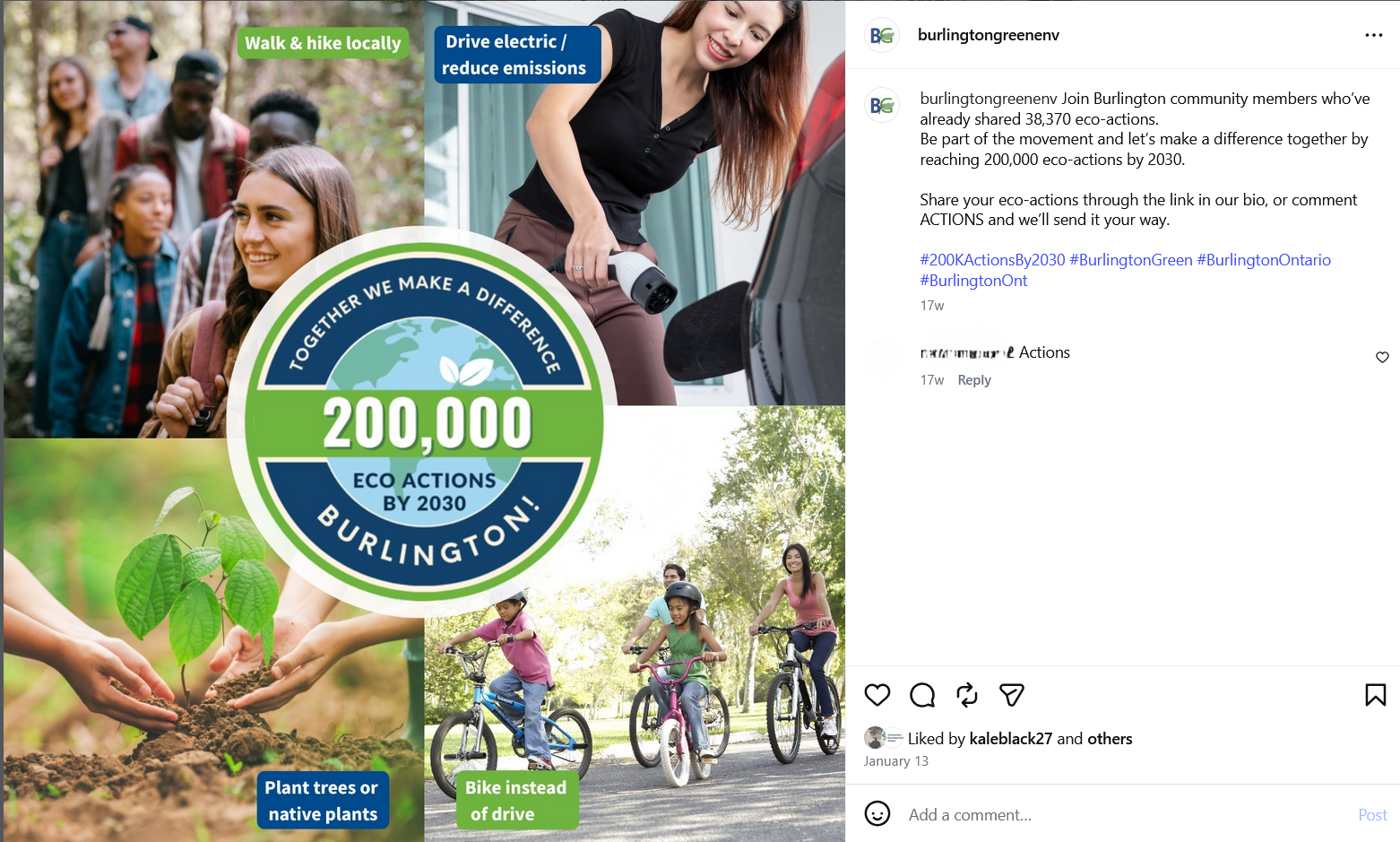
Since 2024, BurlingtonGreen has been tracking what it calls “eco-actions.” Its goal is to have the city’s residents complete 200,000 eco-actions by 2030.
A press release from the organization listed examples of eco-actions, such as walking or biking instead of driving, reducing household waste and energy use, planting trees or pollinator gardens, and purchasing second-hand items.
Currently, over 64,600 eco-actions have been tracked on BurlingtonGreen’s website.
Manuela Perez Guzman, marketing and communications coordinator for BurlingtonGreen, said that the inspiration for the campaign came out of the “escalating urgency for greater environmental action.”
Perez Guzman said that the 200,000 goal is based on general estimates BurlingtonGreen made regarding “a portion of the number of people or groups we typically reach or engage with each year, while factoring growth and new audiences, across the 5-year campaign period.”
She said that many eco-actions are things that residents may not immediately consider environmentally friendly, such as walking instead of driving, air-drying laundry, and eating plant-based foods instead of meat.
The press release stated that the initiative is “rooted in BurlingtonGreen’s longstanding belief that together, we make a difference.”
Amy Schnurr, executive director of BurlingtonGreen, spoke about the campaign.
“Environmental issues can feel overwhelming, but meaningful change happens when everyday actions are taken collectively,” Schnurr said.
Burlingtonians can either submit their eco-actions on the BurlingtonGreen website or on a physical panel at a BurlingtonGreen event.
The panel has five topic areas: transportation; homes and energy; waste; nature and biodiversity; and lifestyle and leadership, with each topic containing six to eight actions.
Perez Guzman said that BurlingtonGreen just updated the panel to include 14 additional eco-actions, and that participants are welcome to add their own eco-action to the website if it’s not already listed.
Community members and groups can also request to borrow a panel for use at one of their own events. Grace United Church has already borrowed one of the panels earlier this year, for use by its congregation for two weeks.
Residents from surrounding municipalities can also request a panel, although their eco-actions won’t be recorded as part of the campaign.
“There was a professor who contacted us saying she saw the 200K panel at one of our events, and wanted to borrow it for her students,” Perez Guzman said. “But she was outside of Burlington, so what we ended up doing was sending her a digital copy of the panel to print.”
Perez Guzman said that the campaign also gives BurlingtonGreen valuable data on which eco-actions are more popular than others.
“In 2025, the most popular actions were walking, biking, taking public transit, air drying laundry, pollinator-friendly gardening, recycling, and buying second-hand items,” she said. “On the other hand, we have the less popular actions, like carpooling, installing an electric heat pump, and eating less meat.”
“What we want to do is get that data in and see why they are less popular,” Perez Guzman continued. “Is it because people are not aware of them, or is it because they don’t know how to implement an electric heat pump at home or start eating a plant-dominant diet?”
Perez Guzman spoke about how the campaign has gone so far.
“We have made a lot of progress, and it’s been very positive to hear that people are engaging with our campaign,” she said.
Perez Guzman said that she is “very optimistic” that BurlingtonGreen will meet the goal by 2030.