
By Arham Saeed
They’re in the water you drink, the food you eat, and even the air inside your home, and scientists are increasingly worried about what they’re doing to your body. Microplastics and nanoplastics (MNPs) are tiny plastic fragments shed by everything from water bottles to car tires and are now detected in human blood, lungs, and even brain tissue. For Canadians looking to stay informed about emerging health risks, the evidence is growing: these invisible particles may be disrupting hormones, damaging organs, and affecting everything from fertility to heart health. Here’s what the latest research says and what you can do about it.
Can touching something as common as a receipt lower testosterone? If so, it may be linked to MNP exposure, as MNPs are used in numerous ways within society, composing many everyday items. However, the main concern with microplastics is their detrimental impact on the environment, but new research indicates adverse effects on human physiological and endocrine health (Lee et al., 2023).
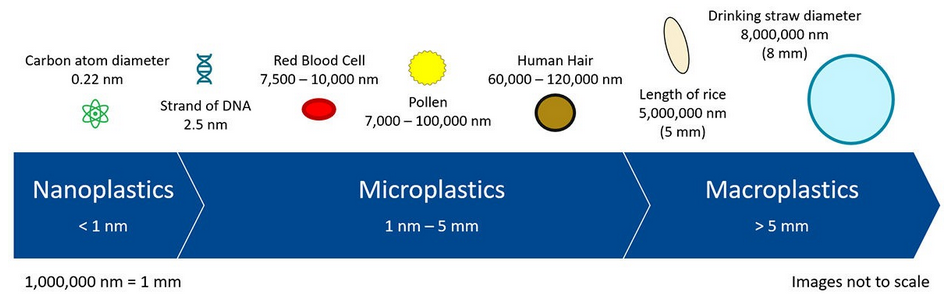
MNPs are defined as plastic fragments with particle sizes ≤5 mm and ≤1 μm, respectively (Figure 1; Feng et al., 2023). MNPs can originate from primary sources, such as those found in cosmetics and personal care products, or from secondary sources through processes such as weathering, degradation, and breakdown of larger plastic products like tires (Feng et al., 2023). Ultimately, the widespread and heavy use of plastic worldwide makes exposure to MNPs inevitable, as they are found everywhere from outdoor air, soil, and water to beverages, food, and day-to-day objects (Feng et al., 2023).
Microplastics were originally scrutinized for their detrimental impact on the environment, particularly on aquatic and marine habitats and the life that inhabits them (Lee et al., 2023). Although this is still an ongoing concern, more recent research is investigating the impact of MNPs on human health. MNPs enter the body directly through food and water ingestion, absorption through contact, or inhalation of airborne MNP particles (Lee et al., 2023). When MNPs are released into the environment, it’s nearly impossible to retrieve them due to their tiny size and the immense quantities involved (Lieberoff, n.d.). MNPs can be ingested by animals and taken up by plants, and when animals consume one another, these MNPs accumulate at higher concentrations in animals at higher trophic levels within a given ecosystem’s food web (Feng et al., 2023). Ultimately, this can harm or kill various species and pose health hazards to humans who consume animal products. Airborne MNPs released into the environment from sources such as tire degradation, manufacturing plants, and the breakdown of other synthetic plastic polymers may be inhaled by both animals and humans (Feng et al., 2023). Lastly, chemicals used to make polycarbonate plastics and epoxy resins in items like receipts, such as BPA and BPS, can be absorbed directly through the skin and are also linked to endocrine disruption and cancer (Thoene et al., 2020).
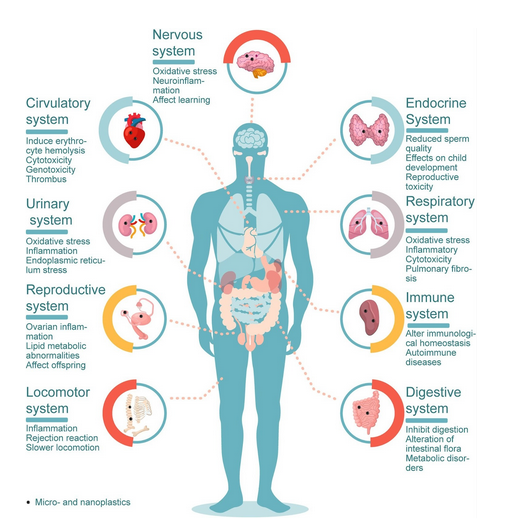
MNPs can cross the gastrointestinal tract, allowing them to circulate in the bloodstream and may even cross the blood-brain barrier, resulting in accumulation within the brain (Feng et al., 2023). MNPs accumulate in multiple organs, including the liver, brain, lungs, and heart, contributing to toxicity and interfering with biological function. More concerning is MNP accumulation in endocrine glands, as in vivo (animal) and in vitro (petri dishes) experiments have shown adverse effects on the reproductive glands, such as the testes and ovaries, and on glands responsible for metabolism, such as the thyroid gland. Evidence from multiple research studies suggests MNPs can impair nine organ systems, including the digestive, respiratory, circulatory, reproductive, nervous, immune, endocrine, urinary, and locomotor systems, as illustrated in Figure 2 (Feng et al., 2023).
Although research has been conducted to identify the methods of MNP exposure effects and their ultimate impact on human health, much is yet to be discovered. Large gaps remain in quantifying the concentration or amount of MNP exposure, identifying mechanisms of MNP intake, and, furthermore, the mechanisms of MNP intoxication and health impairment, especially in humans, due to ethical principles (Feng et al., 2023). This has created a gap in the literature that many future research studies can aim to fill; however, the direction of the evidence suggests negative health impacts, though human causality is still being studied.
While research is still catching up to the scale of the problem, the direction of the evidence is increasingly clear: micro- and nanoplastics are widespread, persistent, and capable of interacting with human biological systems in ways that raise significant health concerns. However, this is not a reason to panic — but it is a reason to act. Small habit changes can meaningfully reduce your daily exposure: choose a reusable water bottle over single-use plastic, avoid microwaving food in plastic containers, opt for paperless receipts, and eat fresh or frozen foods rather than those packaged in plastic.
At a policy level, staying engaged matters too. Canada has taken steps to regulate some single-use plastics, and public awareness is one of the drivers that pushes those conversations forward. For more information, Health Canada’s website offers guidance on plastic safety, and organizations like the Canadian Environmental Law Association track ongoing regulatory developments. The science on MNPs is still evolving, but waiting for certainty before taking small, sensible precautions isn’t necessary.
References
Feng, Yudong, Chen Tu, Ruijie Li, et al. 2023. “A Systematic Review of the Impacts of Exposure to Micro- and Nano-Plastics on Human Tissue Accumulation and Health.” Eco-Environment & Health 2 (4): 195–207. https://doi.org/10.1016/j.eehl.2023.08.002.
Lee, Yongjin, Jaelim Cho, Jungwoo Sohn, and Changsoo Kim. 2023. “Health Effects of Microplastic Exposures: Current Issues and Perspectives in South Korea.” Yonsei Medical Journal 64 (5): 301–8. https://doi.org/10.3349/ymj.2023.0048.
Lieberoff, Barb. n.d. “Microplastics.” Accessed January 5, 2026. https://epa.illinois.gov/topics/water-quality/microplastics.html.
Thoene, Michael, Ewa Dzika, Slawomir Gonkowski, and Joanna Wojtkiewicz. 2020. “Bisphenol S in Food Causes Hormonal and Obesogenic Effects Comparable to or Worse than Bisphenol A: A Literature Review.” Nutrients 12 (2): 532. https://doi.org/10.3390/nu12020532.

Hey, I’m Arham! I’m a fourth-year student at McMaster University studying Integrated Science and concentrating in Biology. My favourite hobby is basketball, and I love Star Wars! I also have a passion for helping my community, which I do in countless ways. One example is my involvement with Dare to Be Youth Charity as a Community Youth Council member.