By Jack Brittle, Local Journalism Initiative Reporter
On April 14, the City of Burlington continued its Committee of the Whole meeting from the previous day. The meeting included discussion of various items and topics relevant to the city and its citizens, with one item in particular, Item 13.2, the Draft Housing Community Improvement Plan Amendment, sparking a lengthy conversation.
Kate Hill-Montague, supervisor of planning policy for the city, gave council a presentation on the item.
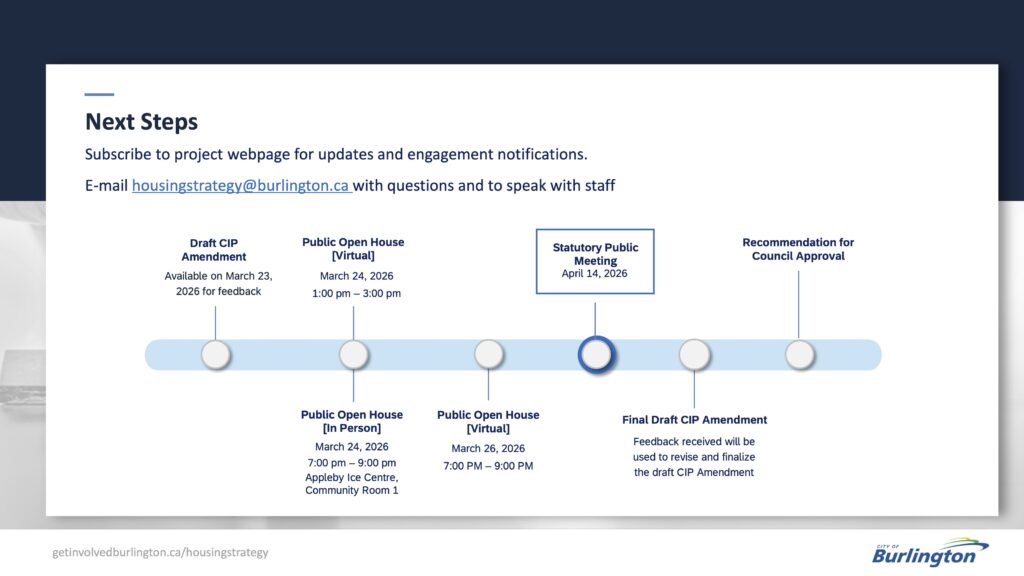
According to Hill-Montague, the proposed temporary programs have been available on the Get Involved Burlington website since March 23, and were also the subject of three open houses from March 24 to March 26.
She clarified that there was no decision before the committee today.
“Rather, this is an opportunity for staff to provide an overview of the temporary programs and to seek feedback from council and the community,” Hill-Montague said.
Staff was previously directed by council to identify opportunities to amend the current Community Improvement Plan (CIP), to “propose new temporary programs that would incentivize a wider range of housing options to assist in bringing more housing units online more quickly.”
The CIP, focused on affordable rental units, was approved in the spring of 2025. The direction also clarified that property taxes should not be used in funding these temporary programs.
Hill-Montague gave council an update on recent announcements made by the provincial and federal governments, which are relevant to the potential amendments.
“The details of those announcements are yet to be released, and staff will continue to monitor them closely to identify how these programs might be used by the city,” Hill-Montague said.
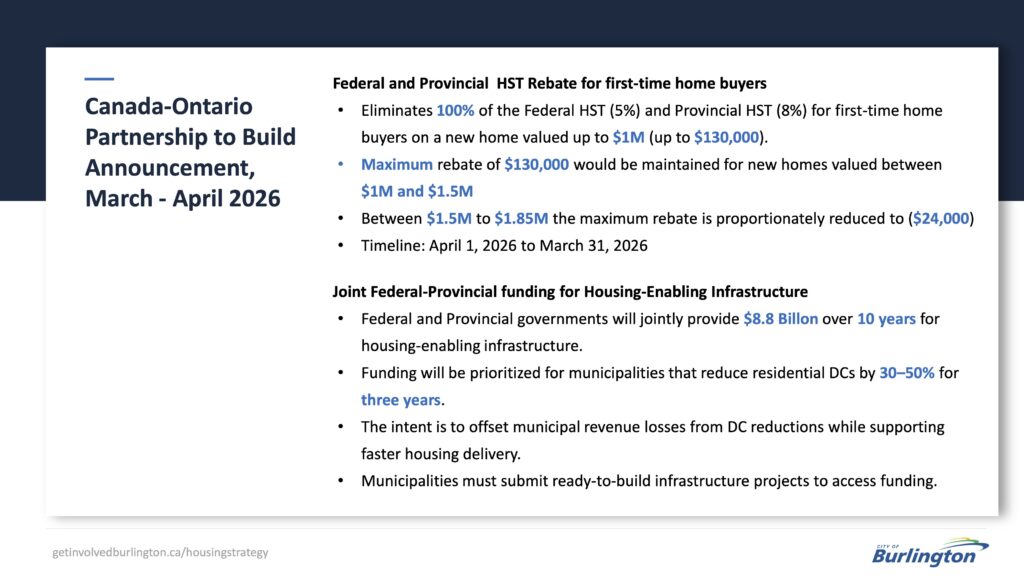
“The first set of announcements were related to HST rebates, both at the federal and provincial levels,” Hill-Montague continued. “Both levels of government have committed to a time-limited program to waive the 13% HST for first-time home buyers on new homes. Secondly, there was an announcement of a federal and provincial partnership committing to jointly providing $8.8 billion over 10 years for housing, enabling infrastructure, and investment.”
“Very few details about this program have yet to come to light,” she noted. “But what we do know so far is that the funding will prioritize municipalities that reduce their residential development charges by 30 to 50% for a duration of three years.”
Staff recommended rebranding the CIP title as the “CIP for Housing” to be “inclusive of ownership tenure and the targeted affordability criteria in the temporary programs,” as well as setting up new criteria and a new section with temporary programs.
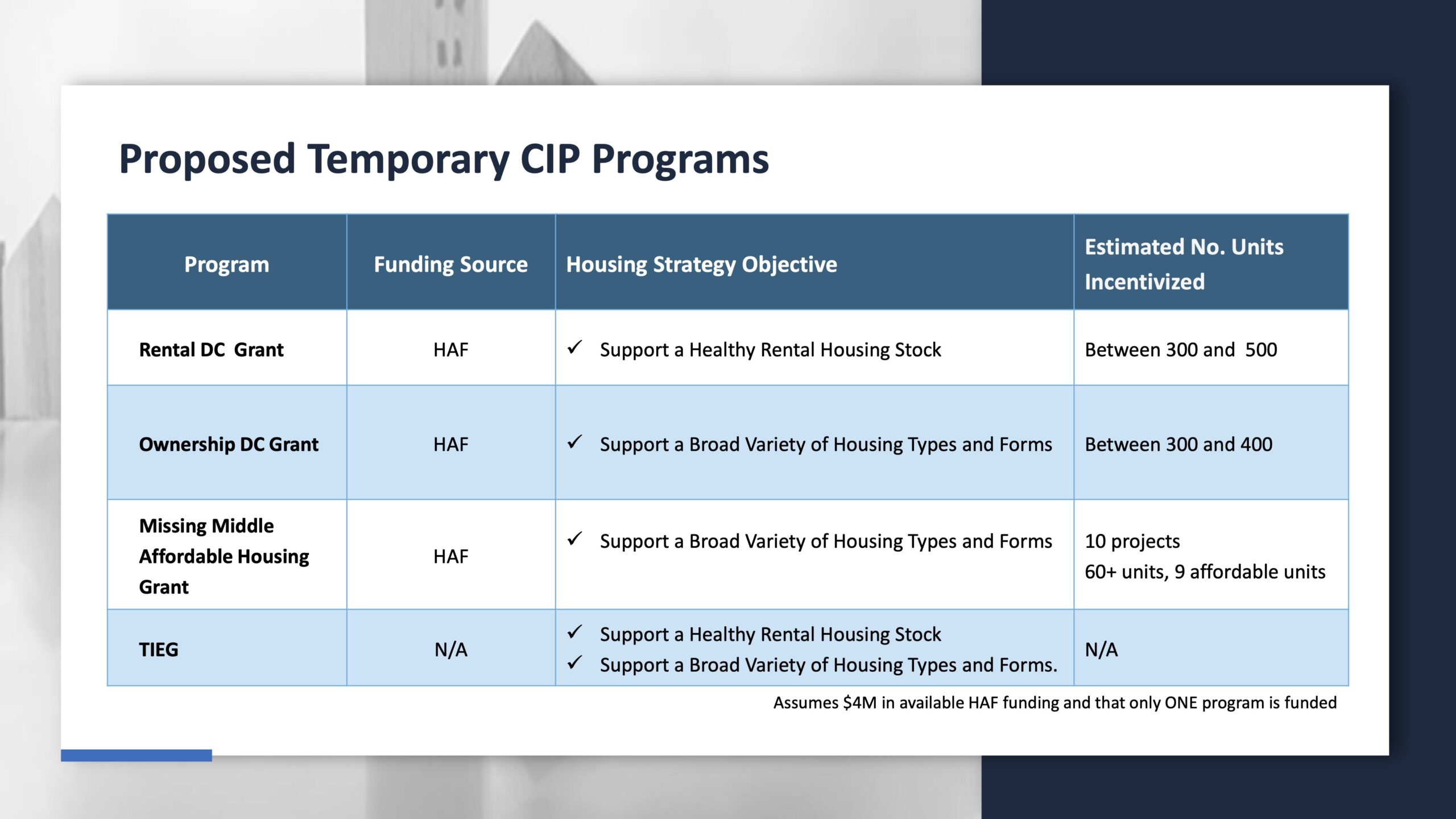
Three temporary programs were proposed by city staff. The first was a purpose-built rental development charges (DC) grant program.
“This program is intended to grant 100% of the city’s portion of the development charges for purpose-built rental units, assuming those rental units maintain their rental tenure for 15 years,” Hill-Montague said. “The intent of this program is very simple. It’s to encourage more purpose-built rental units in our city. As we know, Burlington is in short supply of that type of unit.”
The next program was a development charge grant reduction program for ownership units.
“This program is intended to incentivize units that have a certain proportion of two- and three-bedroom units,” Hill-Montague said. “It also includes those that have larger unit sizes as well as missing-middle built form types.”
The third program proposed was a missing-middle affordable grant program.
“That program targets providing affordable housing in a missing-middle built typology,” Hill-Montague explained. “That is a type of housing that’s no more than four storeys, in the form of new purpose-built rental or ownership units. This program offers a cap of up to $400,000 per project. The projects would need to contain a minimum of six units and a minimum of 15% affordable units.”
The final program was a tax increment equivalent grant program.
“The program focuses on encouraging purpose-built rental units,” Hill-Montague said. “It uses the difference between what a property value is assessed at today, versus what it is assessed at once the building has been built on the property. The intent here is to support rental project viability over time. The city would return a portion of the increased tax assessment to the developer over a five-year period, either at a fixed rate of 100% for those projects that include affordable units or at a declining rate. This helps unlock projects that might not otherwise move forward in the near term without requiring any upfront budget from the city.”
Hill-Montague said that these programs can be considered as a “menu of options.”
“There’s an opportunity to run any combination of these programs,” she continued. “You could run one program, or elect to run a number of them, and then have different funding levels and caps. You could also opt to have some of these programs waiting in the wings, and when more funding becomes available, be in a position of readiness to turn those programs on.”
Sandra Longden delegated to council on behalf of the Cornerstone Association of Realtors (CAR) to express its support for the amendments.
“We agree with the assessment that housing starts are far below target,” Longden said. “There is a need for many more family-sized, missing-middle, and affordable units for those who want to call Burlington home. As was rightfully noted in the recommendation report, the variety of announcements made by the federal and provincial governments around financial incentives necessitate an amendment of the CIP to recalibrate to those changes.”
Longden questioned the exclusion of detached and semi-detached options, as she said that Canadians still have a strong preference for these types of homes, according to Abacus Data on behalf of the Canadian Real Estate Association.
She said that CAR is advocating for a minimum of 30% DC reductions on all residential units, so that the city can access the newly announced federal and provincial funding.
“We are consistent in our belief that a development charge reduction program for all residential units would provide a meaningful boost to housing supply and market confidence,” Longden said. “The slowdown is not concentrated in just one segment; it is systemic. This is why we are advocating against a narrowly scoped incentive and support a broad-based DC reduction that restores market confidence across the board.”
Longden relayed that she met last week with two “small to medium-sized” developers who are clients of hers. She said that they had just started to revisit launching their missing-middle initiative housing build projects “as a direct result of the lowering and removal of DCs in some municipalities and the new HST relief program.”
Longden explained that they have chosen to start in municipalities that have lowered or removed these DCs.
She also spoke about housing affordability in the city.
“In Burlington, the average sale price of all property types is around $1.06 million this year,” Longden said. “It’s not attainable now for a lot of families, and if we don’t begin building, this problem will only get worse. Price corrections alone will not solve the affordability problem in Burlington. Reducing the cost of building will move the needle.”
CAR suggested an additional 30% DC reduction on all units, including detached and semi-detached townhomes.
Ward 2 Councillor Lisa Kearns voiced her concern about how these programs will be funded.
“The city doesn’t have any money to offset eliminated development charges,” Kearns said. “I still don’t understand how we will make up, as a city, any offsets that are given to the development community for high premium…completely open, market rate developments that are being asked to also have an offset for.”
Kearns asked if CAR believes that any offsets should be backstopped by the taxpayer.
“Our organization doesn’t have a hard viewpoint on where it needs to come from,” Longden said. “Just a holistic viewpoint on what’s best to move these issues forward and help the community as a whole.”
Curt Benson, chief administrative officer for the city, said that it is important for the city to be prepared if funding becomes available from the federal or provincial government for these programs.
“What we’ve heard from council very clearly is that whatever programs exist, we do not want any impact or monies drawn from the existing property tax base,” Benson said. “I think that’s the first principle, loud and clear. Right now, we do have some HAF [Housing Accelerator Fund] money that’s available for supporting those programs. But we also know, given the federal and provincial joint announcement, that there are potentially more dollars to be flowing to municipalities in Ontario. So what we want to do is make sure that we’re setting up the programs from a policy perspective.”
Kearns said that the city is chasing funding that it doesn’t fully understand.
“My understanding from the federal and provincial government announcement is that there would be a required equal portion coming from the municipalities in order to unlock those available funds,” Kearns said.
Benson said he is not “of the same understanding” as Kearns regarding putting up a matching dollar.
“I think we need to take stock in those details once they’re released, and get back to council in terms of how to proceed,” Benson said.
Ward 4 Councillor Shawna Stolte said that one of the reasons the city would include these types of properties in the exemptions is that they “tip into the less affordable options for people, and that would potentially not meet the goals of our housing strategy and housing affordability fund.”
Hill-Montague said that council could likely expect an update from staff about the proposals during the May Committee of the Whole meeting.
“I think the financials will be more fully baked and put forward in front of council,” Benson said. “Hopefully, we actually know a little bit more about the parameters around the funding program that was announced a couple of weeks ago…and what monies are on the table for support of these programs, and what is not. But I think the direction, as council provided in March, is very clear to staff that there should be no impact on the existing property tax base.”
Stolte said that while she isn’t advocating taking money from the tax base, something needs to be done about the housing crisis in Ontario.
“I would hate to think that if we had not received that HAF funding,” Stolte said. “That this council would be sitting here saying, ‘Sorry, we’re not going to do anything about the housing crisis because we’re not getting funding from elsewhere.’”
Ward 3 Councillor Rory Nisan said that while the federal and provincial announcements are a step in the right direction, it’s “far from the new deal that municipalities deserve, that would unlock the housing through a change from the DCs.”
“We’re still stuck in this sort of piecemeal situation,” Nisan said. “And it doesn’t sound like they want to make us whole through the new funding either. It’s not just a housing crisis, it’s an affordability crisis across the board. And that does go to our taxpayers as well. So we have to be careful that we’re not robbing Peter to pay Paul here. It’s a needle that we have to thread in order to support that housing.”
“We can’t put the Ontario economy on our backs,” Nisan continued. “And we can’t put it on our taxpayers’ backs either.”
The motion to direct the director of community planning to consider council, agency, development partner, and community feedback received on the Draft Housing Community Improvement Plan Amendments, passed unanimously.