
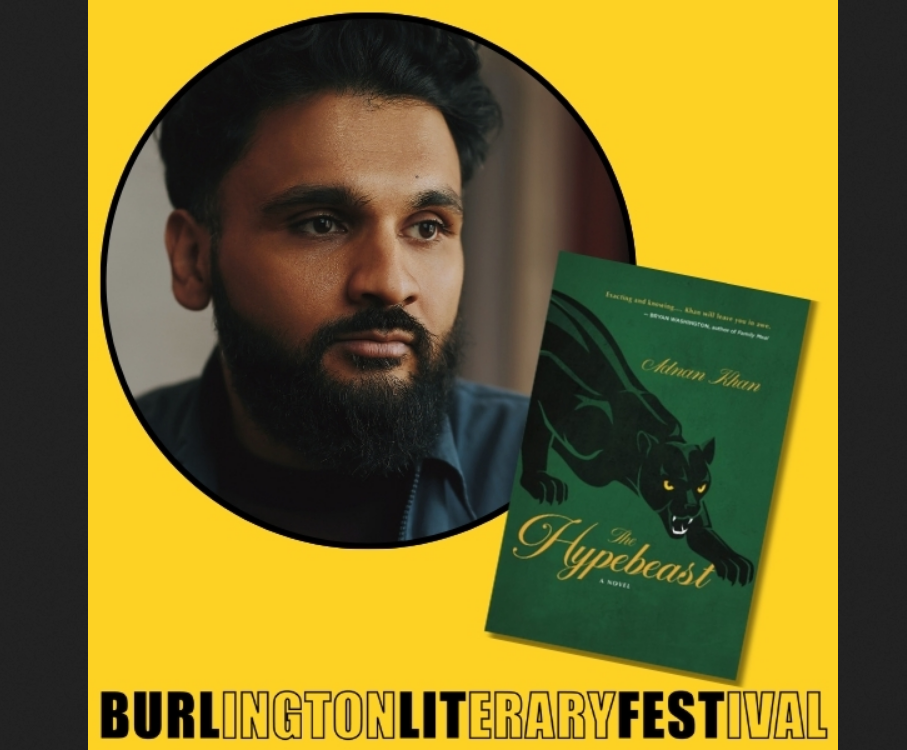
Ahead of his BurlLITFest event This Weekend, the author discusses the themes driving his latest novel.
By Maisha Hasan, Local Journalism Initiative Reporter
“How did we go from conquerors to Uber delivery, from emperors to 7/11?”
This is an excerpt from acclaimed author Adnan Khan’s latest novel, The Hypebeast. The book sets its sharp eye on faith, family, race, and strangled ambition, using Toronto as its backdrop.
The character who anchors these themes is Hamid Shaikh, a scarily ambitious twenty-something, fixed on changing his life for the “better,” through any means necessary — selling faulty technology, scamming older immigrants for money, and other various schemes he falls into.
Hamid is difficult to empathize with, but Khan isn’t necessarily interested in garnering much empathy.
“I am interested in characters that have to make decisions, deciding what the right thing to do is, deciding what the wrong thing to do is; that push and pull has always been interesting to me,” Khan said. “I don’t know if I made a conscious decision, but that’s sort of how I view what an interesting character is. Someone who has to struggle with making choices.”
Hamid hails from Bombay, immigrating at a young age to Canada. Throughout the novel, it was a deliberate decision to mention race whenever it was relevant.
“I really wanted to chart how we sort of categorize things, how we view things, and I think one of the unknowns that we don’t talk a lot about is race. People of colour often are more comfortable talking about it because that’s how we’re viewed,” Khan said.
Hamid, who worries about how he is perceived, refills Grey Goose bottles with cheap vodka and buys sneakers he cannot afford, sees race as another status symbol to calculate, size up in his head carefully.
“In literature, it won’t mention that the characters are white, but it’ll always mention the characters that are not white — the Chinese guy, Black guy, whatever — I wanted to play with that…sort of show how he organizes the world and how he is constantly aware of the shifting dynamics when it comes to race. It’s certainly part of his worldview and how he’s looking at things,” Khan said.
If luxury items and people aided his search for status, his girlfriend, Natalie, could also be included in such a conversation.
“For him, he’s not necessarily able to separate [love and status]. I would say that he is not always aware of what he’s categorizing and what means something to him. Sometimes he definitely is, like when he talks about BMWs and certain brands, sometimes he’s not, but there are moments where he sort of categorizes Natalie and tries to understand her within a sort of social dynamic,” Khan said.
The way in which Hamid scores his riches by scamming elder immigrants not only reflects the real-life schemes but also Hamid’s character.
“It’s quite a common thing to sort of shut the door behind you, prey on the community that you know. [Hamid] is a predator. He’s not necessarily going to step outside into a place that’s uncomfortable to him, a social environment that he doesn’t know about; he’s going to stay within the confines of the world that he understands. That happens to be one of the immigrants, and he knows the language of that world,” Khan said.
The transgressions and relationships between immigrants and South Asians are ones that Khan wanted to emphasize.
“I was definitely really interested in that relationship between South Asians, particularly new immigrants and old immigrants. There’s a very interesting racial tension there…in recent years, I’ve noticed that there is very much like a, ‘We’re this type of Indian and you guys are those type of South Asians,’ I think that’s something that he’s part of. I don’t know that he was categorized in sociological ways; it’s just something that he does, it’s just something that he was raised with, another way he tries to stay on top,” Khan described.
Khan elaborated on Hamid and others’ need for power, tying it to conversations about toxic masculinity.
“I was quite curious to understand why toxic masculinity helps these guys, right? They’re getting something from it. It’s providing them an advantage in some way…they adopt that pose and that personality and those traits for a reason. I kind of wanted to understand what that reason might be without judging them. I think we’ve gotten quite happy at criticizing South Asian men, which is fair, but I think there needs to be a bit of balance in terms of understanding why communities are the way they are,” Khan said.
Another dynamic character is Abdul Mohammad, a former Guantanamo Bay detainee turned social media imam whom Hamid gets caught up with.
“I was interested in how cultures sort of move and shape, and how religion sort of intersects with culture. With [the characters in the book], I’m trying to blur the line between what they feel and what kind of faith they actually have, and how they’re trying to utilize things. I think one of the things about these characters that I was trying to do is show, in some ways, how utilitarian they are, how they’re trying to use things in their lives to their benefit,” Khan explained.
What that benefit may be remains unclear, even to the characters.
“That is what I wanted to show with Abdul: how religious he actually is, and what he believes in is meant to be a little bit murky. It was constantly conflicting with his drive to survive and be present in the world,” Khan said.
Khan’s experience with the perception of Muslims, particularly Muslim men, was born out of growing up in the age of Al-Qaeda, 9/11, seeing how that shift played out in the world, to how he and people like him were portrayed. It wasn’t hard for him to include that in the book.
The book itself spans a wide range in the aforementioned conversations, plot twists and tonal shifts.
“The novel was written in a big burst of energy. Once I started editing it with my editor, the whole book actually became quite hard to work on. It’s quite a gnarly book; it’s not always pleasant. I think the scenes that are probably hard to read were the ones that were hard to write. I don’t want to give anything away for people, but there are a couple of scenes in the book that are a little bit uncomfortable, and I think those are the ones that, [as I was writing], I had to decide how deep and down into that hole I wanted to get into.”
Adnan Khan is discussing The Hypebeast at Burlington Public Library (BPL) this Saturday, November 22, from 2:00 p.m. to 2:30 p.m. For more information and to register, visit BPL’s website.