By Jack Brittle, Local Journalism Initiative Reporter
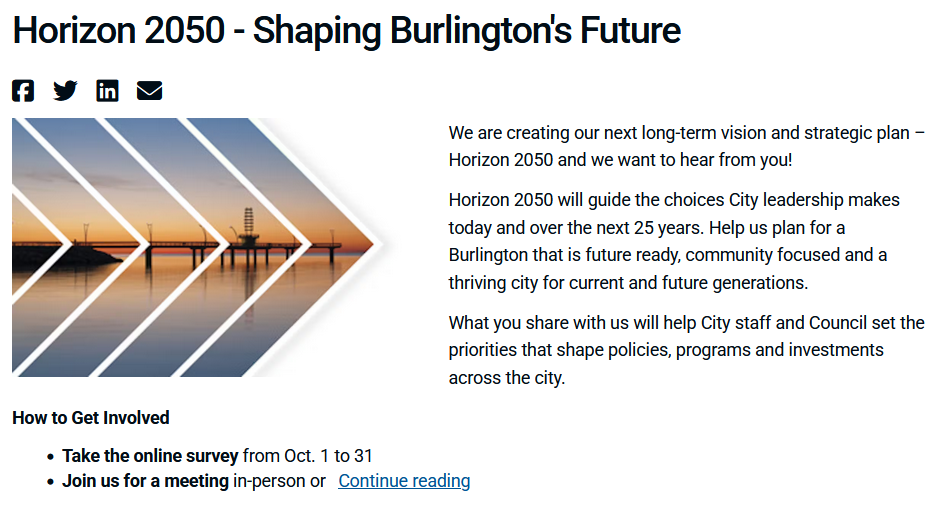
On October 21, the City of Burlington held a virtual community engagement session to discuss Horizon 2050, which the city describes as “a long-term plan to guide how our city will grow.”
The session was the fourth and final meeting before the public survey on Horizon 2050 closes on October 31.
Several city staff members facilitated the meeting and asked attendees to offer their perspective on prompts about Burlington’s future.
Tracy Hasselfeldt, engagement and volunteer advisor at the city, began the meeting by explaining what Horizon 2050 is.
Horizon 2050 “reflects the aspirations of residents, community members, city partners, businesses, staff, and council,” read a PowerPoint slide presented by Hasselfeldt. The plan “aims to build a thriving, inclusive, and future-ready Burlington for generations to come.”
Hasselfeldt also said that the plan will be heavily focused on community feedback and will be examined every 10 years to ensure it is still on track.
She also clarified that attendees should be focused on the future of Burlington, not how it looks right now.
“We’re not here tonight to fix any problems that are happening in Burlington now,” Hasselfeldt said. “This is a forward-thinking workshop. So we want you to think about what you want to see in Burlington for future generations. Whether it’s yourself, your kids, or grandkids. And then the last part of the long term is we want to make sure there’s a sense of belonging and pride in Burlington.”
The City of Burlington drew inspiration from a similar strategy implemented by Helsinki, Finland, which decreased homelessness, increased physical activity, and addressed loneliness.
She said that the city sent staff to Helsinki to study how they prepared and put into place their strategy.
More information on the Helsinki report can be found here.
Hasselfeldt then presented attendees with six “vision statements,” describing what Burlington should strive for in the next 25 years.
The vision statements were: “ The city of people, place and possibility”; “The city to live for life”; “The happiest and healthiest city in Canada”; “A sustainable, inclusive, and resilient city where people and nature thrive together”; “A connected city where urban energy meets rural charm”; and “The creative city where ideas flourish and communities prosper.”
These statements are not set in stone, but are meant as a starting point.
“These are just suggestions that we’re putting out there to get a feel for what residents think,” Hasselfeldt explained.
Next, attendees were asked, “What words would you use to describe Burlington in the next 25 years?” Their ideal future Burlington was described as safe, innovative, walkable, forward-thinking, connected, and eco-friendly by participants.
Nicole Barich-Williams, another advisor for engagement and volunteers, posed the next question to residents: “What does multi-modal mobility look like or mean for Burlington in 2050?” The presentation defined this as ensuring “the city enables all ages and abilities to move safely and sustainably by walking, cycling, transit, or new mobility options.”
One of the city staff members on the call collected responses from attendees and put them on virtual sticky notes below the question on the PowerPoint slide.
Some responses from attendees included “transit frequency and connectivity,” “walkable land use planning, close to neighbourhoods,” and “connecting trails and corridors.”
The next question posed was “What does affordability, equity, and access look like or mean for Burlington in 2050?”
Responses ranged from removing reliance on the automobile, freedom of mobility not being age-gated, to focusing more on bigger parks like Spencer Smith, rather than parkettes.
Attendees were then asked to consider what health and well-being would look like or mean for Burlington in 2050. Attendees suggested more local gathering spaces, cleaner air, and increased police presence.
The next two slides focused on transparent, adaptive governance and resilient, responsive systems. The suggestions ranged from tech-focused to people-focused: more open data, encouraging citizens to participate in Burlington’s Advisory Committees, and upgrading infrastructure to exceed current standards.
To end the meeting, staff presented six guiding principles to attendees and asked which principles resonated the most for those present. The choices were: affordability; sustainability and resilience; quality of life; economic impact; innovation and adaptability; and data-driven.
Participants suggested that the guiding principles be easy to understand. One questioned the definition of “affordability,” asking if it meant more affordable taxes and fewer city services. The same participant added that they care more about the value they receive than the money it costs.
Hasselfeldt encouraged attendees to fill out the online survey if they came up with any feedback after the event, and provided a roadmap for Horizon 2050.
“We will be working with consultants to develop a draft of our strategic plan for 2050, which will then be going out for round two of engagement,” Hasselfeldt said. “[At that point] you’ll be able to see a draft, review it, and leave comments. And then there’ll be a report going to council.”
Feedback and content testing will take place from December to January, with the final plan expected to be approved between January and March.
To learn more about Horizon 2050 and find the link to the online survey, visit www.getinvolvedburlington.ca/horizon2050.