By Jack Brittle, Local Journalism Initiative Reporter
Earlier this summer, the City of Burlington released the first draft of the new zoning bylaw that council is looking to adopt in the fall of this year, and the public has only a few more days to comment on it.
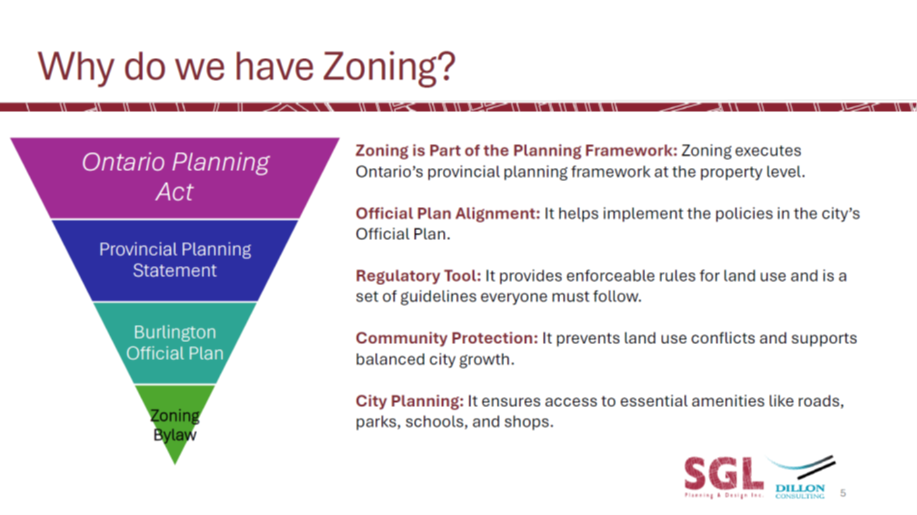
Every time the city approves a new Official Plan, it typically also creates a new Zoning Bylaw to go along with it.
The City’s current Official Plan was adopted in 2020.
Paul Sharman, Ward 5 councillor, explained the purpose of an Official Plan.
“The official plan is to take a look at the entire structure of the city,” Sharman said. “All of the land, every aspect of it. It looks at the laws, whether they be from the region or the province, and then takes a look at the land use in its present state and what the planning people believe has to happen to the properties when they become available.”
According to the city’s Community Engagement Backgrounder to Draft 1 for the bylaw, a zoning bylaw outlines how land can be used, decides the types of buildings and activities that are allowed, where buildings and other structures can be located and other details like lot sizes, parking requirements, setbacks from property lines or other structures, and building height and density.
The current zoning bylaw is over 20 years old. According to the same backgrounder, the new bylaw will “be user-friendly, reflect modern practices, be a catalyst for development and be developed through a consultative process.”
The city has also created an interactive map for residents to use to see if their property will be affected by the new bylaw.
Sharman said that a focus on funding models that support affordable housing is one of the biggest changes in the new bylaw.
“What’s changing is that we’ve gone from market-driven development to wanting to stimulate development of a different kind,” Sharman said. “The market has changed. Most young people, probably 100,000 people in Halton, cannot ever afford to buy a home here. We have a crisis, but we’re not by ourselves.”
“Every municipality in the province has been talking about how one and a half million houses are required in the next ten years,” Sharman continued. “Well, we had COVID, and we lost five years to that. We’re not going to have any production of housing to speak of in the next two or three years either, so the objective of the zoning bylaw is to attempt to facilitate access to more housing in the City of Burlington.”
Sharman cited an increased focus on additional residential units (ARU), more funding from the Canadian Mortgage and Housing Corporation, and grants from the province as influences for the change.
Sharman said that encouraging ARUs is the only way that the city could both increase housing and give money to residents for helping meet that goal.
The city was previously approved for Ontario’s Housing Accelerator Funding, which will allocate $21 million to Burlington.
Sharman said the city has already qualified for half of that money.
Sharman spoke about some of the feedback the city has received regarding the current housing strategy.
“The feedback we’ve had in the past on the housing strategy was positive, because people recognize that their children and grandchildren need somewhere to live,” Sharman said. “The older community members get very anxious, however, about the increase in population, the impact on road congestion, and the use of parks and things like that in recreation centres. So there’s anxiety about this as well.”
Some residents have expressed concern about the possibility of ARUs in their neighbourhoods.
“When we talked about the ARUs, some people were very upset and very anxious that we would see them on every property in Burlington, people putting in an additional housing unit, to which I kept saying to people, ‘That’s not gonna happen,’” Sharman said. “There’ll be some, but I don’t expect a lot.”
The drive for housing has been influenced not just by the need for younger people to have a place to live, but also by the province.
“We are looking for massive densification,” Sharman said. “We have been given a goal by the province to grow the population of Burlington by 70,000 people by the year 2051. But in addition to that, they’ve converted about 700 acres of land that was previously for employment use, to be turned into what we call mixed use, that’s housing and businesses all in the same place.”
Sharman said that he doesn’t anticipate a huge influx of ARUs due to a relatively high cost, estimated by Sharman to be $200,000 to $250,000.
“We can’t really look at people’s financing and figure out how it’s going to help them or how it’s feasible for them, but getting an ARU is the only affordable kind of thing we can help people with to make it viable,” Sharman said.
Sharman said that the change that the Housing Strategy and new zoning bylaw will bring is necessary to adapt to the current situation the city is in.
“If all we had to do was just the same old, same old, carrying on, and we did not have a view on the world coming forward to us, we would end up in deep trouble,” Sharman said.
A public comment form is available for residents to fill out and give feedback on the first draft of the bylaw; add your perspective by Aug. 5, 2025.