By Kezia Royer-Burkett, Local Journalism Initiative Reporter
It has been 51 days, 1,224 hours, and 73,440 minutes and counting since the fatal shooting of Erixon Kabera, a 43-year-old father, by Hamilton police officers. On November 9, 2024, Kabera was shot multiple times and succumbed to his injuries at 2:47 a.m. on Nov. 10 in the hospital. This tragic incident has left his family and his Rwandan community in shock and grief, sparking demands for transparency and justice. Kabera leaves behind his three sons and their mother, Lydia Nimbeshaho, who are now grappling with a profound loss and unanswered questions.
According to police reports, officers responded to a call from a resident of the apartment building where Kabera was located. The Special Investigations Unit (SIU) is now investigating the events that led to Kabera’s death. While early SIU comments noted that gunfire was exchanged, that soon changed to a statement of gunfire coming only from two police officers.
Hamilton Police Chief Frank Bergen expressed condolences to Kabera’s family and the Rwandan community but stated that details about the incident cannot be disclosed until the SIU concludes its inquiry.
For Kabera’s family, this silence has been devastating. “Our family has not received any information from Hamilton Police or the SIU. Whatever the public has, that is the information our family has,” said Nimbeshaho.
She posed urgent and critical questions: “Why was Erixon shot? What justified the use of deadly force? Did the officers have non-lethal options like a Taser? Were the officers trained in de-escalation? Did racial bias influence the officers? Was Erixon seen as a threat because of his race?”
Nimbeshaho shared chilling details about the shooting, confirmed by other members of the family. Kabera was struck by four bullets, hitting vital areas, including his heart, abdomen, and hip.
“His door has four bullet holes. The hallway has bullet marks. Inside the apartment, there is evidence of gunfire,” she explained. The family remains haunted by what they don’t know: what transpired between 3:00 p.m. and 5:00 p.m. on that fateful day to result in such a violent outcome?
“This isn’t just a problem for Black people. This is an issue for all Canadians,” Nimbeshaho stated.
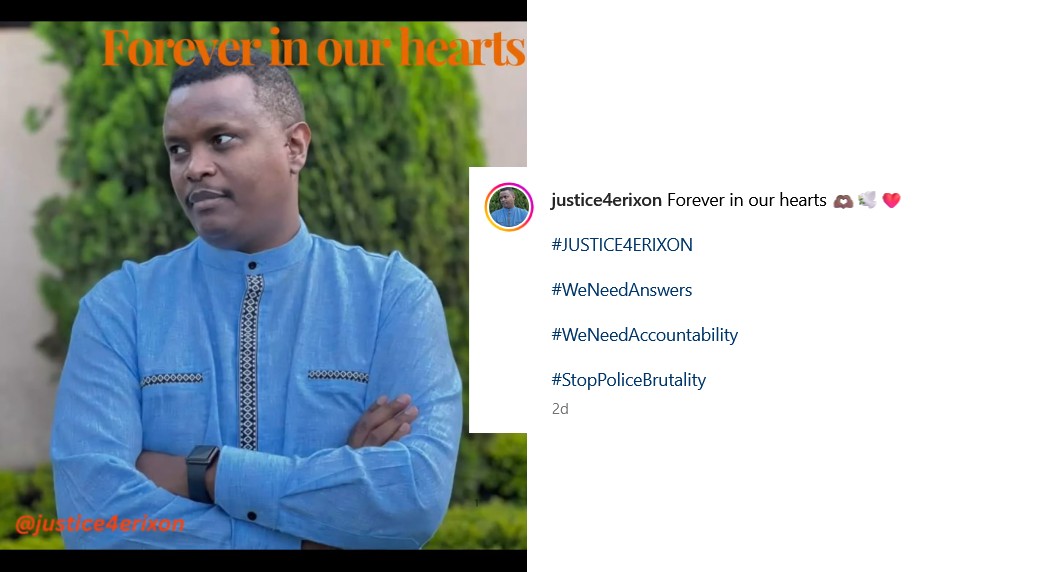
The family has launched a social media account, Justice4Erixon, to rally public support and keep the spotlight on the case. At a vigil held on November 14, 2024, at Hamilton City Hall, and December 14, 2024, at Parliament Hill in Ottawa, community members shared their grief and frustration, particularly over the lack of body cameras on Hamilton police officers. While plans to implement body cameras were recently approved, they have not yet been put in place.
The broader implications of Kabera’s death have resonated deeply within the community. Registered psychotherapist Kimberly Cato highlighted the systemic nature of police violence. “Unnecessary force placed upon diverse communities is a very well-known fact. It doesn’t matter if the abuse happened in the neighbouring county. Your brain doesn’t distinguish between Hamilton or elsewhere; it just sees the uniform and the gun as a threat. This systemic problem affects the entire community,” she explained.
Statistics on the use of force in Halton underscore the gravity of the issue. Based on 2021 population data and 2023 Halton police use-of-force incidents, Black individuals are significantly overrepresented in police use-of-force events, with a ratio of 7.8 compared to 0.6 for white individuals, much like similar Black overrepresentation in use-of-force events by Hamilton police as reported in late 2024.
As the SIU continues its inquiry, the family faces a 120-day wait for answers. Nimbeshaho criticized the lack of communication from Hamilton police. “The Chief of Police has never reached out to our family or offered support. This silence feels like they are siding with the police, not with our family or our community,” she said. The impact on Kabera’s young sons has been profound. “This is supposed to be the best time of their lives, but they can’t enjoy it because of fear,” she added.
Community leaders, like Lohifa Pogoson-Acker, a family friend and activist, emphasized the importance of both patience and systemic reform. “This isn’t just about one incident; it’s about preventing this from happening again,” Pogoson-Acker said. Activists have also called for greater accountability, pointing out that culpability extends beyond individual officers to the systems and structures that enabled this tragedy.
The Kabera family’s grief has been compounded by the absence of support mechanisms.
“We should be hearing from the mayor of Hamilton. We shouldn’t be wondering who to call for help and support,” Nimbeshaho said. “Instead of grieving, we’re spending this time trying to get answers.”
She called on Canadians to recognize this issue as a collective concern, noting that the safety of one’s home should not be a privilege but a right.
Erixon Kabera’s body was flown to Rwanda for burial shortly after the shooting, but his family’s fight for justice has only begun. As they await answers from the SIU, the community is left grappling with unresolved questions about accountability, racial bias, and the disproportionate use of force in policing.
“This cannot become another story swept under the rug,” Pogoson-Acker said, echoing the sentiments of a community determined to ensure that Kabera’s death sparks meaningful change.