
By Emily R. Zarevich, Local Journalism Initiative Reporter
The Art Gallery of Burlington (AGB) has proudly surpassed fifty years as a city centre of fine arts and culture. Fifty years is half a life, half a century, half an era. The people who work there now have made it a priority to start the year of 2025 strong with two major exhibits that challenge our perspectives of how eras unfold and how our futures may look. The first is Time Isn’t Real, curated by the AGB’s Senior Curator Suzanne Carte, and Dry Thunder, a solo exhibition by Misbah Ahmed, curated by Sarah Edo. Time Isn’t Real is a commentary of several voices on the passage of time, a universally accepted method for organizing our lives that may or may not be a construct. Dry Thunder is one distinct voice, storytelling one unique childhood.
Clay is a pliable, resilient, and accommodating medium, and it is the material of choice for all of the artists who contributed to Time Isn’t Real. The first question visitors may ask themselves when they step into the fully occupied Lee-Chin Family Gallery is how much time each artist devoted to making their individual visions a reality. It’s hard not to be practical-minded when confronted with such a staggering philosophical stance. Is time really not real when an artist has only so many hours in the day to work on their art? And doesn’t a clay artist have to time how long their clay bakes? That makes the message of the overall exhibit all the more fascinating to take in. Time, as a concept, can be real in a technical sense, but it can forfeit its power when the artist decides it doesn’t have any. Time can be just some invisible, made-up idea. Clay, that you can hold and mold in your hands, is real, and ready to be made into anything.
Hannah Faas’s sculptures are psychedelic and appear to represent the alien life forms of a planet we haven’t discovered yet or a sci-fi future that has only been explored so far in films and graphic novels. However, on closer inspection, Faas’s pieces can also evoke thoughts of a simpler past. The frosty pink icing on birthday cakes. Grade school drawings. Saturday morning cartoons. Toys. The happy, memorable childhood meets the uncertain, imagined forthcoming in this corner of the exhibit.
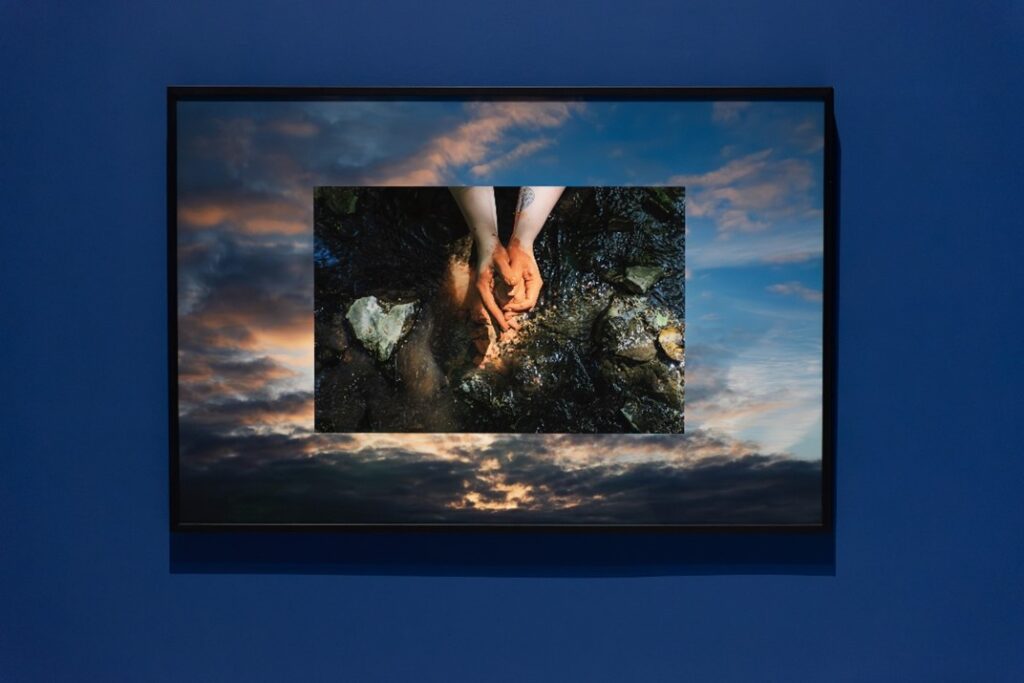
Alex Jacobs-Blum’s series of digital photographs feature women lounging, relaxed and content, in the midst of thriving nature. The photographs on three walls frame and surround the clay mounds of Earth, reminiscent of a woman’s shapely breasts. Is this setup meant to be in any way erotic, or are our eyes overly trained to see and consider human bodies before they consider the natural world? Jacobs-Blum’s work argues for peaceful coexistence between the land and its inhabitants. A necessary coexistence upon which our eventual reality depends.
Anahita Norouzi’s giant cracked and disembodied head — a wondrous single mound on its own — rolls to the side, slumped and defeated like it’s the last remnant of a fallen civilization. It has a blank, unsettling, thousand-yard stare. It’s intimidating and eerie. Visitors may be hesitant to approach it, though it has every element of an awe-inspiring, photographic tourist landmark. One cannot even begin to imagine the full-bodied statue that it might have belonged to in its universe. It might have been the head that sat on the shoulders of another world’s answer to Michelangelo’s David.
Speaking of eerie, how about puppets? Gabi Dao’s ceramic, bat-like creatures are an uncanny, disturbing cast straight out of a child’s nightmare, but they’re implied to be immortal and older than time itself. Not just because they are made out of clay, but because they just might be outcasted angels. The video playing on an endless loop is called Lucifer Falls from Heaven at Dawn. A gruesome plotline for a puppet show.
Here in Canada, where the freezing rain falls hard and the snow piles up high, it’s hard to imagine any kind of hard weather ever being dry. That’s why multidisciplinary artist Misbah Ahmed has imagined it for us, in the forms of oil painting and ceramic structure. Ahmed grew up in Islamabad, the capital city of Pakistan, where the mountainous horizon was often spared getting its tips wet. The sky would sometimes spew dry thunder, meaning thunderstorms and lightning strikes unaccompanied by rain. From a child’s perspective, it must have been like a free show, and that’s exactly how Ahmed portrays it. In Ahmed’s paintings, the sky is adorned lushly in deep blues and greys that invite the viewer’s eye with its jewel-like tones. “Look up, not down,” the brushstrokes seem to say, and the curious gaze of onlookers take it in along with Ahmed’s awestruck, ant-like human figures.
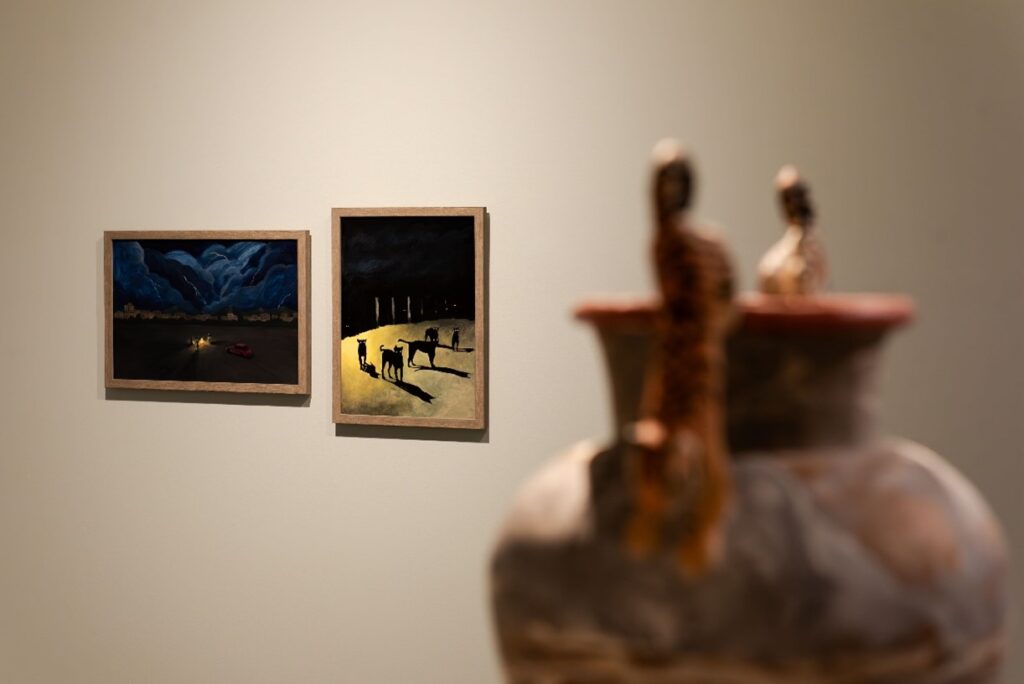
Ahmed’s clay and porcelain pots are intricate stories by themselves. Family history is interwoven with mythology as different artistic techniques are interwoven to create a finished product. Ahmed’s paintings and pots all complement each other in that everything in the exhibit looks like something that would adorn a fondly remembered childhood household. Even the spooky Street Dogs has a comforting aspect to it if one interprets the dogs as the guardians of the night rather than a threat. The cozy Perry Gallery hosts an equally cozy feeling of a childhood filled with boundless noteworthy moments.
Time Isn’t Real opened on January 17, 2025, and will remain on display in the Lee-Chin Family Gallery until April 27, 2025. Dry Thunder was set up in the Perry Gallery on January 11, 2025, and will remain in place until April 27, 2025. Whatever your stance on time is, there are plenty of days left to pop into the art gallery and support local talent.