By Maisha Hasan, Local Journalism Initiative Reporter
“What happens to our community when we ostracize valuable people?”
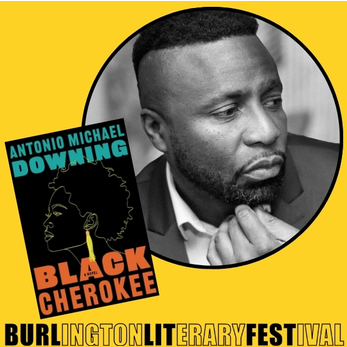
This is the question author and storyteller Antonio Michael Downing asks in his novel, Black Cherokee, which he will discuss at the Burlington Public Library (BPL) on Thursday, Nov. 19, as part of the Burlington Literary Festival (also known as BurlLITFest). The event will take place in Centennial Hall at the library’s Central branch.
“Storyteller” is too limited a word to describe what Downing has done for most of his life, including his work as a writer, musician and, since 2024, host of CBC Radio’s The Next Chapter. His novel, which came out last year, is another expression of that storytelling.
The book is Downing’s fiction debut — Saga Boy was his widely praised 2021 memoir — but doesn’t stray from topics of identity he has explored in the past.
“Saga Boy took me to places of home and identity and family, but I think that was sort of a thread, and when I pulled on it a little further, what I found was because it was a memoir, I was limited by what actually happened. I find often fiction contains more truth than nonfiction, or a different kind of truth,” Downing said.
Downing has written about familial relationships and the shadow of colonialism hanging over his life, which led to the idea for his novel.
“What does it mean to have a sort of broken family that isn’t mine? It started in the seed of Trinidad, where I’m from, where we encounter Indigenous people; they’re usually mixed with Black folks, so they’re usually Afro-Indigenous,” Downing said.
He jokes that the first white person he saw was Queen Elizabeth on a postage stamp. When he came to Canada from Trinidad, he ironically attended a high school named after Queen Elizabeth, with her picture right in the middle of the atrium.
Later, when settling into northwestern Ontario, his early life experiences and the community surrounding him proved pivotal in shaping his understanding of race, kinship, and Indigenous survival in Canada.
“[When] I landed in Wabigoon and Sioux Lookout, it’s a town that’s almost 50% Indigenous. I felt like those experiences got me on the path. It’s not just curiosity; I come to it from kinship to the Black side of that ‘Black Cherokee’ equation. It’s a history that is so untold, that it’s almost lost. There are only a handful of scholars who are experts in this history. I spoke to probably half of them in the making of this book,” Downing said.
The history that Downing unearthed is the legacy of the Cherokee Freedmen, the Black people who were formerly enslaved by wealthy Cherokee families and whose descendants went on to fight for recognition within the Cherokee Nation. It’s that history that is the subject of Black Cherokee, told through the eyes of Ophelia Blue Rivers, a young girl growing up in South Carolina in the 1990s who has both Black and Cherokee ancestry.
Despite her deep roots in the town of Etsi, townsfolk constantly deny her Cherokee side, and she endures bullying at school, where she is either too Black or too much of a standout.
“I felt that so many of our conversations we have about our politics have to do with who’s included and who’s excluded, so exploring it through Ophelia, really what I was attempting to do is deal with the issue of communities who exclude people,” Downing said.
Her struggles to find guidance and support in the community aren’t unique; Downing points to similar challenges experienced by marginalized groups of people in Canada today.
“You can think about it in terms of how we treat new immigrants to the country. We’ll say, well, are they full Canadians? Are they real Canadians? Or those discussions of should trans people have full rights as ‘regular’ people? On and on and on, over and over, we keep coming back to this idea of people who are already members of our community, should they be included or excluded?” Downing said.
Grandma Blue and others in Ophelia’s life try to teach her how to live and why things are the way they are — which may come from their own resentment.
But as much as Ophelia gets passed from person to person, she learns something new each time that contradicts life as she knew it before.
“There are things that are passed down, but also restrain us. Sometimes that’s not a bad thing because sometimes we’ll resent it when we’re younger and when we get a little perspective, we’ll turn around and go, ‘I’m really glad they restrained me in that way.’ Some of it is just stuff that is trauma that has been passed down, and we’ve healed from it so we don’t have to carry it anymore,” Downing said.
Ophelia wants to help the town of Etsi even if they don’t want or acknowledge her efforts. The people in her life — her aunt, her love interest — all end up letting her down, to say the least, leaving her outlook on life soured.
Ophelia tries to fit herself into boxes instead, rejecting her optimistic ideals, but ultimately chooses to embrace both sides of her identity.
The novel spans her upbringing, leaving readers conflicted about her choices at the end, but at least they are hers to make.
“I want her to know how much power she had, that she didn’t know she had. When we’re children, we blame ourselves for things that aren’t our fault, and we beat ourselves up about it, and we carry that with us. I hope that if she looks back, she sees that none of it was her fault, how brave she was, and I hope that makes her feel proud of herself,” Downing continued. “The end of the book is interesting. It’s intentionally designed to not tell you what happens to Ophelia and how you should feel about the ending.”
To hear Antonio Michael Downing discuss Black Cherokee at Burlington Public Library’s Central branch, located at 2331 New Street, on Thursday, Nov. 19, from 7 to 8 p.m., click here to register. The event is free to attend. A Different Drummer Books will also be on-site with copies of the book available for purchase and signing.