By Maisha Hasan, Local Journalism Initiative Reporter
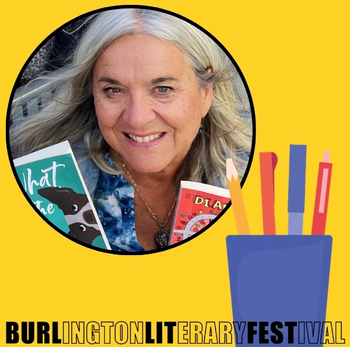
Hallmarks of an average Canadian childhood might include meticulously colouring in a map of the Canadian provinces and territories, anticipating snow days in the winter months, and reading books by Burlington-based author Sylvia McNicoll, a well-known name in school libraries and at Scholastic book fairs.
McNicoll has been writing books for children and youth since the late 1980s, but has been writing since her own childhood. She has now published 40 books; the latest, Blue to the Sky, won a 2025 Hamilton Literary Arts Award.
On Saturday, Nov. 21, McNicoll will be hosting a poetry-writing workshop for youth aged 11 to 14 at Burlington Public Library as part of BurlLITFest.
Below, McNicoll discusses the craft of writing children’s books and what children’s literature can offer to the world. Answers have been lightly edited for clarity and flow.
Your stories are laced with hardships that the characters have to navigate. Do they come from experiences in your own life that you now have a better perspective on?
No, not anymore. I mean, you bring the experience of your childhood there, and I am probably 15 on the inside. I’m stuck in that era, but I have nine grandchildren. I read the newspapers a lot, and a lot of the problems in [the books] are me pondering over these issues. Kids make stupid mistakes that cost them their lives, and that makes me crazy. And as an author, I am a god. So I can give them another chance. So I wrote books where the characters would die in the first chapter or maybe the second chapter. And then they’d go to heaven, meet someone who was, you know, there from their past life…maybe escape their fate.
As a writer for young kids and tweens, do you feel you owe it to them to take on heavier topics, or would it be ‘easier’ to write lighter stories?
I think the answer is that we try to give kids a platform of resilience, you know, in a positive way. I back away from being too “edgy” for kids, and I have to correct myself. Crush. candy. corpse. is a book about Alzheimer’s. And it was about a teenager on trial for manslaughter by accident, for giving a senior a candy that she choked on. And that was based on my mother; that was my real-life experience. Not that she died choking on a candy, but I went every day to visit my mother. I wanted to give her food treats because she loved her food, and that was all that was left. The nurse said, “You can’t give her that.” She said, “She’ll choke on it.” I thought, you want quality of life…you want quality of life at this point; you want to have fun. You can’t deny everything to live your life longer. I think it’s good for kids to experience the hard stuff between pages rather than in real life.
When it comes to children’s books, do you value a lesson learned at the end, or is there value in books that simply relate to kids’ experiences?
When you present an experience to someone, they engage with it and learn something, or gain something from it. What I most want to give kids is resilience. But when I write a book, I don’t think of the kid. I put myself first and meet kids where they are. Maybe that’s a fault, but I feel that most of the time, most kids’ writers are writing for themselves first. You can’t work on a project for one or two years or longer if that story isn’t something that you engage with. You can’t just sit there and say, “Oh, what would a child like?” No, you please yourself. And children are just younger humans. And young adults are well-behaved children, as far as I’m concerned. I don’t think of them as adults that are young, I think of them as children that are old.
How has your approach to writing and storytelling changed throughout your career?
Well, I’m still figuring that one out, too, because Canadian publishers, on whom I depend to be published, do a lot of picture books. In my opinion, they’re doing way too many picture books, and they need early chapter books.
How would you address concerns that kids aren’t reading as much as previous generations?
I have nine grandchildren, and more than before, they need to be encouraged to read. When my career first began, the whole language was a thing, and authors would go into the schools. There would be huge festivals, and busloads of kids would come to hear authors speak, and they would chant your name, and now that is not so. The other thing is, I mean, we’re all very concerned about kids losing their attention span. Whenever this comes up, I think to myself, don’t [blame social media]. Instead, focus on reading; read out loud to the kids. Grow an attention span for reading. You can develop an attention span just as you can lose an attention span.
What has your experience been working with kids in writing, and what perspectives can they offer as writers that maybe other age groups lack?
In the past, the workshops that we do with the library attract kids that parents want to drop off while they go shopping. The kids are very creative, especially the ones who come to workshops and want to be there. In the past, I have worked in schools. As an artist in education, at that point, it’s compulsory for the child to sit there and do one of my writing exercises. Some of them, you’ll go to them and try to inspire them in some way, working one-on-one until they get an idea, and they’ll just sit there and say, “I don’t know.” Because they’re not comfortable in their head waiting, thinking, or pondering for an idea. I think story creation is about thinking about a problem and thinking about how to solve it, which is excellent for all of us, to think about a problem and think about how to solve it.
What perspective do they bring to the table? They usually lack inhibition, so their ideas are out there. If you’re dealing with an adult, they might have saner ideas than what the kids come up with. And it’s all individual. Again, I will go back to saying that a child is just a young human. They’re not a whole different species. What makes us cry makes them cry, and what makes us cry internally, we may not show it; they show it. So the difference is that a child wears their heart more on their sleeve than an adult does.
That perspective, that children wear their hearts on their sleeves more than adults, is exactly what young people can expect to explore during McNicoll’s BurlLITFest workshop; as the workshop description says, “Let your feelings explode through poetry!”
For youth aged 11 to 14 who would like to attend Sylvia McNicoll’s poetry-writing workshop, “Louder Than a Firecracker,” at the Central branch of Burlington Public Library on Nov. 21, click here to register. Details of other BurlLITFest events are also available on the Burlington Public Library website.