By Maisha Hasan, Local Journalism Initiative Reporter
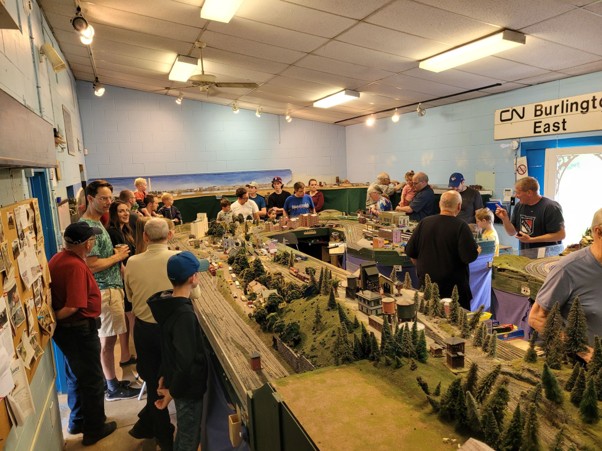
Tucked away in a small building and courtyard in Hidden Valley Park, an entire working railway system exists — all miniature, of course. Since the 1980s, the Burlington Model Railway Club has been a fixture in the community, bringing together model railway enthusiasts from Burlington and the surrounding area.
For Martin Keenan, the club’s president, and Joel Waterman, the Garden (G) Division superintendent, that means meeting every Thursday morning from April to November — until winter takes over and temperatures make it too difficult to build and operate the models.
Waterman joined after seeing a train show in the mid-eighties, where the club had a display. The G Division began in 1997, when the club moved to its current location in the garden area of a decommissioned pool.
Keenan joined the club shortly after attending an open house in 2013.
“I had participated in the model railway hobby in my younger days, but had dropped out of the hobby for several decades. I had gotten interested again around 2010 owing to changes in the hobby that meant that accurate model railway equipment in accurate Canadian colour schemes had become widely available,” Keenan said.
Keenan’s interest also stems from the fact that he is a railway historian, “in particular the railways in our area and the equipment that operated on them.”
This overlap in his interests comes to life in the model railway.
“The indoor layouts are built on wooden substructures, so a lot of carpentry is involved in building a model layout, particularly a layout with slopes and multiple levels. There is also considerable skill involved in laying down model railway tracks that will operate smoothly and look like a miniature version of the real thing,” Keenan said. “Modern layouts are equipped with a digital command control system that allows us to control multiple trains relatively easily, but this requires an extensive amount of wiring to ensure that the control system works properly and that the electrical power works properly on all the tracks.”
Both layouts are meticulously crafted.
“Our railroad is built on a fine gravel bed in a garden. The large trains we run are powered by electricity through the rails, or onboard batteries using radio control, or by real steam,” Waterman said.
They’ve even added tiny speakers to the outdoor exhibit in recent years to further immerse visitors.
“In G Division we are interested in attracting families to our open days, so have recently started to include things children can do — like a separate railway that children can move train cars around by hand, pushbutton stations that cause a sound or a motion to occur, etc,” Waterman said.
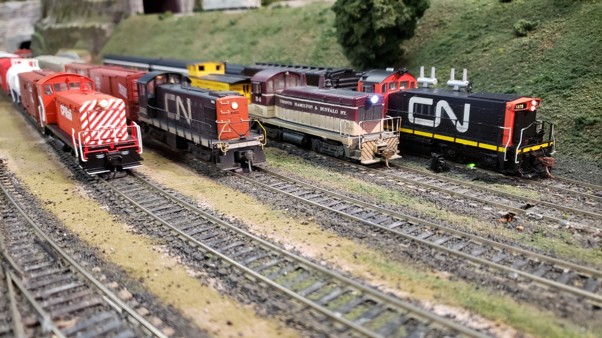
The club’s HO-scale layout, which features smaller trains than the outdoor G Division, has also featured scavenger hunts, with maps handed out to visitors.
“We know that we have a lot of regular visitors, and we try to make changes or improvements from one year to the next so that there is something new to see. The experience is also elevated by the improved sound and lights on modern model locomotives, and the improved control systems that allow them to be controlled remotely,” Keenan said.
Members appreciate the interest visitors show at exhibitions, including questions about how to become more involved in both the club and the hobby, particularly from younger visitors.
“We love the enthusiasm of our younger visitors. I haven’t forgotten my own visits to model railway layouts when I was a youngster, and it’s really great to be able to do this from the other side, so to speak… we always try to make sure we have a model GO train running, as it’s the one train that we figure that our younger visitors will have seen in real life. We’re also hoping to find new members interested in joining us,” Keenan said.
Of course, railway modelling involves some knowledge of railways and basic construction skills — factors that may make people hesitant to start.
“Among the membership, we have people that have developed expertise in particular areas, and use their skills to support the club layouts,” he said. Those specific skills include scenery, wiring, and control systems, with members who specialize in laying track or in repairing and overhauling model locomotives.
“We are also interested in transferring those skills, so that newer members can learn from more experienced members. On a regular running evening, a lot of the discussion will be about modelling projects that we are individually working on, and issues that we may be having in completing them…I know that I have learned a lot from other members about getting my model railway equipment to operate more reliably,” Keenan said.
There is one public demonstration left this season, on September 26 from 11 a.m. to 3 p.m. The demonstration is also part of the HOMES tour, an event organized by the Hamilton-based HO Model Engineers Society. A number of private model railway layouts and model railway clubs will be open to visitors that day.
As always, admission is free, and donations are greatly appreciated. For more information, visit the website.