By Maisha Hasan, Local Journalism Initiative Reporter
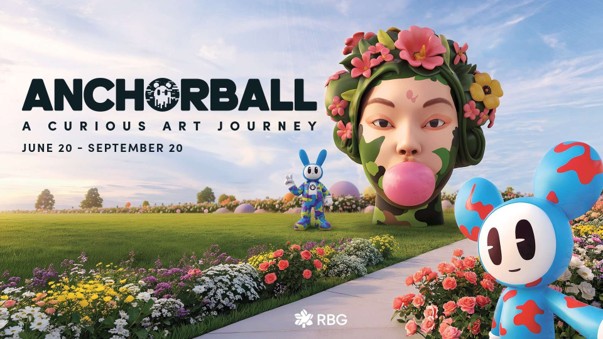
Sculptures up to 12 feet tall will soon inhabit the Royal Botanical Gardens (RBG) in the Canadian premiere of ANCHORBALL: A Curious Art Journey, with works by internationally recognized artist and sculptor, Ken Kelleher, who works under the name Anchorball. The exhibit opens June 20, 2026, and will stay at RBG until September 20, 2026.
Kelleher is celebrated globally, with art displayed from Shanghai and Miami to Saudi Arabia. His career began in web design before slowly transitioning to 3D sculptures and design.
Across RBG will be eighteen sculptural characters that belong to Kelleher’s fictional universe, “Low Orbit City,” further enhanced by the use of augmented reality, creating an immersive, interactive world.
“The world of botanical gardens in general, just having such a wide variety of trees, shrubs, botanicals, just lends itself so well to these pieces, a lot of them being floral-themed,” Kelleher said.
RBG Development Lead Jeremy Freiburger had first approached the team about bringing on Kelleher, to which they enthusiastically responded. This project has been in the works since last summer, but truly began in the fall.
For Freiburger, with a background in data analysis from previous consulting work, he began by exploring who the current RBG audience is, and how different types of exhibits might appeal to both the current audience and new visitors.
Freiburger described the RBG team’s excitement upon seeing Kelleher’s work: “That is something we have not seen before. I think it was ‘Bubblegum Girl,’ in particular, that when Ken posted that on Instagram, I was like, ‘She just needs to be here.’”
Talks with Kelleher came next. “[Ken] had sort of given us, ‘Here’s the lay of the land, here’s all my wackadoodle ideas,’ things he’s done and not done or wants to do,” Freiburger said.
As for the inspiration for those ideas, Kelleher cannot pinpoint one source for his ideas — they come from everywhere.
“[The ideas] are happening all the time, and I always have that feeling like I need to act on them. I couldn’t live without expressing myself visually. That really came out in the form of sculpture early on, which was really more like abstract sculpture, formal sculpture, stainless steel, bronze, things like that,” Kelleher explained.
His artistic practice evolved from there, incorporating the pop art influences that helped shape his distinctive characters and colourful installations, in materials ranging from fibreglass to inflatables.
“I had a passion for pop art. I love pop art characters. Eventually, I found my way into this world of making characters,” Kelleher said.
Once the ideas stick, with collaboration from his wife and creative partner, Sol Kelleher, he puts it to paper. More accurately, in the case of his large-scale sculptures and installations, Kelleher envisions how the idea will work with the host venue itself.
Seeing the actual space and coordinating with Freiburger helped bring these ideas to fruition.
The next step involved a lot of well-thought-out logistical and behind-the-scenes work, Freiburger explained.
“How do we get those here? How do we get them in a shipping container? Is it on a boat? Is it in a plane? Working out whose logistics and how that affects the scale of a sculpture. We’ve only got a shipping container, nine feet high, nine feet wide. If we’re going to do bigger than that, we have to split it into multiple parts.”
Then other experts had to get involved.
“We engaged both Ken’s engineers in China, who are the fabricators, and an Ontario engineer to make sure that everything matches up with our building code, which then tells us how many thousand pounds of concrete to hold all these guys down,” Freiburger said.
That is just the external work of getting all the parts sent to Burlington. For the actual assembly and construction, that takes another set of people: an install team trying to manoeuvre forklifts and giant boxes during RBG’s closed hours, from 6 p.m. until 10 a.m. Freiburger credits that work to a team of around six people.
There are also difficulties that come with arranging an exhibit that is out in the open: how does the RBG keep it a secret?
“We’ve had a team of volunteers who have sewn these giant bags of landscape fabric. Once a piece is installed, they all get covered so that no one can see them until launch day, where Ken and I get to rip the covers off and show everybody what he’s made,” Freiburger said.
With Freiburger’s encouragement, Kelleher incorporated the augmented reality (AR) aspect into the exhibit.
“I’ve done AR in the past on some projects, just pure AR projects. I remember when it first came out and working with some different teams, apps, and stuff like that. It was a lot of fun, so when Jeremy brought up that idea, it [sounded] awesome because it’s a way that we can add more characters into the show,” Kelleher said.
The augmented reality further deepens the ‘Low Orbit City’ world, introducing a treasure hunt and almost incorporating the visitors into the exhibit itself.
“I think, nowadays in this world, with so many things going on, seeing things that spark the imagination and art and music [is important]. It’s kind of always very low on the totem pole when it comes to culture, capitalism, people wanting to build massive buildings, [these things] constantly get pushed away, off the priority list,” Kelleher continued.
Kelleher’s work is often meant to be interacted with, as well as to light up viewers’ imaginations. And given the global and public nature of many of his pieces, photos of those interactions often find their way back to him. The pictures he sees of kids playing and interacting with the statues are his favourites.
“A toucan I made in Shanghai was eight metres tall. The picture comes back, and there are girls on the foot, and it’s just so much fun for them. [I] think about how that sort of sets their imagination for the future, things that they can think about, things that they might want to do. Maybe they become an artist or do something creative,” Kelleher said.
The interaction and inspiration this exhibit encourages further excites Freiburger, who looks forward to audiences of all ages enjoying it.
“You don’t have to have that ‘click’ moment when you’re just a kid. You can have that when you’re 75, you can have it when you’re 43. I think we’re lucky as people that work in the arts to get to try and spur those moments of change or wonder,” Freiburger said.
Of those audiences, Freiburger further noted, “They’re kids at heart, and we get to see them pull up those things from their childhood and throughout their life and put that wonder and awe and imagination right in front of us and let us have that moment, even if it’s not the thing we naturally do.”
Admission to Anchorball: A Curious Art Journey is included in the cost of RBG admission, and is on sale now; the Canada Strong Pass, which grants free admission to visitors up to 17 years old, and half-price admission to visitors who are 18 to 24 years old, is in effect from June 19 until Sept. 7.