By Jack Brittle, Local Journalism Initiative Reporter
Burlington is moving forward with its Horizon 2050 vision plan following committee discussions that highlighted both strong support and debate over how the city defines environmental priorities. Horizon 2050 was drafted to outline Burlington’s future over the next 25 years.
Amy Schnurr, executive director of BurlingtonGreen, delegated before council on behalf of the environmental charitable organization and elaborated on the group’s thoughts about the plan.
“We think it’s a great vision,” Schnurr said. “It’s really terrific to see climate and the environment embedded in various areas of the strategy.”
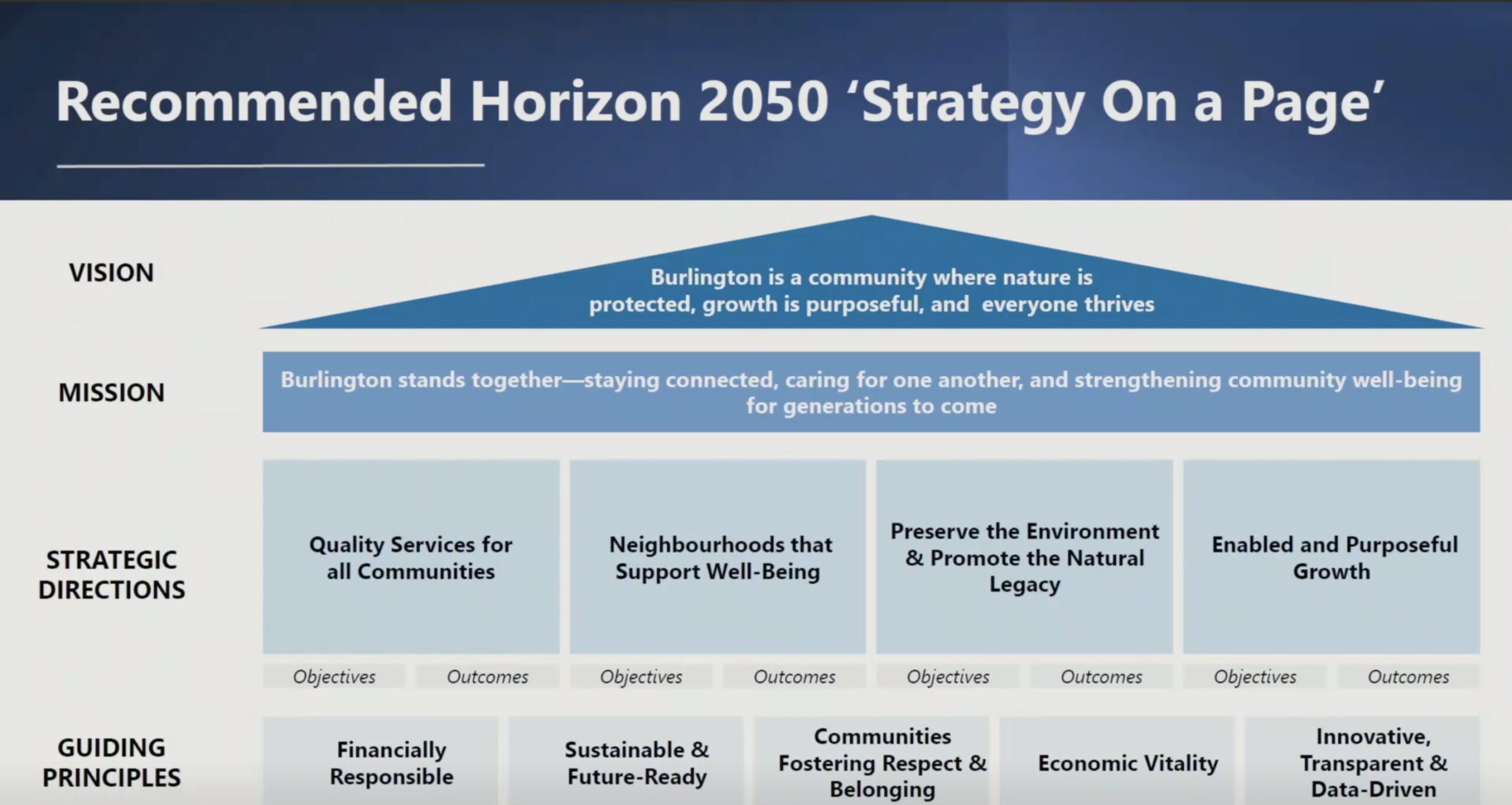
Schnurr singled out the “Sustainable and Future-Ready” guiding principle, which states that the city will “protect and enhance our natural environment, act on climate change, and plan with long-term responsibility.”
Schnurr said the group’s only recommendation was to tweak the vision statement.
“It falls short,” Schnurr said. “It just mentions the protection of nature. And we know that caring for the environment goes beyond that.
Horizon 2050’s vision statement is “Burlington is a community where nature is protected, growth is purposeful, and everyone belongs.”
Schnurr suggested replacing “protection of nature” with “a healthy environment is a priority.”
Andrew Scott, chief transformation officer for the city, said that Horizon 2050 was initiated on April 15 following council direction and has seen “significant engagement undertaken with a proposed strategy, informed by residents, business owners, city staff, and council.”
City staff recommended that council endorse the Horizon 2050 Strategic Plan as a replacement for Vision 2040.
Andy Potter, a partner with Deloitte, said that 2050 is not a “fundamental reset” from 2040, but rather an “evolution.” Deloitte was hired by the city to advise staff on the strategic plan, as part of their “procedure for doing proper strategic planning.” Ward 5 Councillor Paul Sharman said that as a former consultant, he was “very pleased” with Potter and Deloitte’s work.
“They brought discipline and analytics that we didn’t have,” Sharman said.
Stephanie Venimore, manager of corporate strategy and business improvement for the city, said that the vision is meant to be “aspirational” and define the city’s long-term direction.
“What is intentional here is balance,” Venimore said. “The protection of our natural legacy sits alongside growth. The community vision provides council with a long-term decision lens when faced with short and medium-term trade-offs. It defines where we are going, as well as our direction of travel. The mission defines how we, as a community and a city, will collectively get there.”
Through community engagement, the city learned that residents value connection and civic culture, “rooted in care and shared responsibility,” Venimore noted.
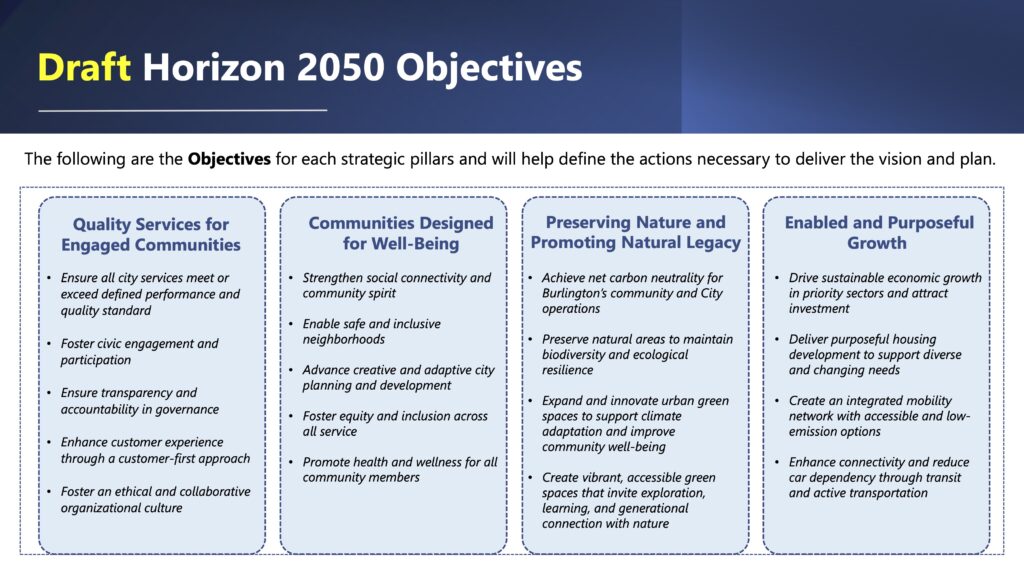
When speaking about the four objectives laid out in the plan, Venimore said that the structure is intentionally “balanced and sequenced.”
“Long-term success requires progress in all four, not advancement in one at the expense of another,” Venimore said. “To ensure accountability, each direction translates into clear, measurable commitments. These objectives are where the strategy bridges into action.”
Sharman said that Horizon 2050 is especially important given the current context of how the city runs.
“The notion of a strategic plan in an environment where we are very controlled, by laws and bylaws…innovation is something that sometimes eludes us,” Sharman said. “So the very notion of making it active strikes me as being really critical.”
Venimore also responded to Schnurr’s comment about the vision statement.
“When you dig into the document, you can see where the focus on protecting nature dives in very clearly to our climate action and to protecting the environment beyond just nature,” Venimore said.
“Nature is the language that we chose so that it would be understood by all,” Venimore continued. “We did extensive outreach to multiple community members, and nature was the word that landed and resonated with most community members.”
City staff will continue to look at feedback from BurlingtonGreen and other community groups.
Mayor Marianne Meed Ward called the document “very robust,” adding that its strategic directions resonate with her and the community, based on feedback.
“I like the phrase ‘purposeful growth,’” Meed Ward said. “It’s not willy-nilly; it is not foisted on us. We try to plan it in a purposeful way, as much as we can, when we have the OLT hanging over our head.”
Ward 4 Councillor Shawna Stolte said that the city has been doing a better job as of late with engagement, both with residents and council.
“I recall my meeting with you [Venimore] as particularly fulsome,” Stolte said. “It wasn’t just, ‘What do you think?’ We went through it word by word, talking about the meaning of words and what words represent, including the word ‘nature.’ So I just want to thank you. It was a very fulsome exercise.”
Venimore said a more complete package on Horizon 2050 will be brought before council in June of this year.
Ward 2 Councillor Lisa Kearns said that Vision 2040 was “very simple and direct.”
“This one is much more aspirational, connected to community, and rooted in the land that we’re on,” Kearns said. “So I really do like this one quite a lot, and I look forward to that more refined version. I think there’s some feedback that can still come.”
Meed Ward and Sharman spoke to Burlington Local-News.ca about how the plan will inform the city’s decision-making over the next quarter-century.
“Going forward, Horizon 2050 will serve as a guiding framework for council and the organization,” Meed Ward said. “It aligns decisions around growth management, infrastructure, land use planning, and service delivery with the broader outcomes residents told us matter most.”
“The plan will help ensure that future council decisions consistently move Burlington toward the vision residents have identified for their city,” she continued.
Horizon 2050 reflects a collaborative approach, developed with input from many different facets of the city, including businesses, Indigenous partners, service delivery organizations, and the community at large, Meed Ward explained.
Sharman said that Vision 2040 was created under a “false expectation” that the city would have “70,000 to 80,000 people moving in, in 20 years.”
“We had this notion of growing bold,” Sharman said. “But that is so far away from our reality because we have no greenfield space to build on, which makes it very expensive, and more difficult for people to move here.”
He said that the updated plan is an important recognition of the increasing diversity of the city.
Meed Ward said that Horizon 2050 “builds on the foundation” of Vision 2040.
“This plan recognizes how Burlington has evolved and sets a clear direction that places the well-being of current and future residents at the centre of municipal decision-making.”
The motion, to endorse Horizon 2050 as a replacement for Vision 2040, passed unanimously.
It also instructs staff to consider Horizon 2050 in future land planning policy, service delivery, advocacy, and budget planning, as well as to share the Horizon 2050 strategic plan and supportive research with community partners for consideration in their future service planning.