By Jack Brittle, Local Journalism Initiative Reporter
From February 1 to June 28, Conservation Halton is hosting the Spirit of the Lake exhibition at the Crawford Lake Conservation Area. According to the Conservation Halton website, the exhibit “celebrates the park’s rare meromictic lake, whose waters and sediments quietly hold centuries of life, memory, and change.”
Spirit of the Lake features work from four Indigenous artists, all women: Mariah Alexander, Catherine Tammaro, Kelly Greene, and Shayde Sandy. Housed in the Deer Clan Longhouse in the Longhouse Village, the exhibit is open on weekends and holidays from 10:00 a.m. to 4:00 p.m.
Mariah Alexander’s piece “Echoes Beneath the Surface” is a digital drawing, which, according to Alexander, was inspired by “the carbonized corn found within this meromictic lake.”
“I wanted to guide people back in time, seeing the world through the lake’s own gaze, embodied by the blue woman,” Alexander said. “The next time you stand by the water, take a closer look at the small things: a kernel of blackened corn, the fossil cradled in silt, the drifting poplar fluff, a gliding fish under the water’s surface.”
“The water will begin to speak, telling you a great story about a time of Longhouses, clan systems, the creation of the world, and the beauty and connection of all living things,” Alexander continued.
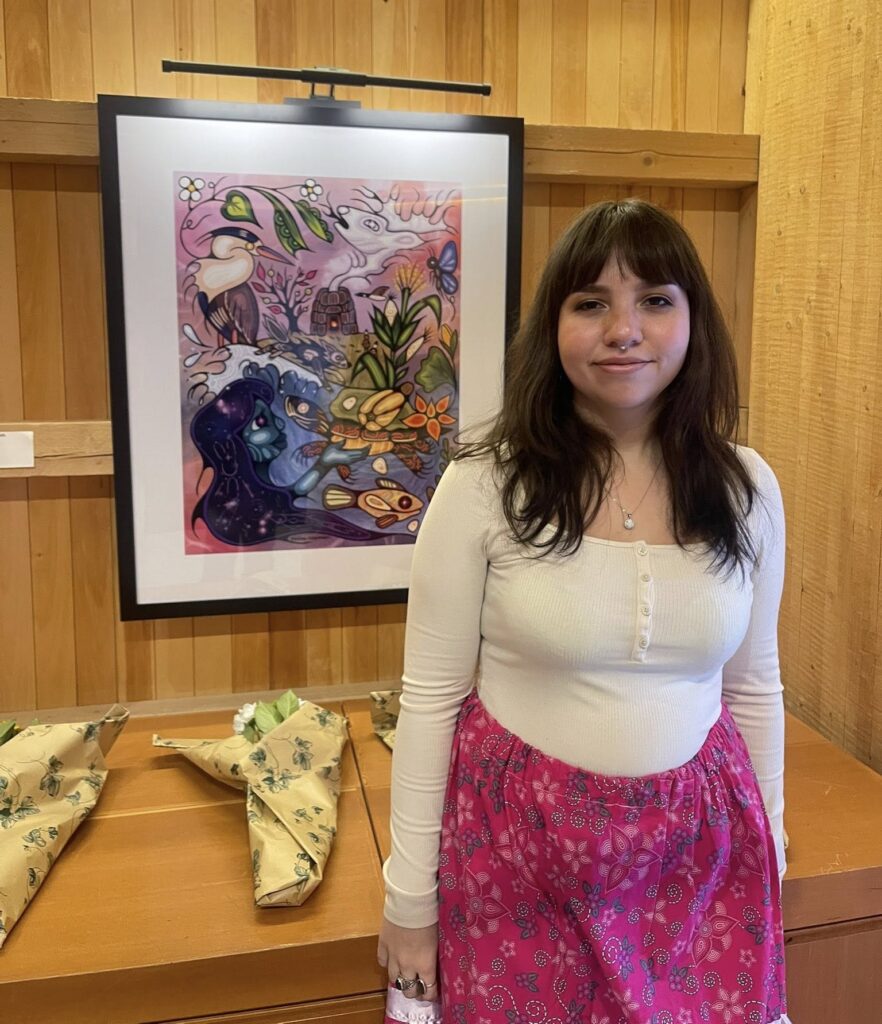
In her speech at the unveiling, Alexander said that water is a storyteller, that it remembers.
“It holds thousands of years in its body,” she said. “It remembers when nature and humanity moved in balance. It remembers a time before borders and colonial systems built on stolen lands. It remembers the treaties that were made. It remembers that migration is ancestral, as ancient as the moment the first person was lowered to earth from the spirit world.”
“May the water remind us of who we are, what we come from, and what we owe to one another,” Alexander continued.
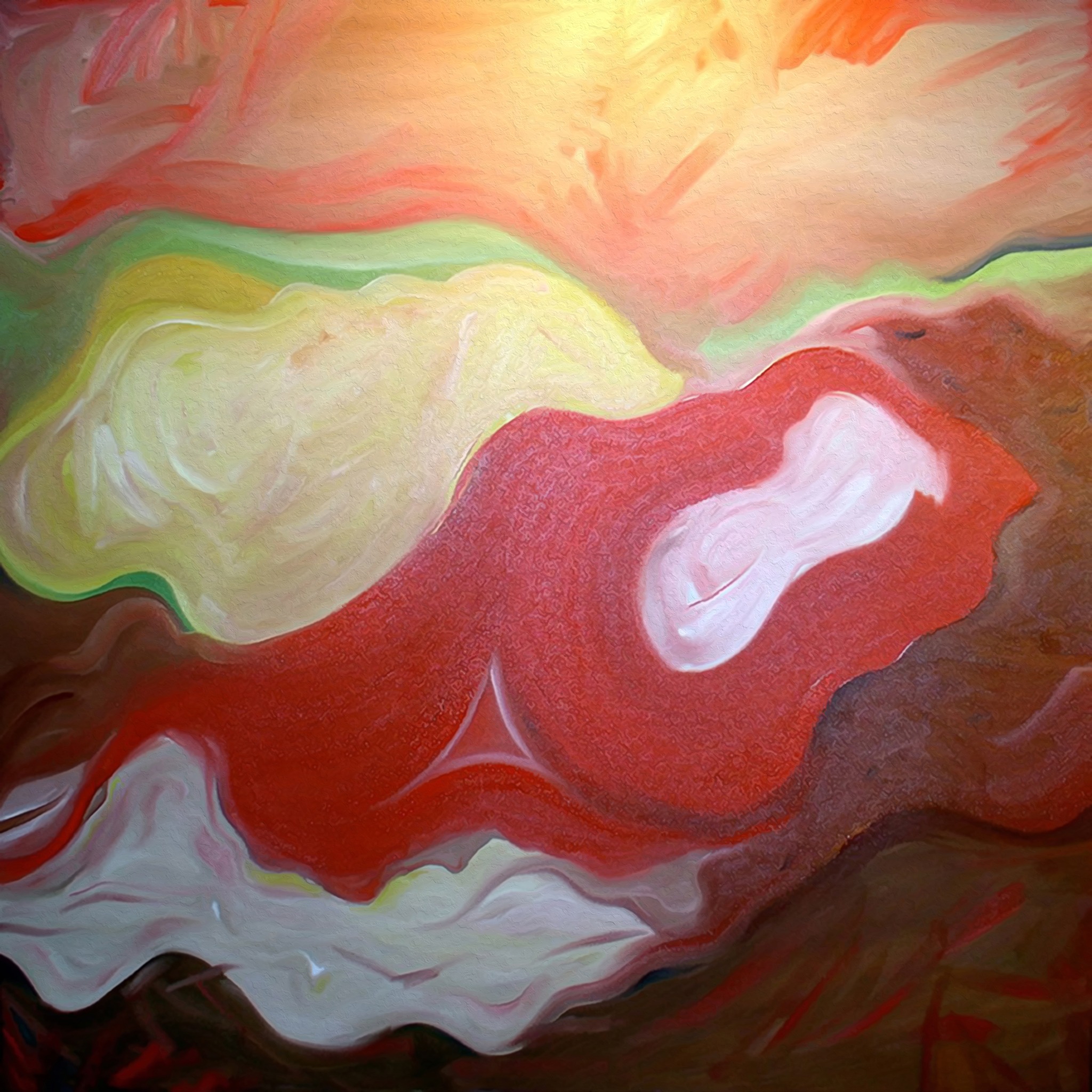
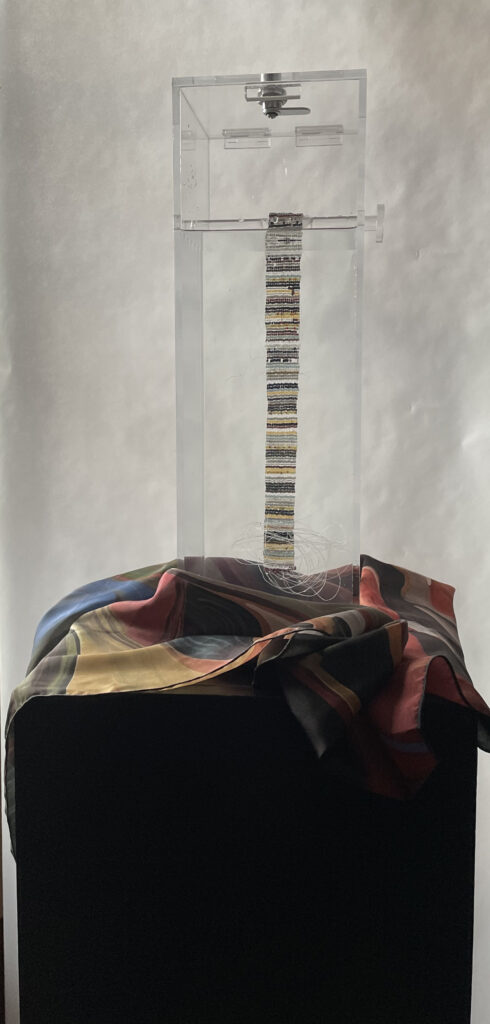
Catherine Tammaro’s contribution is composed of two pieces: “awató⁏mętsó⁏gyaʔ (She, the Land Made),” a 36″ x 36” oil painting, and “yanǫhkǫkyeʔs ~ She Throws Medicine or beadSpitter,” an assemblage which is positioned in front of the painting.
Tammaro spoke about the symbolism of both pieces.
“beadSpitter is essentially a piece with a belt, which signifies my agreement with the lake to protect it,” Tammaro said. It is encased in a vitrine, which contains lake water and wampum beads.
“The painting represents a seed in the earth, which suggests that when Aataentsic landed on the back of the Great Turtle, she brought seeds with her. So, together, that land-and-water connection is about generative powers and our consciousness around them.”
She said that “beadSpitter” is based on an Indigenous narrative that focuses on “an old woman or a witch in a canoe, who guides people in the art of ceremonial implement making.”
Tammaro said that she has facilitated workshops to help women and Two-spirit people participate in the process of sacred implement making.
“The show is very fitting in that regard,” Tammaro said. “I, as an older artist, with three younger women artists. And I’m really glad it’s all women, because women have been hurt by colonialism. So any opportunity for us to express ourselves, I think, is wonderful.”
Tammaro has had her work exhibited by Conservation Halton before and sits on their Indigenous Advisory Council.
“The basis, or foundation, of my work is about my ancestral memory,” Tammaro said. “And there’s a phrase that I use, which was developed by Elizabeth Povinelli from Columbia University, called ‘The Ancestral Present.’ And I believe that a lot of my work comes up in that space, that these are blood memories that I have. These are things that I was never taught, but seem to know.”
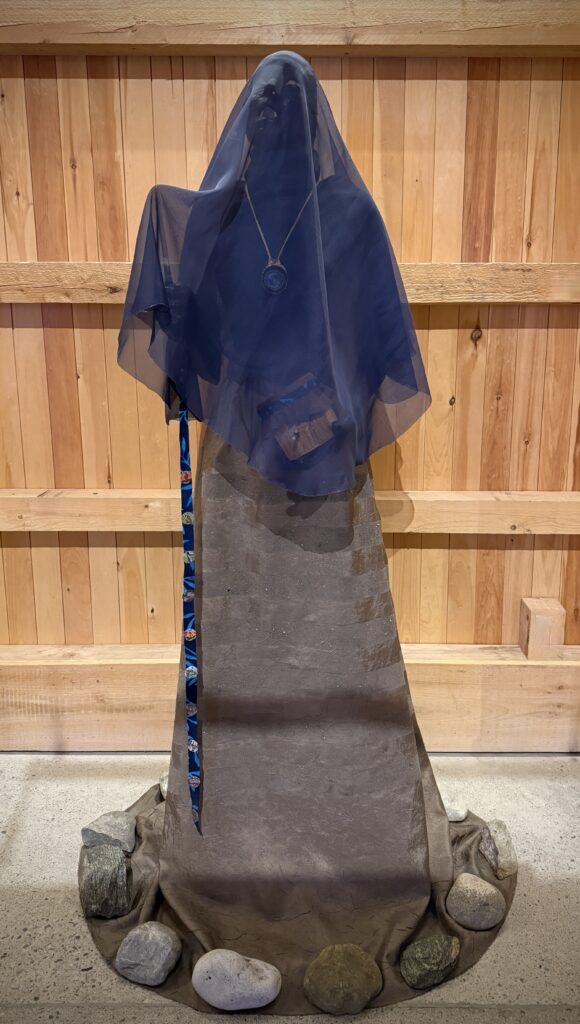
Kelly Greene’s contribution, “She Reveals Her Knowledge and Sings for Healing,” is a sculpture that represents Crawford Lake in a human form.
“It’s my way of trying to communicate, not only that we are living on the Earth, but that she is our mother, and we wouldn’t be here without her,” Greene said. “I want to really show my respect for the Earth and to hopefully impart that on any participants who might be looking at it.”
Greene said that much of her work has an environmental aspect.
“I represent the earth in human form,” Greene said. “I have done plaster casting of my own body in past art pieces I’ve made. And the reason that I make the earth in the form of a human is to appeal to humans’ egocentrism.”
She spoke about the significance of the rocks and the ribbon skirt in the piece.
“What we call rocks are referred to as grandfathers [in Indigenous culture],” Greene said. “I wanted to put them at the bottom of the skirt, not only to spread out the ribbon skirt, but because that is my representation of the sediment core at the bottom of Crawford Lake, with the seven distinct layers in the sediment core and also the seven ribbons.”
“When I am talking about anything that has to do with the Earth, I use the actual earth in my pieces,” Greene continued.
She explained that rocks are referred to as grandfathers because they are “full of wisdom.”
“A ribbon skirt is an important Indigenous garment that’s typically handmade with fabric and decorated with horizontal ribbons,” Greene said. “It’s a powerful symbol of identity and connection to our culture. Women wear ribbon skirts for ceremonies, powwows, and special events. They honour our ancestors, represent the sacredness of women as life givers and connect the wearers of the ribbon skirts to the earth.”
The seven ribbons also represent the Seventh Generation Value, which, according to the Crawford Lake sculpture details, is a “core value among the Haudenosaunee nations that considers those who will inherit the world in seven generations, that we are borrowing the Earth from those who are not yet born.”
The ribbons are made from soil collected from the grounds surrounding Crawford Lake; in fact, all of the materials in Greene’s sculpture are either natural or purchased secondhand.
Greene said that her sculpture was also inspired by the fact that Crawford Lake is a meromictic lake, which means that the top and bottom layers of water do not mix.
“The sediment core at the bottom remains intact and remains a record keeper of the environment,” Greene said. “And so Crawford Lake, even though she is such a small lake, has been selected as the golden spike for the epoch that we are entering, which some geologists argue we may already be in — the Anthropocene Epoch, coming out of the Holocene Epoch.”
According to National Geographic, the Anthropocene Epoch is “an unofficial unit of geologic time, used to describe the most recent period in Earth’s history when human activity started to have a significant impact on the planet’s climate and ecosystems.”
Greene said that the sculpture is “foreboding.”
“But that is because of my concern about where we’re at in this time of human history on our Earth,” Greene said.
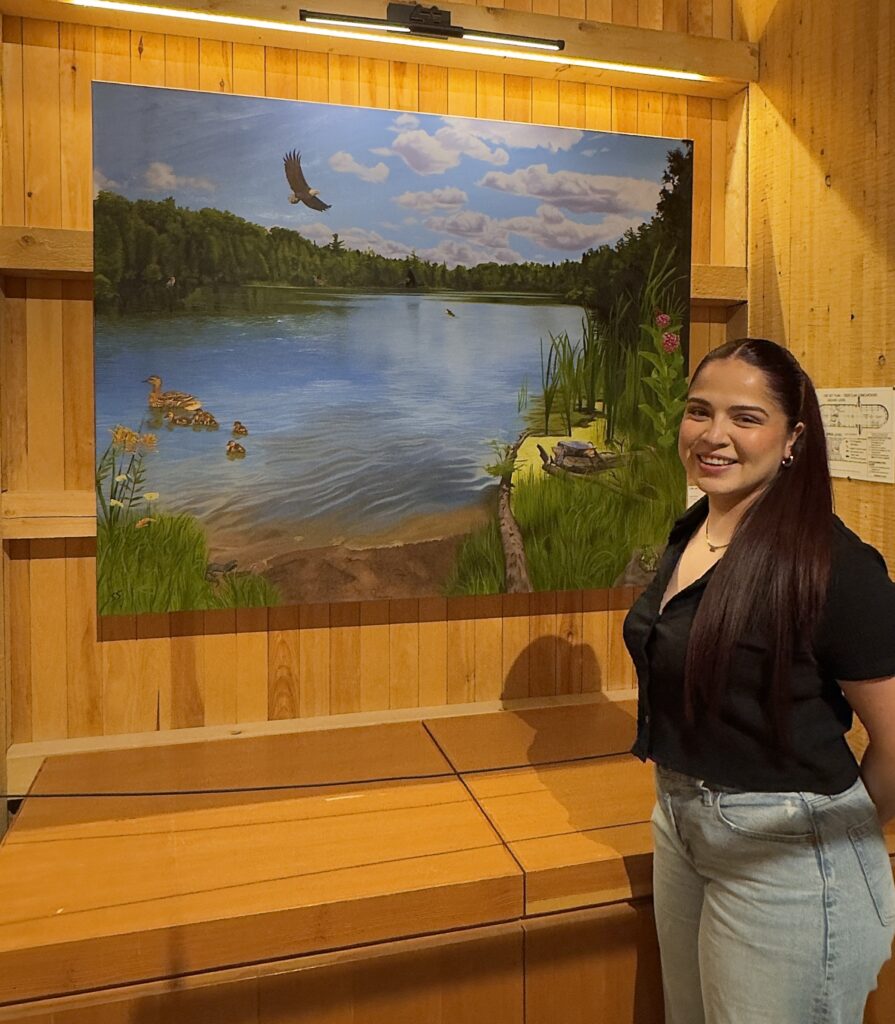
Shayde Sandy’s contribution, “Life on Crawford Lake,” is a painting of the lake itself.
“I made my family come out with me to go get reference photos to start my work,” Sandy said. “We just did our usual go around the trail, and I got my shot. I wanted a timeless piece that shows how iconic Crawford Lake is. I think what makes Crawford Lake iconic is the water and all the animals around it, in the water, on the land, and in the sky.”
Sandy’s painting features a snapping turtle, a monarch butterfly, a deer, an eagle, a Jefferson salamander, and a bass, among others.
She spoke about how Indigenous perspectives on the importance of nature shaped her work.
“Growing up, I was always taught that we’re all connected,” Sandy said. “Water, people, animals, plants, no matter how big or small, everything was created for a reason. We are all interconnected and work together to keep each other going. So I was always taught that we really have to have this respect and gratitude for nature and life.”
Sandy said that working alongside the other artists was a fulfilling experience.
“I think it’s pretty iconic, because we do have that presence at Crawford Lake, with the longhouses, and we’ve settled there before,” Sandy said. “So it’s cool to have this full circle moment by bringing our people back in to display art and share different stories. At the opening reception, we all got a couple of minutes to say some words, and it was really cool to hear how we all took this idea of this exhibit and had such different ideas.”
To find out more about the Spirit of the Lake exhibit, click here.