By Jack Brittle, Local Journalism Initiative Reporter
Burlington council is considering temporarily eliminating development charges (DCs) in an effort to encourage more affordable housing. The proposal was discussed during a March 2 special meeting of council. Council previously set the parameters as “a two-year residential Development Charges exemption on all units that pull a building permit and demonstrate active construction” within that period.
According to the city, Burlington collects development charges to “cover the costs of building infrastructure so that new developments receive municipal services, such as roads, transit, water and sewer infrastructure.”
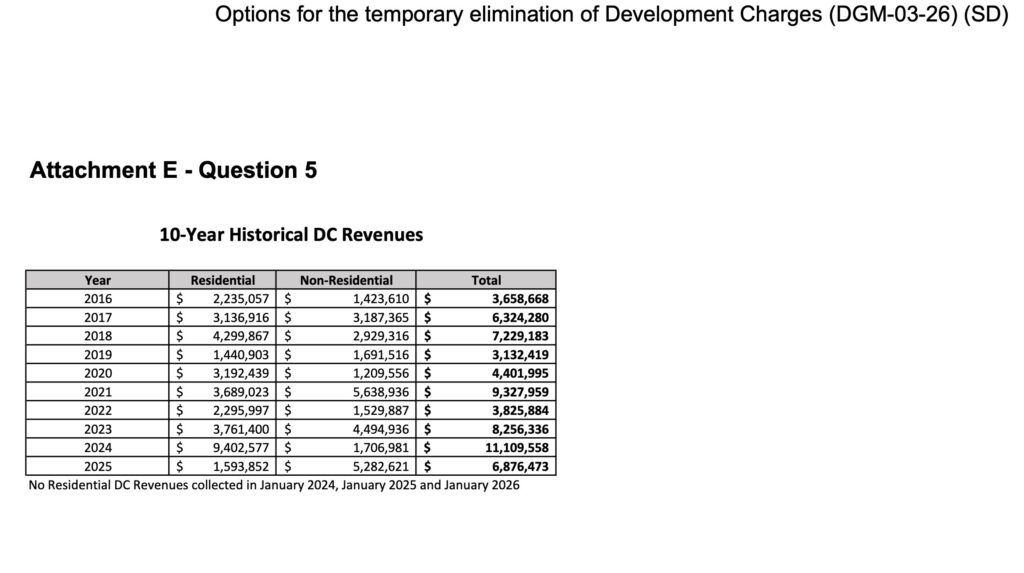
Development charges are collected by developers prior to occupancy of a building. They are charged on a singular basis and are calculated based on the expense of building the property. Both the city and Halton Region collect development charges, as do both of the Halton school boards. According to the city, development charges collected in 2025 from the municipality amounted to over $6.8 million.
A staff memo cautioned that although a two-year period was set by council, the effect of the elimination could extend further.
“Under the Development Charges Act, DCs rates are locked in or frozen at the time of site plan approval, provided a building permit is issued within 18 months of the application approval,” the memo read. “Therefore, any site plans approved towards the end of year two of the DC exemption period will be locked into the exemption for another 18 months to pull permits. Once construction is completed and occupancy achieved, the city will have to subsidize DCs, several years past the intended DC exemption period.”
After initially considering a change to the development charges bylaw, council decided to instead either amend the current Community Improvement Plan (CIP) or draft a new one, which allows more flexibility in specifying which developments are subject to the eliminated charges.
A joint statement from Mayor Marianne Meed Ward, Ward 5 Councillor Paul Sharman, and Ward 1 Councillor Kelvin Galbraith noted “the ability to attach conditions on fee relief, such as no luxury units, and projects that respect our Official Plan.”
The most recent CIP was adopted in 2025, and according to the city, features 10 “financial incentive programs that are designed to help create a variety of affordable rental housing options in Burlington’s urban area.”
The new or amended CIP will be funded by sources other than property taxes.
The same joint statement also suggests using federal Housing Accelerator Fund dollars to offset the lost revenue, with “zero impact on taxpayers.”
Council voted to refer report DGM-03-26, regarding options for the temporary elimination of Development Charges, back to staff, and asked them to report back to the Committee of the Whole on April 13.
Council asked for a focus on the funding option referred to as “2b,” which would amend the Affordable Rental Housing CIP to “adjust one or more existing approved programs to temporarily expand eligibility. It also stated that “a review may identify non-DC exemptions that are more effective stimuli to development given current conditions.”
In a joint statement, Meed Ward and Ward 4 Councillor Shawna Stolte said that “council has said Burlington would only reduce Development Charges if senior governments step in with new, dedicated funding to replace that lost revenue.”
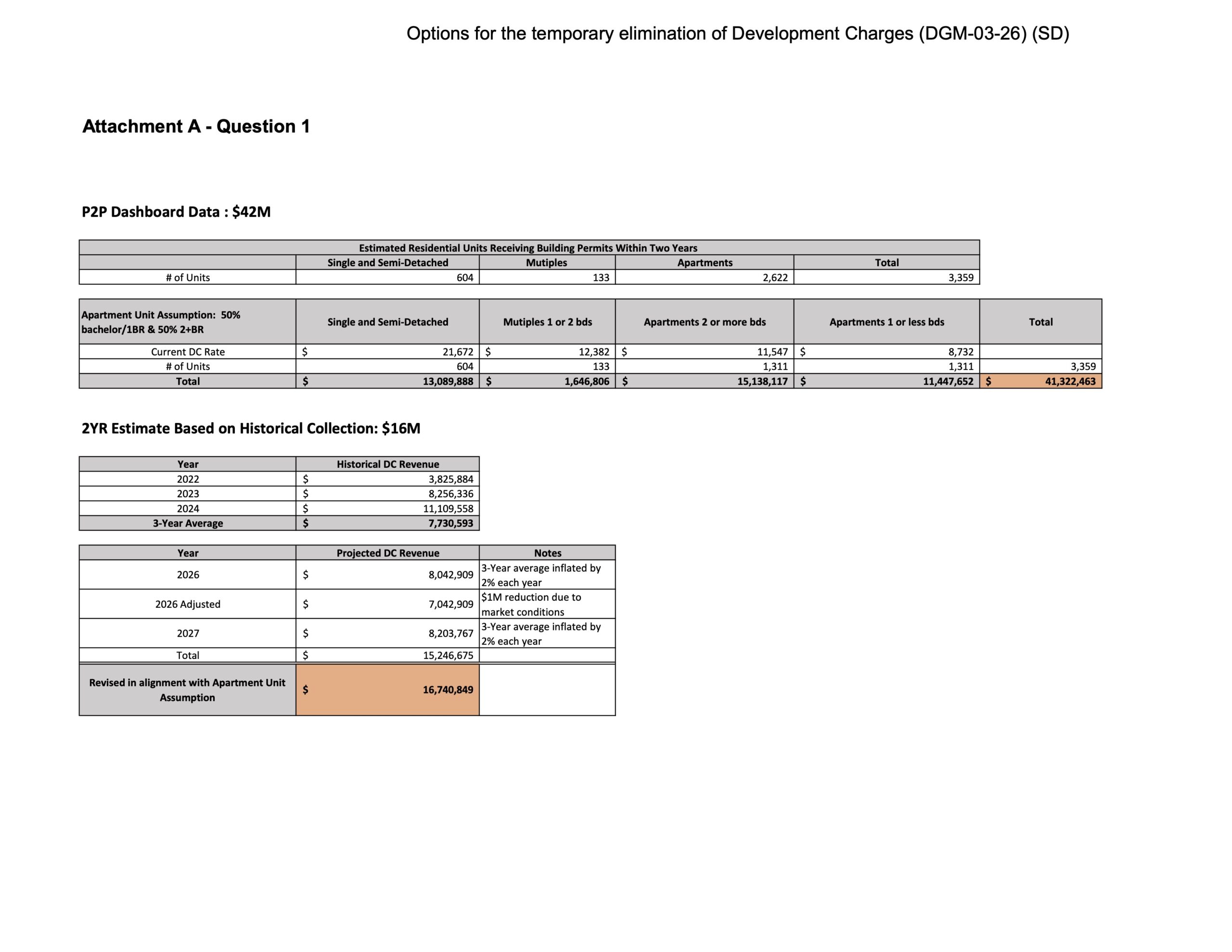
A study conducted by city staff found that revenue lost from the elimination could range from $16 million to $42 million. The $16 million figure is based on a two-year estimate founded in historical data, whereas the $42 million sum is simply the amount that would be forfeited if every project in the city’s Pipeline to Permit portal went ahead.
Residents commenting on the City of Burlington’s social media posts about the special meeting and related statements expressed mixed concerns about the proposal. Some argued that with condo sales declining in recent months and development projects being cancelled, eliminating development charges may not stimulate new building. Others raised concerns about infrastructure capacity, saying growth should be accompanied by investments in roads, green space and recreational facilities.