
By Emily R. Zarevich, Local Journalism Initiative Reporter
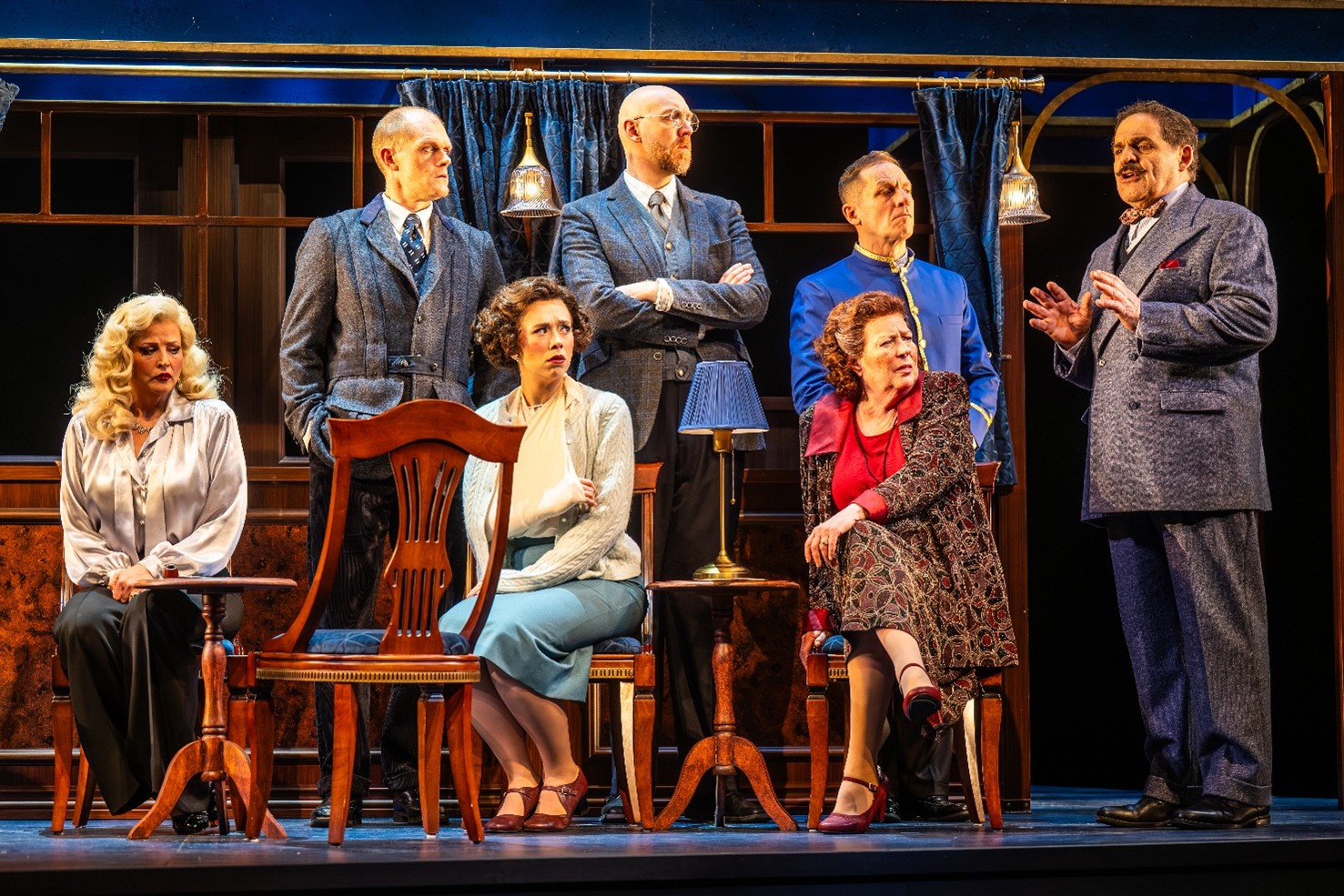
“It’s poetry on wheels!” boasts Monsieur Bouc (played by Brendan Wall), welcoming the world-renowned private detective Hercule Poirot (played by Daniel Kash) aboard the absurdly luxurious, London-bound train, the Orient Express. But what the proud entrepreneur doesn’t quite grasp is that, by inviting Poirot onto his vessel, his so-called “poetry on wheels,” he is in fact derailing the poem, turning it from a fanciful sonnet to a dark narrative. Whenever Poirot is around, a crime will happen, and the Belgian-born investigator will be called upon to solve it. On Wednesday, March 4, 2026, Theatre Aquarius in Hamilton premiered their production of Agatha Christie’s classic and celebrated Murder on the Orient Express to audiences composed of eager puzzle-solvers ready to pick apart the mystery themselves. This version of Christie’s iconic novel is adapted for the stage by playwright Ken Ludwig and directed by Morris Panych, notable for his work on Stratford and Shaw Festival stages.
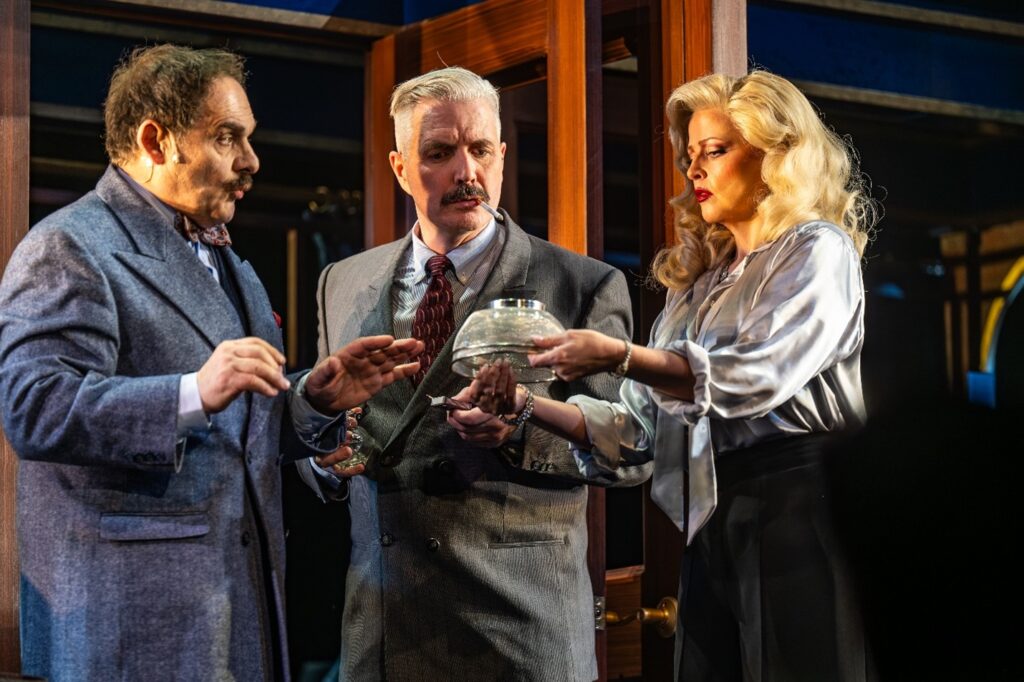
Daniel Kash, with considerable talent, dons a mustache, an accent, and an array of eccentricities to play Hercule Poirot, who is tied with Sherlock Holmes and Nancy Drew for the title of most recognizable fictional detective. Poirot is making a train journey to London after enjoying a leisurely vacation in Istanbul. He is joined in the first-class car of the Orient Express by a selection of peculiar and suspicious individuals, including the brash American husband-hunter Mrs. Hubbard (Nora McLellan), a secretive governess named Mary Debenham (Kiana Woo), the high-strung Russian Princess Dragomiroff (Pamela Mala Sinha), and the doctor-turned-noble Countess Andrenyi (Kristen Peace). The other passengers freely poke fun at Poirot’s odd appearance and mannerisms, but none irk him more than the slimy Samuel Ratchett, played by Martin Happer, who tries to recruit Poirot’s help in blockading a threatening individual who has been sending warning notes.
Poirot, who declares himself off duty, does no such thing. Sure enough, just as the Orient Express has come to a standstill in the middle of Yugoslavia due to heavy snowfall, Ratchett is found dead in his bed. He has been stabbed eight times, and his room is fit to bursting with contradictory clues that baffle even the professional detective protagonist.
The train has stopped completely, the landscape is heaped with snow, and there is nowhere for the perpetrator to run. The killer must still be on the train. Poirot begins a thorough investigation that involves interrogating every single passenger who shared the first-class car with the victim on the night he was murdered. Why are they riding the Orient Express during such a slow tourism season? What were they doing in the early hours of the morning? Most importantly, how do they know the man who was killed?
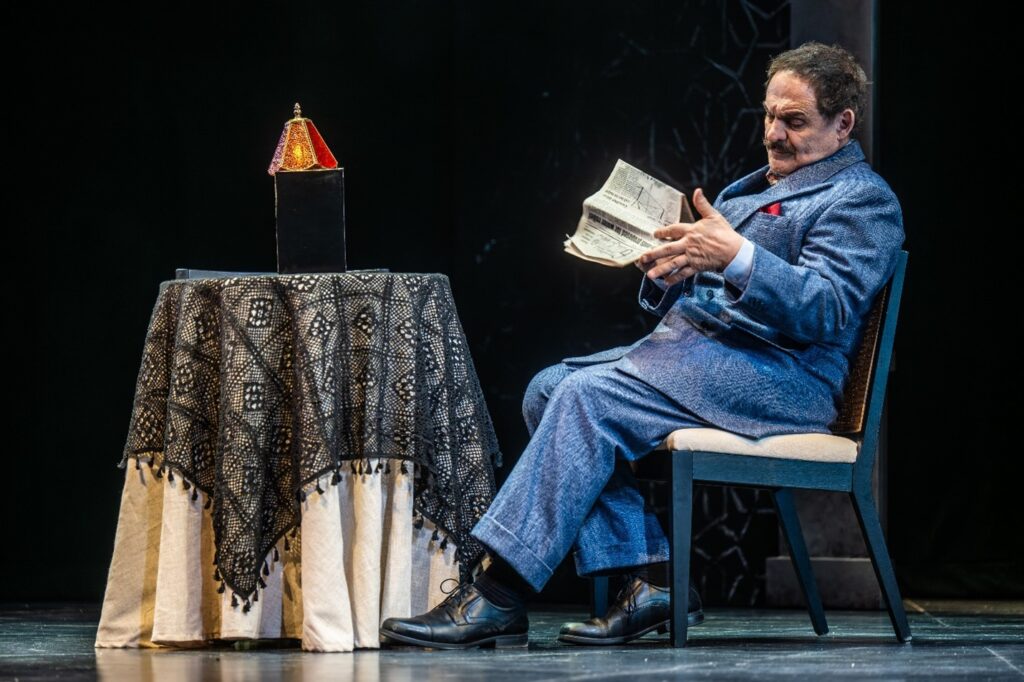
The entire cast comes together with effective chemistry and coordination to confuse and mislead the audience, as the most likely prime suspect keeps changing based on new discoveries. McLellan’s Mrs. Hubbard is especially adept at interfering, prone as she is to barging onto the scene uninvited. The set of this imaginative take on Murder on the Orient Express, designed by Brandon Kleiman, is a wonder. It’s an ever-rotating, finely outfitted train carriage that the cast members have to navigate smoothly without stumbling or losing their balance, which obviously took considerable practice. It turns around and around and around, giving the illusion of a spooky carnival ride that the characters are trapped on together until their unfinished business is resolved. This brilliant set perfectly captures the claustrophobic mood of a murder mystery. The characters in such a story are supposed to be confined in close quarters, so the tension rises, and the criminal, hiding amongst them, cannot go anywhere. Kleiman and crew can be commended for truly understanding Christie’s vision.
Ken Ludwig’s quick and clever script allows ample time for the quirky cast of characters and their assorted idiosyncrasies to be properly introduced in the first act. Poirot’s investigation of the murder through the first and second acts, however, is noticeably rushed in a bid to keep the play length to a reasonable time frame. Clues and expositions fly at the audience at such a rapid pace that there is barely a breather moment to sit and ponder the evidence. The audience’s brains have to hurriedly piece together a favourite suspect before the reveal at the climax. Watching Murder on the Orient Express as a stage play is a vastly different experience from slowly absorbing the story as a novel, where the reader is at leisure to put the book down every once in a while to process new information. This version is a Christie speed run, and audiences have to pay close attention to keep up. No peeking at phones, no whispering to seatmates. Be fully engaged.
Audience members who are already acquainted with the story’s infamous plot twist, either from reading the novel or from watching one of the popular film adaptations, are advised to keep spoilers to themselves in order for their theatre companions to fully enjoy the sensation of being shocked. Agatha Christie’s speciality as a storyteller is catching people off guard with the unexpected, and everyone deserves the privilege of being astonished by the ending of Murder on the Orient Express for the first time. During intermission at the March 5 performance at Theatre Aquarius, pleas for silence could be overheard in the audience. “I see that smirk on your face! Don’t say anything!” If you know, don’t tell.
Showings of Murder on the Orient Express will continue at Theatre Aquarius until March 29, 2026, and tickets can still be bought here. After the train has duly left the station, Theatre Aquarius will be platform-hopping from mystery to music by staging It’s a Good Life If You Don’t Weaken, a jukebox musical comprised of songs by The Tragically Hip, a band in which Canada takes much pride. This rock and roll extravaganza will premiere on April 22, 2026. Tickets can be bought here.