By Emily R. Zarevich, Local Journalism Initiative Reporter
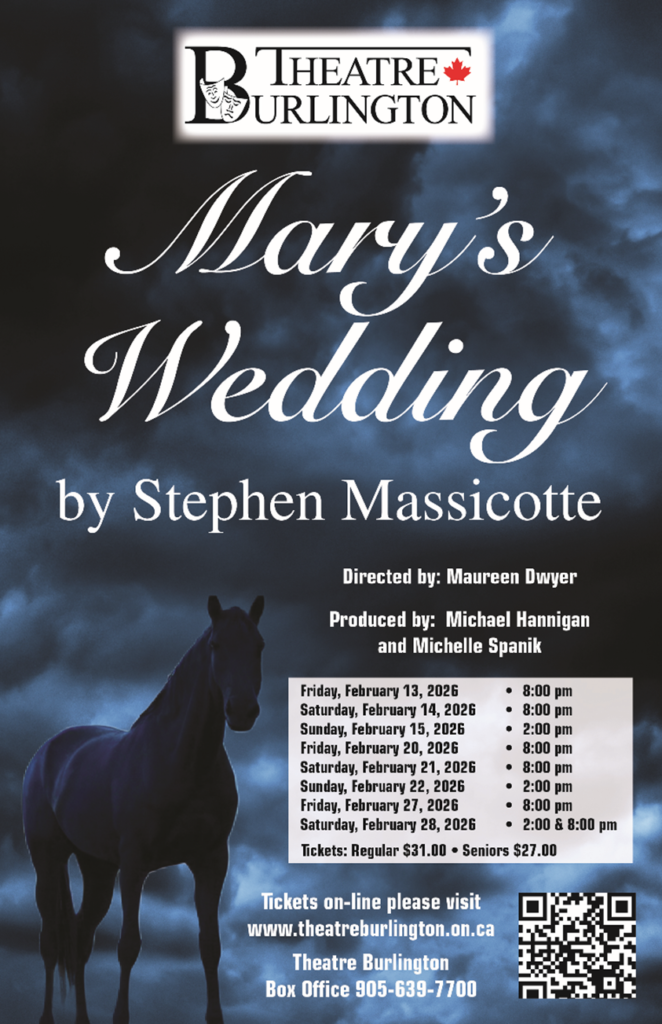
Around Valentine’s Day, people are always drawn towards love stories, new and old. Bumping into someone cute on the street, dating hijinks, long conversations, meeting the families, confronting rivals, and a wedding, always a wedding, at the end. In February 2026, Theatre Burlington on New Street will offer, as its first production of what is anticipated to be an eventful year of drama, a love story that weaves together true, tragic love with the process of grief, major historical events, poetry, and a bittersweet wedding. On February 13, 2026, the theatre will premiere its take on Canadian playwright Stephen Massicotte’s Mary’s Wedding, a poignant wartime tale that concerns two people who are, without a doubt, soulmates, but doomed to be separated by circumstances outside of their control. Tickets can be bought here.
Mary’s Wedding doesn’t require encyclopedic knowledge of world wars in order to be understood. It will be understood. Audiences can expect to encounter familiar and universally human feelings of loss in the form of Mary’s mourning for a future with her Charlie that never manifested. Directing this heartfelt, imaginative retelling of World War I events will be Theatre Burlington’s longtime theatre notable, Maureen Dwyer. Right before the holidays, Dwyer kindly took the time to share her insights on how she’s approaching this play with its minimalist cast, its perspective on real-life people and events, and dark, emotional themes. Answers have been lightly edited and condensed for clarity and flow.
How would you describe the relationship between Mary and Charlie? Is their love new and optimistic, or tried and jaded?
The story spans a time frame from 1913, the Great War, to 1920, the night before Mary’s wedding. Charlie has come to her in a dream. The entire play is a dream, so it isn’t played in linear time. Mary Chalmers has just arrived from Great Britain with her mother. Her father has come earlier. You get the sense she is an educated young woman, probably somewhat affluent. When she and Charlie meet in 1913, she is fifteen. Charlie Edwards is a Canadian farm boy. He’s hard-working, naive, and not as educated as Mary, so you have this social disparity at the start.
I would definitely say their love is “new and optimistic.” It’s exciting and fresh and exhilarating, very much a Romeo-and-Juliet type of relationship. They are both young and naive, but drawn to each other. There is definitely chemistry. However, their love seems forbidden, especially to Mary’s mother, so they cannot properly court each other. And then Charlie goes to war.
These two seem destined to be star-crossed lovers from the start.
A wartime play always has to find a balance between reality and fantasy. How does Mary’s Wedding achieve that balance?
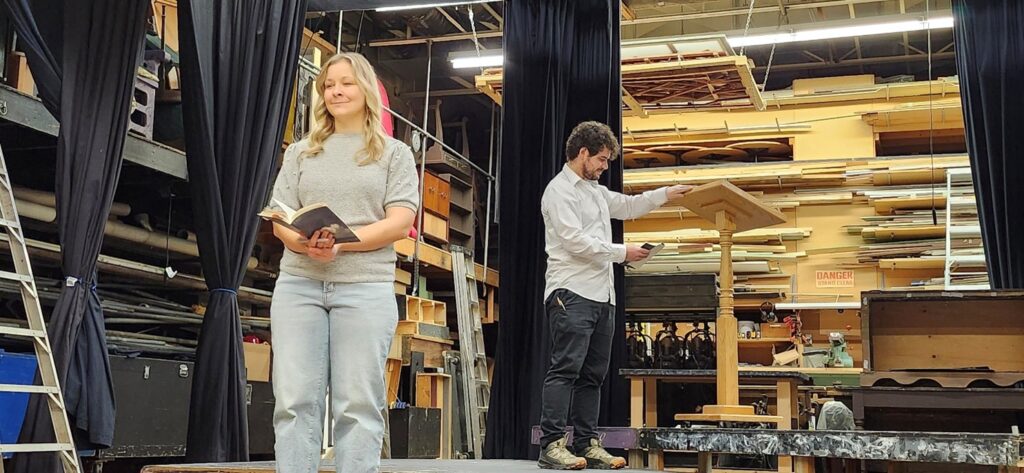
As I mentioned, this play does not unfold in linear time. “It begins at the end and ends at the beginning,” as it says in the play. And it is a dream where memories blur. One minute, we are at tea at Mary’s house, and then it morphs into a bombardment in the trenches. I said to the actors, “This play has to move like a ballet, easing seamlessly into its transitions.” And on top of that, Mary has to become “Flowers,” or Lieutenant Gordon Muriel Flowerdew. He’s an actual historic character who died after leading the charge at Moreuil Wood on March 30, 1918.
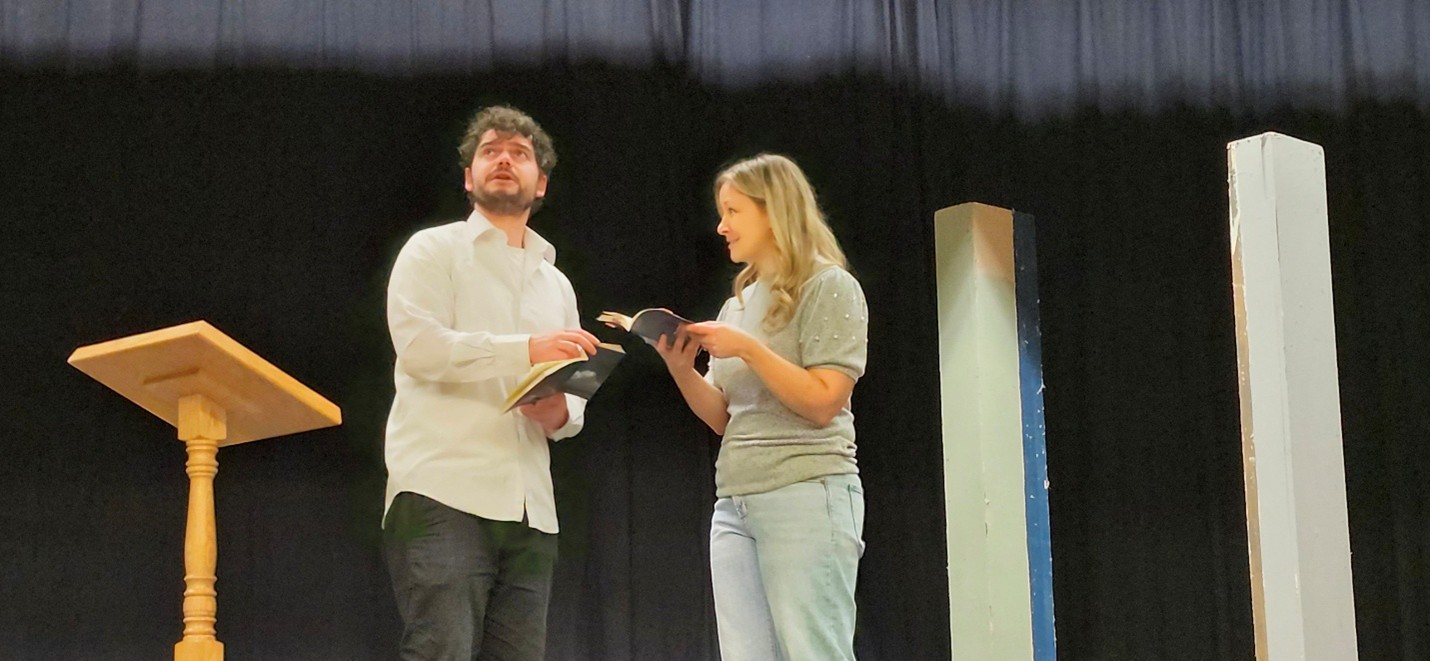
The play definitely doesn’t play as realism. There are times when Mary and Charlie talk directly to the audience to narrate, then other times they are in the scene, “live,” and we are watching in. And yet these characters are very believable and real. There should be no doubt about that. I think, also, that Massicotte has written the war scenes so beautifully from the perspective of a young boy faced with hell. He describes killing someone for the first time and the surreal nature of it. The experience is like a nightmare. I gave Brandon Sim, who plays Charlie, a poem to read. This was “Dulce et Decorum Est” by Wilfred Owen, describing the horror of watching a fellow soldier die from sucking in the chlorine gas. I think Owen captures the horrific nightmare quality of war.
It is normal for human beings to feel helpless in the face of world events outside their control. How does Mary’s Wedding address that angle?
The play starts the night before Mary’s wedding in 1920. Charlie has been dead for two years now. We learn she nearly dies of heartache after his death, like the “Lady of Shalott,” alluded to in this play. Because of the circumstances of their lives, the inevitable challenges, and the circumstances of war, these two cannot fulfill their love. So there is a tremendous feeling of loss and frustration. This play, for me, is about coming to terms with grief and finding the strength and hope to move forward.
Charlie comes to Mary in a dream to help her go on. I shared a story with my actors, one that my mother shared with me. My mom lost her sister, her only sibling, when she was in her early forties. They were very close, and my mother was devastated. She really couldn’t function, and she had small children. Then one night her sister came to her room in a dream and touched her and said, “Helen, it’s alright. I am fine,” and then left. My mom said it was so vivid, so real. And when she woke up, a huge weight had been lifted from her heart. I see this happening to Mary. She is able to move on and marry, despite her loss.
Are you making any creative subversions from Stephen Massicotte’s original script?
No. I am pretty adamant that the playwright’s words and intentions must remain intact. We are finding some interesting choices in delivery, but I am trying to respect the journey of the words. It is written so beautifully. There is no need to alter a perfect piece.